Tuesday, 4 December 2018

Genetic Genealogy Ireland conference lectures online

https://www.youtube.com/channel/UCHnW2NAfPIA2KUipZ_PlUlw/videosThe remainder of the recordings of lectures presented at the 2018 Genetic Genealogy Ireland (GGI) conference have now been uploaded to the GGI video channel on YouTube. (A first instalment of videos was uploaded last month – see blogpost.)

As always, the GGI lecture programme covered a wide range of topics from beginner level subjects to presentations of the latest research and technological developments. For the first time, the 2018 conference also explored ethical issues relating to the use of dna tests in public and social applications to to privacy and data protection.

The newly uploaded lectures are as follows:

  • DNA, Privacy and Data Protection, a panel discussion
  • GDPR, Privacy and Data Protection, with James Irvine 
  • WATO – the latest tool for your atDNA, with Andrew Millard
  • Raising the Dead, with Martin McDowell
  • Finding Missing Persons with DNA, with Debbie Kennett
  • Developments in O'Neill Clan genealogy, with the O'Neill Project Team
  • Running successful Local DNA Projects in Ireland, a panel discussion
  • The North East Galway DNA Project, with Martin Curley
  • Unusual Use of 3rd-Party Tools, with Cathal McEgunn
  • DNA Testing for Genealogy – the basics, with Donna Rutherford
  • Y-SNP Testing: best current tools & a glimpse into the future, with John Cleary
  • Untangling a Tumbleweed Branch of the Y-DNA Tree, with John Brazil

To view the full selection of available videos from the 2018 lectures, and those from each of the GGI conferences held over the previous five years, see the GGI YouTube channel. You'll find an extraordinary library of more than 100 lectures, with topics of appeal to researchers of all levels of experience.

Monday, 3 December 2018

Hurling recognised by UNESCO as Irish Living Heritage

Hurling has been recognised by UNESCO as a key element of Ireland's living heritage and has been added to the organisation's Representative List of the Intangible Cultural Heritage of Humanity.

My grandad, from Cahir,  would have
agreed with the sentiment.
The sport of Hurling (and Camogie, a form of hurling played by women) is a field game played by two teams. It dates back 2,000 years and features strongly in Irish mythology, most notably in the epic saga of Cú Chulainn.

Announcing the inscription last week, Josepha Madigan, TD, Minister for Culture, Heritage and the Gaeltacht, said: “I am delighted that Hurling has achieved international recognition by UNESCO. Hurling is a key element of Irish culture. For centuries, hurling has been an important part of the Irish identity, with men and women passing on this living tradition to each rising generation. I am grateful to the Camogie Association and the GAA for their work with my Department to achieve this UNESCO recognition.”

Intangible cultural heritage, or living heritage, refers to customs, traditions, crafts, games, and practices that are part of people’s lives and identities both individually and as part of wider communities, and that are passed on from generation to generation.

Uachtarán CLG John Horan said: “The UNESCO award... reaffirms the fact that Hurling is more than just a sport. It is a national treasure; an ancient tradition that connects us to our Celtic past and a part of our DNA. At a time of unprecedented popularity for the Game here, we owe a debt of gratitude to the generations of people who preserved, protected and promoted the game at school, club and county levels so that it would survive and thrive for our benefit. All of us involved in the Association are charged with ensuring that the promotional work we undertake preserves Hurling for future generations.”

Find out more about Hurling in the short video below, from GAA Learning in 2014.

New Member for Accredited Genealogists Ireland

Clare Doyle of Tuam, Co Galway is the newest member of Accredited Genealogists Ireland (AGI). She has been an Affiliate of AGI for almost two years.

As well as being a professional genealogist, Clare is a qualified archivist and holds an MA in Local History. She runs her own practice as Wild Atlantic Family Research.

Congratulations to Clare.

New family history show launches today on Channel 4

A new family history focused show will be launching on Channel 4 today.

It's called My Family Secrets Revealed and it will be using traditional family history research and DNA testing to solve family history mysteries. According to its promotional blurb, people from across Northern Ireland, Scotland, Wales and England came to My Family Secrets Revealed’s team of genealogists in the hope of proving, disproving or finally solving mysteries, questions or rumours that have circulated through their families for years.

From learning life-changing details about evasive ancestors, and finding mysterious traces of DNA from regions never expected, to searching for family connections to George Clooney and Elton John, every story on the show taps into our human curiosity about what came before us and who our ancestors were.

The new-format show is the brain child of the Big Mountain team who brought The Genealogy Roadshow to Ireland a few years back. Ancestry is a partner and co-funder. My Family Secrets Revealed will be hosted by Sian Williams and features some of Britain’s respected historians and genealogists.

The programme will air daily at 1:05pm on Channel 4.

See Ancestry Blog for more information.

List of Church of Ireland Parish Registers revised

The colour-coded List of Church of Ireland Parish Registers has been updated and revised.

All 1,131 parish handlists are now linked to the list, allowing researchers to find out more about the history of the parish of their ancestors, the survival or otherwise of its registers, and other miscellaneous information about the local congregation.

New materials transferred to the Representative Church Body Library during 2018 is also accounted for in the revised List.

You can download the List free of charge from the RCB Library here.

A sample from the List

Irish genealogy and history events, 3-16 December

Monday 3 December: Delayed (11am) opening in all NLI sites, plus NLI Reading Room and Manuscript Room closed all day. Venue: National Library of Ireland, Kildare Street, Dublin 2. Delayed opening due to staff development meeting. On-going Monday closures are facilitating extensive redevelopment of the premises. All other services/exhibitons/cafe, including Genealogy Advisory Service, operate as normal. Details.

Monday 3 to Friday 7 December, inclusive: Annual Media Preview of archives of Government Departments. The Reading Room of the National Archives of Ireland will be closed to the public. Only members of the press will be given access. Bishops Street, Dublin 8.

Monday 3 December: Christmas Social. Host: Irish Genealogical Research Society, Ireland Branch. Venue: Café en Seine, 40 Dawson St, Dublin 2. All welcome to drop in for some genealogy chat. From 6pm.

Tuesday 4 December: Art, artifacts and old buildings in Dublin and Wicklow, with Peter Pearson. Host: Kilmacanogue History Society. Venue: Glenview Hotel, Glen of the Downs, Co Wicklow. 8pm. Members €3 / Non-members €4. All welcome.

Tuesday 4 December: A demon in human shape – Murder in Famine Ireland, with Dr Ciaran Reilly. Host: South East Galway Archaeological and Historical Society. Venue: Irish Workhouse Centre, St Brigids Rd, Portumna, Co Galway. 8pm. All welcome.

Tuesday 4 December: From ballots to bullets — Ireland 1918-1919, a History Ireland Hedge School. Host: History Ireland magazine and NLI, in conjunction with exhibition in the National Photgraphic Archive, Temple Bar. Venue: National Library of Ireland, Kildare Street, Dublin 2. Editor Tommy Graham talks to Liz Gillis, Brian Hanley and Niamh Puirséil. 7pm. Free. All welcome.

Wednesday 5 December: Reflections on 1798: Battlefields, Graves and Books, with Dr Gavin Hughes. Host and venue: Linen Hall Library, 17 Donegall Square North, Belfast BT1 5GB. 6pm. £5. Tickets and details.

Friday 7 December: National Library's Main Reading Room closed. Venue: National Library of Ireland, Kildare Street, Dublin 2. Closure to facilitate the annual final of the Poetry Aloud competition. All other National Library services, including the Manuscripts Reading Room, will be open as normal.

Friday 7 December: ‘Home for Christmas’: John Francis O’Reilly and John Kenny, the last German agents to ‘drop in’, with Anthony Kinsella. Host: Military History Society of Ireland. Venue: Griffith College, South Circular Road, Dublin 8. Non-members very welcome. 8pm.

Monday 10 December: NLI Reading Room and Manuscript Room closed all day. Venue: National Library of Ireland, Kildare Street, Dublin 2. On-going Monday closures are facilitating extensive redevelopment of the premises. All other services/exhibitons/cafe, including Genealogy Advisory Service, operate as normal. Details.

Monday 10 December: The Widow's Tale, with Dawn Klos. Host: More Tales of Medieval Dublin lecture series. Venue: Wood Quay Venue, Dublin City Council, Wood Quay, Dublin 8. Admission free. All welcome. 1:05 - 1:50pm.

Tuesday 11 December: Genealogy as a contribution to Local History, with Billy Saunderson. Host: Genealogical Society of Ireland. Venue: Dun Laoghaire Further Education Institute, Cumberland Street, Dun Laoghaire. 8.00pm. All welcome. €3.

Wednesday 12 December: A taste of Galway's past, a celebration of the county's rich food heritage. Lectures, short films, food demonstrations, vintage farm machinery, craft making and more. Free. Host: Galway County Council Heritage Office, Irish Workhouse Centre and other local groups. Venue: Claregalway Castle, Claregalway, Co Galway. 11am to 4pm.

Thursday 13 December: Using Family and Local History Resources Online, a practical workshop that starts with an orientation tour of PRONI and is followed by an introduction to searching resources online. Venue: Public Record Office of Northern Ireland, Titanic Boulevard, Belfast. 11am to 1pm. Free, but space is limited so booking is essential. Details

Thursday 13 December: The history of Capard House in Slieve Bloom, with Ciarán Reilly. Host. Offaly Historical and Archaeological Society. Venue: Offaly History Centre, Bury Quay, Tullamore, Co Offaly. Lecture followed by Christmas refreshments. 8pm.

Friday 14 December: Early closing at the Representative Church Body Library (RCBL) in Churchtown, Dublin.  Library and Archive will close at Noon.

Saturday, 1 December 2018

Ireland Genealogy Projects Archives: end Nov. update

http://www.igp-web.com/IGPArchives/#gsc.tab=0
Ireland Genealogy Projects Archives has been updated with the latest volunteer donations, as below:

CLARE Genealogy Archives - Headstones
Kilmacreehy (Old) Cemetery (near Liscannor)
The Hill Graveyard, Ogonnelloe

CORK Genealogy Archives - Census
Kingwilliamstown Crown Estate Census, 24 Sep 1834

DONEGAL Genealogy Archives - Headstones
Ardara, Church of the Holy Family (R.C.) Graveyard (Additional)

LIMERICK Genealogy Archives - Headstones
St. Mary's Cathedral, Limerick City - Plaques

MAYO Genealogy Archives - Headstones
Aughaval Part 5, Westport

MONAGHAN & FERMANAGH Genealogy Archives - Church Records
Clones Parish Registers, Burials in Magheraveely, 1822-1829
Clones Parish Registers, Clones Burials 1851-1900

OFFALY/KINGS Genealogy Archives - Church Records
Baptisms from Parish of Balliboy & Killoughy (R.C.) 1821

TIPPERARY Genealogy Archives - Church Records
Fethard Parish Baptisms - 1810

WATERFORD Genealogy Archives - Headstones
Butlerstown Cemetery R.C. (A-C) & (D-G)

Friday, 30 November 2018

NAI closed for annual Media Preview, 3-7 December

As happens every year, the Reading Room of the National Archives of Ireland will be closed to the public throughout the first week of December for the annual Media Preview.

This is when news organisations are given access to the annual release of government archives so that the media can provide coverage of pertinent issues in the New Year. This year, the archives being scrutinised relate primarily to the year 1988.

These newly released archives will become available for public inspection from 9:15am on Wednesday 2 January 2019 at the NAI, Bishop Street, Dublin 8.

The Media Preview will take place 3–7 December. Only bonafide journalists and broadcasters will be admitted to the Reading Room.

Wednesday, 28 November 2018

Two more Irish titles join British Newspaper Archive

Following the arrival of the Sunday Tribune on Monday (see blogpost) The Kerryman  is the second Irish newspaper to join the online British Newspaper Archive (BNA) this week. The planned holding will span 1904-2006. So far, all editions from August 1904 to the end of 1910 are available to search and view.

Founded in 1904 and still published weekly from Tralee in County Kerry, the title joins three other Kerry papers – Kerry Evening Post, Kerry Examiner & Munster General Observer and Tralee Chronicle – in the online archive.

And along came a third paper: The Enniscorthy Guardian, which was also known simply as The Guardian from 1986 to 1994. The planned holding will span 1889 to 2005, but it's early days yet with only 37 editions now available, all published in the last decade of the 19th century.

It is the seventh title covering County Wexford to appear in the BNA. The others are The Wexford Conservative, Wexford Constitution, Wexford Independent, Wexford People, New Ross Standard and the Enniscorthy News.

As always, these BNA additions also join the Irish newspaper collection on FindMyPast.

Tuesday, 27 November 2018

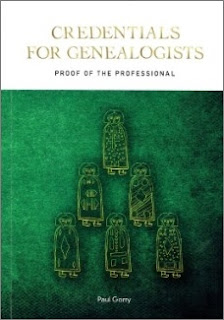
New book review: Credentials for Genealogists

When I first opened Paul Gorry's newly published book, Credentials for Genealogists: Proof of the Professional, I expected a reasoned and well-researched argument in favour of accreditation as the ultimate badge of professionalism within the genealogy industry. (I think it was the sub-title that suggested its focus!)

Sure enough, Paul, a professional genealogist for more than 40 years and a founding member of Accredited Genealogists Ireland (AGI), does advocate accreditation as the only certain means of proving competence and experience, and he sets out his thoughts on this controversial topic in a determined and thorough manner.

https://www.blessingtonbookstore.ie/buy-books-online/local-history/credentials-for-genealogists
As I'm not a professional genealogist, nor a potential or past client of one, I'm not going to jump into the controversy publicly. It is, I think, for those working at the heart of the industry to debate the important issues Paul raises and to consider their impact on the future development of the sector and professional genealogy as a career.

From my 'happily amateur' position on the sidelines, however, I can tell you that I found the book educational and thought provoking, and I imagine many of today's pro genies will wish such a book had been in existence before they took their career leap. I expect many will find Section 1, which sets out a history of the development of professional genealogy and credentials across the globe, highly informative of the industry they have joined or seek to join.

Section 2 concentrates on genealogy, academia and education, and was an eye opener; it explores how the academic course provision lobby has successfully created demand and supply for formal qualifications for nearly all careers, and in the process edged 'Experience' from its long-held position as the top-flight of attainment, even in the one-time cottage industry of genealogy.

Paul writes: "From the perspective of a genealogist rather than someone promoting a course of lectures, I would contend that there is one important difference between holding a certificate or diploma and being accredited as a genealogist. The certificate or diploma shows that the holder has knowledge of genealogy acquired through academic learning. Accreditation shows that they have both knowledge of genealogy and experience of genealogical research, regardless of how they were acquired."

Section 3 – Developing a career in genealogical research – is a gift to a new and upcoming generation of professionals from a knowledgeable, experienced and highly-respected mentor who deals in facts not dreams. Any hobbyist who has ever uttered the words 'Oooh, I'm passionate about genealogy, I am' might have an occasional notion of turning said passion into what they think may be a money spinner. This no-nonsense and practical chapter of the book should help them think long and hard about the realities of the professional job; their suitability to what is nearly always self-employment; their possession (or otherwise) of the necessary attributes of self discipline and commitment to accuracy; the strength of their research, writing and technological skills, and so on.

Paul then dives into the main debate about accreditation in today's market. He presents the findings of a survey he carried out over three years among a number of professional genealogists around the world. Some had credentials, some did not. None is identified, because each was assured confidentiality. Their answers are thoughtful and widen the debate into the value of accreditation to the practitioner, and to what practical changes accreditation bodies themselves might do to ensure accreditation retains its status within the industry. Finally, Paul sets out his own personal observations. Warning: your reading may be interrupted by a few involuntary intakes of breath. He doesn't hold back, but that's his call: they are personal opinions, bravely aired, whether you agree with him or you don't.

Paul stresses that his book is not an assault on those genealogists who choose not to (or cannot) seek credentials. "It is," he writes, "a defence of the overall need for accreditation for the good of the general public and the profession. While there are many excellent professional genealogists who do not hold professional credentials, there are many others who are inexperienced or inept. How is the public to know the difference?"

Credentials for Genealogists provides a fascinating and deep insight into a cottage industry that has developed into a global professional and technologically-driven market. It is also a reference book – more than a third of the 250 pages are made up of appendices, glossary, bibliography and index. It can be ordered from Blessington Books, price €16 plus p&p.