Thursday, 31 March 2022

March brought more free headstone records to Ireland Genealogy Projects Archives

Republican markers at Holy Rosary
Cemetery, Midleton, Co Cork.
Photo courtesy of Angela Gallagher and IGPA.

With the seasons in changing mode, it's not very surprising that researchers are getting out and about again, and that means one thing to the volunteer team at Ireland Genealogy Projects Archives (IGPA): more headstones to photograph and more inscriptions to transcribe. The haul for March includes precisely this, from four burial grounds from three counties.

Here are the details and links to view the free records:

CAVAN Genealogy Archives - Headstones
St. Peters, Templeport (Updated)

CORK Genealogy Archives - Headstones
St. Colman's Graveyard, Cloyne (Parts 1-3)

CORK Genealogy Archives - Headstones
Holy Rosary Cemetery (R.C.) Part 1, Midleton

GALWAY Genealogy Archives - Headstones
Abbeygormacan R.C. Cemetery (Updated)


Monday, 28 March 2022

Irish genealogy, history and heritage events: 28 March to 10 April

Tuesday 29 March: Tithe Records in PRONI, an online talk with Des McCabe. Host: North of Ireland Family History Society, Causeway Coast and Glens Branch. 7:30pm to 9pm. Free. All welcome. Non-members will need to email Causeway@nifhs.org for zoom link.

Tuesday 29 March: Lives of the Belfast Poor in the 19th Century, an in-person event with Dr Robyn Atcheson. Part of the City Cemetery lecture Series from Belfast City Council. Venue: Clifton House, 2 North Queen Street, Belfast BT15 1ES. Free. All welcome. Booking essential. 7:30pm to 8:30pm.

Wednesday 30 March: Ireland 1900 - 1925: Crisis, War and Revolution, an online event highlighting some of the archives available in PRONI’s online resources. Speakers: Janet Hancock, PRONI; Dr Timothy Bowman, University of Kent; Jim McBride, Secretary, History Teachers’ Association NI. 1pm to 2pm. Free. All welcome. Need to book.

Thursday 31 March: Revolution, agrarianism and the burning of Ballydugan House, Co Galway, 1922, with Ann O’Riordan. Part of the online Burning the Big House lecture series. Host: Centre for the Study of Historic Irish houses and Estates, History Department, Maynooth University. 7pm to 8pm. Book here. Fully booked

Thursday 31 March: From Treaty to Civil War, with Cormac Moore, Dublin City Council Historian-in-Residence for the North Central Area. This is the second of the Ireland in 1922 online history talks hosted by Raheny Library. 7pm. Free but need to register your place. Book here.

Thursday 31 March: Launch of Demonised: 'The Islandmagee Witches, 1711', with Dr Andrew Sneddon, and Dr Victoria McCollum. Host: PRONI. An online event to mark the 312th anniversary of the trial of the "Islandmagee witches" in Carrickfergus, Co. Antrim in 1711. 12:15pm to 1:30pm. Free. All welcome. Details.

Monday 4 April: Women and the Great War in Ireland, with Dr Fionnuala Walsh. An online lecture hosted by Offaly History. All welcome. 7:30pm via Zoom. Free. Email info@offalyhistroy.com for the link.

Monday 4 April: The Citizen Army is out today, with Lorcan Collins. An online talk. Part of the Mondays at the Mess series hosted by Richmond Barracks, Dublin. 7pm to 8pm. All welcome. Free, but need to book.

Wednesday 6 April: Griffith’s Valuation and Other Irish Land and Property Records, an online workshop with Miles Davenport. Host: McClelland Irish Library, Phoenix, Arizona USA. 11am–1pm. A Level II / Intermediate workshop. All welcome. Members $15 / Non-Members: $20. Details and registration.

Wednesday 6 April: The Decade of Centenaries: Researching Ireland 1912-1923, an online webinar with Chris Paton. 7.30pm. Free to members and non-members. After the live event, a recording will be available for one month. Need to register. Details.

Wednesday 6 April: Irish Diaspora webinar, an online webinar with Claire Bradley providing advice and tips for identifying your Irish ancestor's place of origin in Ireland. Host: CBGenealogy, Dublin. 8pm – 9:30pm IST/BST. Fee: €10. Need to register in advance. Details.

Thursday 7 April: ‘A barbarous mania of incendiarism’: house burnings in Co Louth, 1921-23, with Jean Young. Part of the online Burning the Big House lecture series. Host: Centre for the Study of Historic Irish houses and Estates, History Department, Maynooth University. 7pm to 8pm. Booking. Fully booked.

Thursday 7 April: The Civil War, with Cormac Moore, Dublin City Council Historian-in-Residence for the North Central Area. Part of the 'Ireland in 1922' online history talks hosted by Raheny Library. 7pm. Free. Need to book here.

Thursday 7 April: Lost Presbyterian Meeting Houses of Belfast, an online lecture with Tom Hartley. Host: Public Record Office of Northern Ireland. 2-3pm. Free and all welcome. Need to register.

Thursday 7 April: Using Ancestry DNA, an online class with Martin McDowell. Host: North of Ireland Family History Society. 7pm to 8pm. All welcome. £10. Need to book by 5 April.

Friday, 25 March 2022

Genealogy updates for England, Scotland & Wales: 2-week summary

Below is a summary of new and updated family history record collections for England, Scotland and Wales released by the major genealogy databases over the last two weeks (see previous summary, 9 March).

My regular summary of releases and updates relating to British collections is designed to help family historians whose Irish ancestors migrated, temporarily or permanently, to England, Scotland or Wales.

By default, it will also be useful to anyone carrying out research in those three nations, regardless of the origin of their ancestors.

The figures in parenthesis in the New Collections section are the numbers of records/images in the new record set.

Unless otherwise stated, the figures in parenthesis in the Updated Collections section reflect the number of records added to the collection in the recent update. In some instances, the supplier has not made this figure available. Where two figures are given, the first is the number of additions, the second is the new total.

Please note that I don't usually include updates of fewer than 1,000 records.


NEW COLLECTIONS


BritishNewspaperArchive, shared with FindMyPast (total 48,825,218 pages)
  • New titles in main collection ($£€)

Historic England


UPDATED COLLECTIONS


Ancestry

FamilySearch

FindMyPast

Free BMD

Scottish Indexes


Some of the above content contains affiliate links. This means I may earn a small commission if you buy via these links. This does not affect the price you pay as a consumer, but it does contribute to keeping Irish Genealogy News online. See Advertising Disclosure tab above.

Thursday, 24 March 2022

5,300+ Irish-born recorded in newly-released Scottish gaol registers

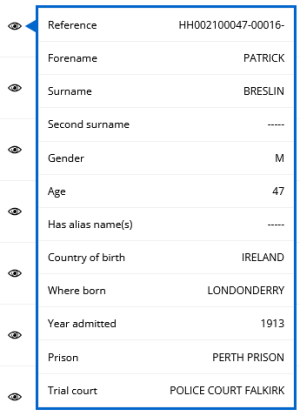
A few weeks ago, in my last summary of new and updated records for English, Scottish and Welsh genealogy, I noted that Scotland's People had uploaded a new collection of Scottish prison registers. It holds details of more than 50,000 admissions to prison . Unfortunately, I didn't have time to check out the collection at the time, but luckily genealogist Jill Williams FIGRS gave me a heads up yesterday that 10% of the prisoners entered in the indexes had been born in Ireland.

Click to search the index

This first batch of prison records are from Perth Prison and date from 1867-1879 and 1888-1921, with gaps. They include both men and women held in custody, tried or untried.

The index doesn't reveal which status relates to each individual, nor does it give up details of their alleged crimes, sentences, occupations, height, general health and religion. Such information is restricted to those researchers who choose to pay to view the full register entry.

I was pleased to find that from the name index I could sort and filter search results under a number of headings, including place of birth, age, date admitted and whether the individuals used an alternative/alias name. For now, since only Perth Prison is represented in the collection, there is no reason for filtering the index according to prison, but this could become a useful option as records are added from other places of detention.

The Irish-born contingent in the collection numbers 5,320 individuals, 80% of them men. One of the regular female prisoners was Bridget Cassidy ('2nd surname' Duchart), from Ballyshannon, Co Donegal. She was admitted eight times to the prison from courts in both Falkirk and Perth between 1907 (aged 34) to 1915. She reveals her home town only twice, other times stating only 'County Donegal' or 'Ireland'.

The youngest person taken into custody was 12-year-old Belfast-born Thomas Connely, while the oldest was James MacKenzie of Dublin who was aged 65 when admitted in 1889.

For more information about the new collection, see Scotland's People's article here.

RCB Library presents early 19th-century map of Glasnevin, Dublin

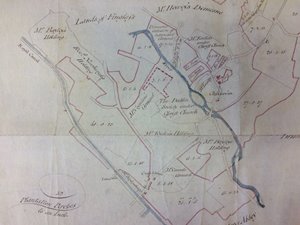
The Archive of the Month from the RCB Library for March shines a spotlight on a beautiful map that makes up part of Ms 1104, a recent addition to the Library’s extensive manuscript collection.

The map of Glasnevin that accompanies the deed.
RCB Library Ms 1104/8

Much like the Lindsay collection of which it is a part, the map is an important document for historians as well as for genealogists researching family members who lived in the area at this time. It provides visual cartographic evidence that predates the Ordnance Survey maps for this area, in which detailed lists of landowners or tenants who lived in this area at the beginning of the 19th century are included.

It was located with a deed dated 22 October 1833 between Hon Rt Revd Charles Dalrymple Lindsay (1760-1846), Dean of Christ Church Cathedral and Bishop of Kildare from 1804 until his death, and William John Gore of Dublin. It was surveyed by John Longfield in 1807

The map is focused primarily on the area surrounding Glasnevin village, incorporating areas that would be familiar to Dubliners today, such as Cross Guns, as well as references to Drumcondra to the east and the ‘Lands of Finglass’ towards the north.

What is striking is what is not visually depicted. For example, although the Botanic Gardens were founded here in 1795, the only reference that the map makes to its presence is a plot of land labelled ‘The Dublin Society under Christ Church’.

Click the map for an enlarged view.

Wednesday, 23 March 2022

New / updated genealogy collections for USA: four-week summary

Below is a summary of US family history collections released or updated by the major genealogy databases in the last four weeks. (The previous summary list was published on 23 February – see blogpost).

My regular summaries are designed to help family historians whose Irish ancestors emigrated, temporarily or permanently, to the United States.

By default, they should also be useful to anyone carrying out research in the US, regardless of the origin of their ancestors.

The figures in parenthesis in the New Collections section are the numbers of records or images in each new record set, if provided by the database.

Unless otherwise stated, the figures in parenthesis in the Updated Collections section reflect the number of records added to the collection in the recent update, if a number has been clearly noted by the supplier, and the revised total. I do not include updates of fewer than 1,000 records.


NEW COLLECTIONS


Ancestry

New York City Municipal Archives

FamilySearch

FindMyPast

MyHeritage


UPDATED COLLECTIONS


AmericanAncestors

Ancestry

FamilySearch


Some of the above content contains affiliate links. This means I may earn a small commission if you buy via these links. This does not affect the price you pay as a consumer, but it does contribute to keeping Irish Genealogy News online. See Advertising Disclosure tab above.

Monday, 21 March 2022

Irish genealogy, history and heritage events, 21 March to 3 April

Monday 21 March: Titanic, an in person event with Tom Hartley. Part of the City Cemetery lecture Series from Belfast City Council. Venue: Falls Park Bowling Pavilion, 63 Andersonstown Rd, Belfast BT11 9AH. Free. All welcome. 11am to 12noon.Booking essential.

Monday 21 March: Symbolism and Belfast City Cemetery, an in-person event with Tom Hartley. Part of the City Cemetery lecture Series from Belfast City Council. Venue: Elmwood Building - Geography Building, Queen's University, Elmwood Avenue, Belfast.Lecture starts 7:30pm. Tea available from 7pm. Free. All welcome. Booking essential.

Monday 21 March–29 April Burning the Big House: The Story of the Irish Country House in Revolution, 1920-23, an in-person exhibition curated by Professor Terence Dooley. Venue: Irish Architectural Archives, 45 Merrion Square East, Dublin 2. Free. 10am to 5pm.

Tuesday 22 March: Researching Irish Presbyterian Family History, with Dr William Roulston. An online event hosted by the North of Ireland Family History Society, Belfast Branch. 7:30pm-9pm GMT. Free. All welcome, but non-members need to request zoom link via Belfast.Treasurer@nifhs.org.

Tuesday 22 March Online burial research, with PRONI and PlotBox. Part of the City Cemetery Lecture Series from Belfast City Council. Venue: PRONI, 2, Titanic Boulevard, Belfast, BT3 9HQ. Free. All welcome. You can attend this event in-person or watch it live online via Zoom. Booking is essential for both. 12:30 to 1:30pm.

Wednesday 23 March: Viscount Pirrie – Mister Titanic, an in-person lecture with Mark Doherty. Part of the City Cemetery Lecture Series from Belfast City Council. Venue: EastSide Visitor Centre, 402 Newtownards Road, Belfast BT4. All welcome. 7:30pm to 8:30pm. Free, but booking essential.

Thursday 24 March: What’s new in Family Tree Maker, an online interactive discussion with Mark Olson, Stefan Harms and Pierre Clouthier. A two-hour session exploring new plug-ins for the software and giving you the opportunity to ask questions and receive answers from the FTM team. 7pm-9pm GMT. Host: North of Ireland Family History Society. Free. Need to email for link. Details.

Thursday 24 March: An Overview of Ireland in 1922, with Cormac Moore, Dublin City Council Historian-in-Residence for the North Central Area. This is the first of the Ireland in 1922 online history talks hosted by Raheny Library. 7pm. Free. Need to book here.

Thursday 24 March: Burning the Big House: the story of the country house during the Irish Revolution, 1920-23, with Terence Dooley. First of the online Burning the Big House lecture series. Host: Centre for the Study of Historic Irish houses and Estates, History Department, Maynooth University. 7pm to 8pm. Booking. Fully booked.

Friday 25 March: Emigration, from Ireland to Australia and New Zealand, an online class with Mike McKeag. Host: North of Ireland Family History Society. 2pm-3pm GMT. All welcome. Fee: £15 for class and notes, or £10 for class only. Booking.

Friday 25 March: PRONI's online records, an online class with Andrew Kane, an online class with Mike McKeag. Host: North of Ireland Family History Society. 2pm-3pm GMT. All welcome. Fee: £10 for class only. Booking.

Saturday 26 March: Material Legacies: The Archaeology of the Irish Revolutionary Period, a free online conference. A collaboration between UCD School of Archaeology in association with Abarta Heritage and the Landscapes of Revolution Project. 9:30am to 4pm GMT. Details and booking.

Saturday 26 March: Carrickfergus, as it was during the Second World War, an in-person guided walk with Lead The Way Tours. 10:30am to 1pm. Details and tickets (£5, under 16s; £10, adults). Need to book by 25 March.

Sunday 27 March: The Merchants who Grew a City: a Tour of Belfast’s Industrial History, an in-person tour by Imagine! Belfast Festival of Ideas & Politics. Meet at the Big Fish, Donegall Quay, Belfast, BT1 3NG. 2pm to 4:30pm. See details and buy tickets (£15) at eventbrite.

Tuesday 29 March: Tithe Records in PRONI, an online talk with Des McCabe. Host: North of Ireland Family History Society, Causeway Coast and Glens Branch. 7:30pm to 9pm. Free. All welcome. Non-members will need to email Causeway@nifhs.org for zoom link.

Tuesday 29 March: Lives of the Belfast Poor in the 19th Century, an in-person event with Dr Robyn Atcheson. Part of the City Cemetery lecture Series from Belfast City Council. Venue: Clifton House, 2 North Queen Street, Belfast BT15 1ES. Free. All welcome. Booking essential. 7:30pm to 8:30pm.

Wednesday 30 March: Ireland 1900 - 1925: Crisis, War and Revolution, an online event highlighting some of the archives available in PRONI’s online resources. Speakers: Janet Hancock, PRONI; Dr Timothy Bowman, University of Kent; Jim McBride, Secretary, History Teachers’ Association NI. 1pm to 2pm. Free. All welcome. Need to book.

Thursday 31 March: Revolution, agrarianism and the burning of Ballydugan House, Co Galway, 1922, with Ann O’Riordan. Part of the online Burning the Big House lecture series. Host: Centre for the Study of Historic Irish houses and Estates, History Department, Maynooth University. 7pm to 8pm. Booking. Fully booked

Thursday 31 March: From Treaty to Civil War, with Cormac Moore, Dublin City Council Historian-in-Residence for the North Central Area. This is the second of the Ireland in 1922 online history talks hosted by Raheny Library. 7pm. Free. Need to book here.

Thursday 31 March: Launch of Demonised: 'The Islandmagee Witches, 1711', with Dr Andrew Sneddon, and Dr Victoria McCollum. Host: PRONI. An online event to mark the 312th anniversary of the trial of the "Islandmagee witches" in Carrickfergus, Co. Antrim in 1711. 12:15pm to 1:30pm. Free. All welcome. Details.


Thursday, 17 March 2022

St Patrick's Day deliveries from FindMyPast.ie

FindMyPast.ie has created and released an index + transcriptions record set to a collection of Waterford County Burials Registers. The registers are from three cemeteries: St Carthage's in Lismore, St Declan's in Ardmore, and (producing more that 15,000 index entries) St Otteran's. The latter is also known as Ballinaneeshagh and is located two miles to the west of Waterford City.

The records span 1862 to 2006.

These registers have been freely available (with others) as unindexed pdf images for some years on the website of Waterford City and County Archives, so if you don't have a findmypast subscription, you could browse through them here.

In addition, a new, free collection of Views of Ireland has been uploaded. Comprising 117 photos (some colourised) and illustrations dating from the 19th century, they take in some of the island's most beautiful scenery.

They capture landscapes in 17 counties: Antrim, Clare, Cork, Donegal, Dublin, Fermanagh, Galway, Kerry, Kilkenny, LondonDerry, Louth, Mayo, Sligo, Waterford and Wicklow.


Some of the above content contains affiliate links. This means I may earn a small commission if you buy via these links. This does not affect the price you pay as a consumer, but it does contribute to keeping IrishGenealogyNews online. See Advertising Disclosure tab above.

Largest collection of free NYC vital/bmd records released online

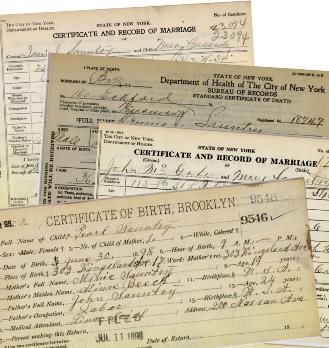
The largest collection of publicly available New York City birth, marriage, and death records has been released, free, on the Department of Records and Information Services (DORIS) website.

Some of my free haul

As far as I'm aware, this was not intended to be a St Patrick's Day gift, but for those researchers descended from the vast number of Irish-born immigrants who arrived in New York City in the 19th and early 20th centuries, it's a pot of Irish gold, all right!

The database holds 9,318,625 indexed and imaged vital records dating from 1855 to 1949. The images are copies of birth certificates, marriage certificates, marriage licences and death certificates

This number represents about 70% of the New York City Municipal Archives' holding from across all five boroughs, so if you can't find your ancestors now, just be patient: they may be along as the digitisation project progresses.

You'll find charts showing the digitisation status by year for each type of record in each borough on the Digital Vital Records page here. You should also bear in mind, if searching for births, that about a quarter of babies born before 1909 were not reported so there will be no file.

The Search page is here: You have a choice of searching by Certificate Number or by Name, the latter facility being still in Beta, so may not be entirely accurate. Since I didn't know any certificate numbers for my extended family, I used the Name search and screengrabbed more than 70 Santrys for my one-name study. However, I became suspicious that the search function wasn't picking up varient spellings. Sure enough, when I searched for Sauntry, I found another eight events. Do bear this in mind.

Happy hunting.

New book tells 900-year story of St James's Church and Graveyard

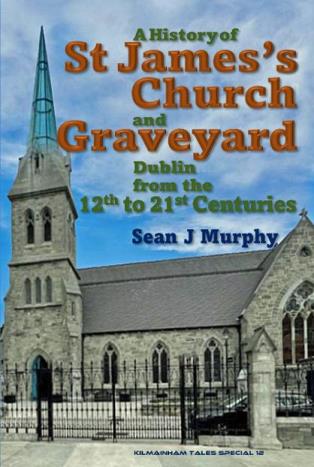
Genealogist and lecturer Sean J Murphy has published another book: A History of St James's Church and Graveyard. This Dublin burial ground was once the capital's largest inner city graveyard, with an estimated total of 100,000 individuals interred from the 12th century to 1989.

Founded back in 1189–92, the church and burial ground has an intriguing history. It was named for the saint said to be buried in Santiago de Compostela in Spain, and over the past 900 years has become the final resting place of many celebrated/famous people.

The church building closed as a place of worship in 1963 and, following refurbishment and conversion, is now home to the Pearse Lyons Distillery, while the cemetery surrounding and behind it has long been overgrown and inaccessible. Now in the care of Dublin City Council, it is currently being restored and will (hopefully) be reopened the public.

Sean's 180-page book is published by Kilmainham Tales. It costs €12:50 plus postage and packaging, direct from the publisher. For further details, and P&P-inclusive prices to other regions, click the book's cover picture, right.

ISBN: 978-1-908056-89-4