Thursday, 8 May 2014

May/June issue of History Ireland in the shops

£6/€7 , and worth every penny/cent
The May/June issue of History Ireland magazine is now in the shops.

After the last edition's special focus on Brian Boru and the Battle of Clontarf, this issue returns to its more regular arrangement of offering a wide selection of features covering themes from early medieval to 20th-century history. The cover graphic, by Robert Ballagh, relates to the Reputations feature which examines the riddle of Erskine Childers, described in the article as 'Ireland's Laurence of Arabia', and the Howth/Kilcoole gunrunnings.

There's an in-depth look (four articles) at the range of material held by the Military Archives and especially the Military Service Pensions Collection, part of which was released online in January (see my blogpost for details), a piece about sources for family and finances in 15th-century Dublin, and examinations of the Phoenix Park murders of 1882, Dublin's Unionists and Lord Sligo's plunder of ancient Greece. And plenty more besides.

Add in all the regular columns and reviews, there's certainly enough to keep me quiet for a while!



New Book: Dublin, the making of a capital city

Just published by Profile Books is Dublin: The making of a capital city by David Dickson, Professor in Modern History, Trinity College Dublin. The book provides the first comprehensive survey of the city’s history to appear in more than 30 years and brings together in a single volume the work of many dozens of historians, geographers and archaeologists.

It traces some 1,400 years of the city, from Viking settlement to capital and reveals how much Dublin was always a hybrid place, a melting pot and sometimes a collision point for Viking, Gaelic and Anglo-Norman settlers, for New English and Ulster Scots, Huguenot and Jewish immigrants. It argues that much of the city’s cultural singularity, both within Ireland and globally, was the result of this hybridity.

The principal focus of the book is on the post-medieval emergence of Dublin as an internationally significant city, evolving from 17th-century court town to a parliamentary metropolis in the 18th century, and from a politically and religiously polarized town of the 19th century to the embattled centre of a new nation in the 20th. It concludes with a magisterial analysis of the vast city-region that had taken shape by 2000.

In essence, Dublin reveals the rich and intriguing story behind the development of the capital city and provides a comprehensive backdrop to the lives of our Dublin ancestors.

The book is also being published by the Lilliput Press in a special limited (76-book) edition, clothbound and cased, and signed by the author.

A North American edition will be published by Harvard University Press in the autumn.

Wednesday, 7 May 2014

Early closing Friday as cycles cause traffic mayhem

Belfast is expecting traffic gridlock on Thursday and Friday as the city prepares to launch the Giro d'Italia cycling event, one of the world's biggest sporting occasions. It's not so much the bicycles that will cause the problems as the road closures, but it's going to make moving around the city difficult, either way.

Both the General Register Office of Northern Ireland (GRONI) and the Public Records Office of Northern Ireland (PRONI) have announced that they will close their doors early on Friday 9 May.
  • GRONI's counter and telephone ordering services will close at 3:00pm. No priority orders will be taken after 2:00pm.
  • PRONI will close at 3:15pm. As the Giro d'Italia start line is in the Titanic Quarter, where PRONI is based, it's probably sensible to anticipate congestion and traffic problems from the day before.

Financial compensation for Civil War damage

In the excitement of last week's releases of the Pre-1901 census fragments, Census search forms and Soldiers' Wills, it seems news of another interesting project being undertaken by the National Archives of Ireland (NAI) has been overlooked: the listing of the Finance Compensation (post-truce) files. This collection of about 20,000 files relates to claims for compensation for loss of or damage to property that occurred as a result of military action between July 1921 and March 1923. Claims were made under the Damage to Property (Compensation) Act, 1923.

The National Archives describes these files as recording 'the name and address of the claimant and the amount paid in compensation and also a brief narrative of the military action or incident that led to the loss of the property, along with an inventory of the property lost. Using these files, a detailed picture of every incident causing loss of, destruction of, or damage to property during the Civil War can be established.'

So far, the NAI has added the files for three counties to its online catalogue. Images are not available; researchers can access the original files in the NAI Reading Room in Bishop Street, Dublin.

The three counties are:

Files for more counties will be added to the catalogue in due course.

The records of earlier compensation schemes covering 1916 and the period of the War of Independence are also held by the NAI; the Property Losses (Ireland) Committee files, which mainly relate to damage in Dublin during the 1916 Rising, are expected to be made available later in 2014.

A separate archive – the Compensation (Ireland) Commission or Shaw Commission – relates to claims for the period January 1919 to July 1921. The majority of these record only the name and address of the claimant and the amount paid in compensation.

(If you experience any difficulty reaching the county pages above, use the links on this National Archives Page.


Tuesday, 6 May 2014

Great Parchment Book Day in London, 25 July

The Great Parchment Book will be the star turn at a special event at London Metropolitan Archives (LMA) on Friday 25 July.

The free dedicated event will start at 9:30am and will focus on the story of the Great Parchment Book and on accessing historical documents through innovative technologies. Tea and coffee will be provided; bring your own lunch.

Since it was launched last year, the website of the Great Parchment Book has received more than 50,000 virtual visitors, while over at the Guildhall in Derry, the Plantation: Process, people, perspectives exhibition (which, until recently, displayed a folio from the Book) received 323,033 visitors from June to March. More recently, the Book has been added to the European History Primary Sources (EHPS) website.

The Great Parchment Book Day at LMA will be a free event but you'll need to book. Details.


PRONI catches Wheel Fever!

http://www.proni.gov.uk/index/exhibitions_talks_and_events/online_exhibitions1/wheel_fever.htm
Click to view online Wheel Fever exhibition
The Public Record Office of Northern Ireland (PRONI) has fully embraced the spirit of the Giro d'Italia! With many of the world's premiere cyclists peddling through the Titanic Quarter at the end of this week, the PRONI team has taken the opportunity to uncover some of the gems from its archival collections connected to the history of cycling.

The best of these documents and images can now been viewed in a small pop-up exhibition in PRONI's atrium space. This presentation will be on display until the end of May.

If you won't be visiting during the month, take a look at the online 'highlight reel' of the exhibition (click image).

Back To Our Past – 2014 dates confirmed

Back To Our Past will be returning to the RDS in Dublin in October.

Ireland's very own genealogy exhibition and conference will be held from Friday 17 October to Sunday 19 October inclusive in the Industries Hall and will, once again, form a distinct part of the annual Over 50s Show.

Details will follow towards the end of the summer. For now, just get the dates in your diary!


Moore Street commemorative centre approved

Revised designs for the creation of a commemorative centre at the national monument at Nos. 14 – 17 Moore Street, Dublin, have been approved. Some new conditinos were also imposed.

No. 16 Moore St was the final headquarters of the leaders of the 1916 Rising prior to surrender. Nos. 14, 15, 16 and 17 Moore St were preserved as a national monument by order in 2007. This status means that any works affecting the monument require the written consent of the Minister for the Department of Arts, Heritage and the Gaeltacht (DAHG).

The approval and new conditions came from Jimmy Deenihan, TD, Minister for DAHG. Making the announcment, he said: 'The decision I have made will secure the future of one of the most important sites in modern Irish history. Together with the interpretive centre planned for the GPO, the Moore Street commemorative centre will provide a key focal point for our commemoration of the events, the people, and the sacrifices they made in 1916.

'Now that funding is in place, and appropriate restoration proposals have been approved, this is our great opportunity - within a limited window of time - to have a fully restored commemorative centre at Moore Street for the 100th anniversary commemorations in 2016.'


Irish Historic Towns Atlas Seminar, 23 May

The third and final seminar in the Maps and Texts: using the Irish Historic Towns Atlas – Georgian and Victorian Towns series will be held in Academy House, 19 Dawson Street, Dublin 2 on Friday 23 May.

The series, which started in 2012, compares towns from a chronological and interdisciplinary perspective. This year's seminar will focus on urban development in the 18th and 19th centuries and themes under the spotlight will be towns with military barracks, the Big House and town improvement, canals, railways, public buildings and valuation maps. The plenary paper will focus on the capital and will preview the imminent publication of Irish Historic Towns Atlas, no. 26, Dublin, part III, 1756 to 1847 by Rob Goodbody.

Speakers include Toby Barnard, Arnold Horner, David Fleming, Jacinta Prunty, Helene Bradley, Frank Cullen, Rob Goodbody and David Dickson. You can download the full programme here.

It's free to attend the seminar but you need to book by email or phone +353-1-6762570 ext. 207.

Certificate in Oral History course starts in September

http://www.dublincity.ie /RecreationandCulture/libraries/News%20Items/Documents/Oral-History-2014.pdf
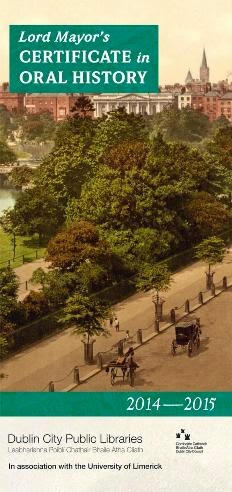
A Certificate in Oral History course will be starting in the Autumn. It'll be held at Dublin City Library & Archive, Pearse Street, Dublin on Monday evenings.

The course is designed to equip participants with skills in the preparation and conduct of oral history projects, including best practice in the collectino and archiving of oral history interviews. It will examine the wealth of recorded oral narrative sources in Ireland in both oral history and folklore.

It runs from September to April next year.

There's a fee of €500 and the deadline for applications is 29 August.

Two bursaries are available (closing date 14 August, email cityarchives@dublincity.ie).

To download the Lord Mayor’s Certificate in Oral History course brochure (2Mb pdf), click the picture, right.