Wednesday, 4 January 2023

In numbers: A snapshot of Irish society in 2022

The Central Statistics Office (CSO) has released its Year in Numbers – Part I, Society and Environment, an overview of the Republic of Ireland in 2022. You can view detailed information in the full release by clicking the CSO logo below, but I've pulled out some of the highlights likely to be of most interest to family historians.

Population
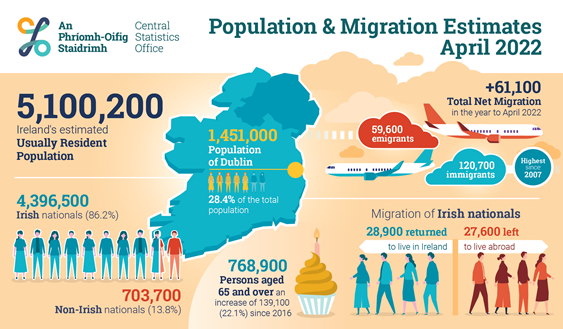
As of Census night on 3 April 2022, the preliminary population count of 'usually resident' individuals in Ireland is 5.1 million – an increase of 7.6% from 2016 and the largest population recorded in a Census since 1841.

Of this total population, more than 86% were Irish nationals. Some 768,900 were people aged 65 and over, an increase of 139,100 in the last six years.

All 26 counties experienced a growth in population. The proportion of the population living in Dublin rose to 28.4% of the total in 2022 and now stands at 1,451,000 people.

Names for new-borns
When it comes to choosing names for children, the Irish have long picked a wider variety of names for girls than for boys, and 2021, the last year for which full data is available, was no different. The number of names registered were 4,741for girls and 3,863 for boys. 

Fiadh topped the most popular name for girls for the first time, ousting the perennially popular Grace, while Jack hung on to the top spot as it has done every year bar one since 2007. Among the new entrants in the boys top 100 were Teddy, Daithí, Páidhí, Jaxon, Brody, Ted, Hunter, Tadgh, Tiernan and Arlo. In the girls top 100 there were just three new names: Indie, Ayla and Lottie.

Mary, for decades the most popular baby girl's name in Ireland, started to decline in popularity in the 1970s and fell out of the top 100 names list for the first time in 201, plunging to 127th position.

The number of babies born in 2021 was 58,443, down almost 22% since 2011 when 74,650 births were registered.

Surnames of new-borns
The 'Top 10' surnames for babies registered during 2021 – the last full year available – were as follows:

The CSO produces statistical data for the Republic of Ireland only.
  1. Murphy (1)
  2. Kelly (2)
  3. Ryan (8)
  4. Walsh (4)
  5. Byrne (7)
  6. O’Brien (6)
  7. O’Connor (9)
  8. O’Sullivan (3)
  9. McCarthy (13)
  10. Doyle (12).

Those dropping out of the Top 10 list were Smith, previously at position 5, and O'Neill, previously holding the 10th spot.

Marriages
Ireland's brides and grooms are getting older. This trend has been in evidence for some years. In opposite-sex marriages, in 2021, the average age for brides was 35.4 years and for grooms, 37.4 years; in 1981, the average ages were 24.7 years and 27.5 years. Same-sex weddings in 2021 saw both parties slightly older: 39.9 years for women and 40.4 years for men.

While the most popular form of ceremony for opposite-sex couples was a Catholic ceremony (40%), it was closely followed by civil ceremonies (34%). Some 57% of all marriages were religious ceremonies, with 39% Catholic, 1.1% Church of Ireland, and 8% Spiritualist Union of Ireland; 8.6% opted for other religious ceremonies.

The majority of non-religious ceremonies were civil marriages, which accounted for 35% (5,987) of all marriages; the remaining 1,462 (8.5%) of couples chose Humanist ceremonies. Fridays were the most popular day of the week for marriages, and August the most popular month.

Deaths
There were 33,055 deaths in the Republic in 2021. Cancer and circulatory disease were the biggest causes of death accounting for 55.2% of deaths in April, May, and June 2022. 

Education
More than half (53%) of 25–64-year-olds in 2022 have a third level education, the highest level in the EU27. This has grown from 40% in 2012. (A report in April 2022 found that 80% of 2019 graduates were in substantial employment in the first year after graduation and their median or mid-point earnings was €555 per week.)
Tuesday, 3 January 2023

AGI and City Colleges launch Advanced Diploma in Irish genealogy

The long-standing collaboration between City Colleges and Accredited Genealogists Ireland (AGI) is moving up a notch with the launch of an online course suitable for students who are already familiar with basic Irish resources. It aims to advance students’ knowledge of the sources for Irish genealogy.

This Diploma in Family History Research (advanced) course is aimed at both the dedicated amateur and budding professional and is suitable for students who already have a good grounding in civil registration, census, parish and land survey records. Its object is to advance students’ knowledge of Irish genealogy with topics such as military records, DNA, Estate records, Registry of Deeds, Testamentary records and much more.

It will commence on 26 January and will take place online every Thursday evening for ten weeks. Lectures are given by AGI members who are recognised experts in their field.

Each lecture has time for discussion and questions. Minor projects during the course reinforce taught principles and will give students the skills to compile their own genealogical report with the professional edge learned during the course.

For those within easy reach of Dublin, an in-person guided visit to a repository or archive will be offered during the course.

For more detailed information, see the Course Plan for Spring 2023 (docx).

Applications to join the course may be made to City Colleges by visiting www.citycolleges.ie or by phoning: 00 353 1 416 0034.

Friday, 23 December 2022

Latest Irish releases to check out over the festive period

Well here it is, Merry Christmas, and to help you survive the festive season, I've gathered some of this month's latest releases of records and videos plus some recent podcasts. Dig in and enjoy. IrishGenealogyNews will be back in early January 2023.

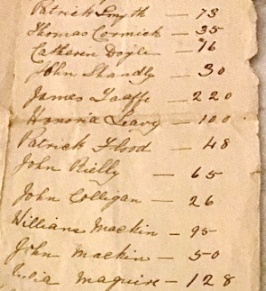
Ireland, Licences To Keep Arms 1832-1836: This Parliamentary report holds the details of 6,352 individuals who were granted licences for firearms and swords by county magistrates at the Quarter Sessions Courts across the island from 1 August 1832 during the years stated. The records note names and residences of the licencees, the type of weapon (guns, pistols, carbines, blunderbusses, swords and bayonets) and the name and address of the county magistrate who approved their licence application. See sample image below.

Northern Ireland, Wills and Administrations, Index, 1621–1858: This collection contains will and administration records from various Dioceses of The Church of Ireland in the six counties that now make up Northern Ireland. The vast majority of the 75,722 records date between 1621 and 1858 and typically contain the name of the deceased, the date and place when the will was signed, probated or administered by letter or by bond. Some records contain the residence of the individual and date of death.

Newspaper BMD announcements (Co. Clare): Part of the Lord Dunboyne collection, 1824–1878, these birth, marriage and death notices span 1824–1855, 1852–1854 and 1850–1855 respectively and were published in The Clare Journal, Limerick Chronicle, The Times, The Clare Freeman, Dublin Evening Mail and the Freeman's Journal. The collection was created by Theobald Fitz-Walter Butler, Lord Dunboyne (1806–1881) and has been transcribed by volunteers and indexed by County Clare Library staff.

Donegal local authority minutes: Donegal County Archives has been busy in the rundown to Christmas, digitising and releasing more of its Urban District and Rural District Councils Minute Books from the Revolutionary period in the early 1900s. During December the following were released: the Letterkenny Urban Council's Minutes 1922 and 1923; Buncrana Urban District Council's Minutes 1913–1916; Bundoran Urban District Council Minutes 1914-1926, and Londonderry No.2 Rural District Council Minutes (covering Burt/Killea/Bridgend & south #Inishowen area of Co. Donegal), 1899–1908. All available in pdf format and free to download.

MemsDead.com – is a brand new website that's been developed by Ciara Chivers of Shamrock Roots to help genealogists make the most of an excellent but underused resource: the Journal of the Journal of the Association for the Preservation of the Memorials of the Dead in Ireland, which is also known as the Journal of the Irish Memorials Association. The journal was published from 1888 to 1934 and is a treasure trove of headstone inscriptions, many of which can no longer be read or have simply disappeared, but its rewards are notoriously hard won. Memsdead aims to guide you to a greater understanding of the resource, and provides researchers with tools to overcome its difficulties.

PRONI YouTube videos: In the last few weeks, the Public Record Office of Northern Ireland has released videos of a number of lectures presented earlier in the year and of interest to genealogists and social historians. Among them is the launch presentation for the online registers for Indoor Relief to the Belfast Workhouse 1892-1921 (BG7/GK); Olympic and Aquitania: Eyeing Up the Competition; The Uses and Abuses of Magic in Modern British and Irish History; and Demonised: 'The Islandmagee Witches, 1711' Project; and Researching armed forces in the 19th and 20th centuries; Records at The National Archives.

Irish History Podcast: This podcast is produced by historian and archaeologist Fin Dwyer and now has a huge library available to enjoy. His last two recordings for 2022 made great listening: A Slum City - Life & Death in Late Victorian Dublin and A Lost Town in the Wicklow Mountains.

IrishGenPod: The Irish GenPod is published by Senior Times magazine (the organisers of the Back To Our Past show) and sees professional genealogist Paul Gorry, FIGRS MAGI interviewing people working in Ireland's genealogy services, archives and related fields. In the autumn series (nos 5–8) he interviews Tom McGrath, author of Unspoken; Susan Hood, archivist of the RCB Library; Andrew and Johathan Martin of the Irish Newspaper Archives; and Steven Smyrl, professional genealogist, campaigner, historian and author.


Thursday, 22 December 2022

England, Scotland & Wales genealogy updates: 2-week summary

Below is a summary of newly released and updated family history record collections for England, Scotland and Wales from the major genealogy databases. (Previous summary, 9 December.)

My regular summary of releases and updates relating to British collections is designed to help family historians whose Irish ancestors migrated, temporarily or permanently, to England, Scotland or Wales.

By default, it will also be useful to anyone carrying out research in those three nations, regardless of the origin of their ancestors.

The figures in parenthesis in the New Collections section are the numbers of records/images in the new record set.

Unless otherwise stated, the figures in parenthesis in the Updated Collections section reflect the number of records added to the collection in the recent update. In some instances, the supplier has not made this figure available. Where two figures are given, the first is the number of additions, the second is the new total.

Please note that I don't usually include updates of fewer than 1,000 records.


NEW COLLECTIONS


Ancestry

BritishNewspaperArchive (and shared with FindMyPast)
  • New titles in main collection ($£€)

FindMyPast

UPDATED COLLECTIONS


Ancestry

FindMyPast

TheGenealogist

Some of the above content contains affiliate links. This means I may earn a small commission if you buy via these links. This does not affect the price you pay as a consumer, but it does contribute to keeping Irish Genealogy News online. See Advertising Disclosure tab above.

Wednesday, 21 December 2022

Christmas and New Year closures at major Irish genealogy venues

Below are the planned opening and closing times of the main genealogy repositories over the Christmas 2022 and New Year 2023 period. They're all subject to change, so if you're travelling any distance, check the venue's website or, better, phone.

Republic of Ireland

DCL&A and all Dublin City Libraries will be closed from Christmas Eve to 2 January inclusive. Reopening 3 January.

Royal Irish Academy: Library closed from Saturday 24 December until Monday 9 January 2023 at 10am inclusive.

National Library of Ireland: Reading Room and Exhibitions closed from 5pm on Friday 23 December until 9:30am (10am for Seamus Heaney) on Tuesday 3 January.

National Archives of Ireland: Reading Room closed from 5pm Friday 23 December until 10am Tuesday 3 January.

General Register Office: Research Room closed from Friday 23 December to Monday 2 January inclusive. Email service will be available Friday 23 December, Wednesday 28, Thursday 29 and Friday 30 December. Normal service from Tuesday 3 January.

Local County and Branch Libraries: Most appear to be closed from Saturday 24 December to Tuesday 3 January but some are opening for just one day during that period. Check with each venue.

RCB Library:The Church of Ireland library and archive has unexcpectedly had to close its doors on Wednesday 21 and Thursday 22 December. It will be open, 9:30am to 1pm only on Friday 23 December and will not re-open until Tuesday 3 January.

Northern Ireland

Public Record Office of Northern Ireland (PRONI): Closed Monday 26 to Wednesday 28 December. Open Thursday 29 and Friday 30 December. Closed Monday 2 January. Returns to regular hours on Tuesday 3 January at 9am.

General Register Office of Northern Ireland (GRONI): Closed Monday 26 to Wednesday 28 December. Open Thursday 29 and Friday 30 December. Closed Monday 2 January. Returns to regular hours at 9:30am on Tuesday 3 January.

NILibraries / Local County and Branch Libraries: From Monday 19 to Friday 23 December inclusive, all libraries will close at 5pm. From Saturday 24 December to Monday 2 January 2023 inclusive, all libraries will be closed.

England & Wales

The National Archives, Kew, London: Closed Saturday 24 to Wednesday 28 December inclusive. Open Thursday 29 December and Friday 30 December. Closed Monday 2 January. Reopening Tuesday 3 January.

National Library of Wales: Closed from Saturday 24 December 2022 to Monday 2 January inclusive. Reopens 9am on Tuesday 3 January

Scotland

National Library of Scotland: Closed Saturday 24 to Tuesday 27 December inclusive. Open Wednesday 28 to Friday 30 December with revised hours. Closed Saturday 31 December to Tuesday 3 January inclusive. Reopening Wednesday 4 January.

Tuesday, 20 December 2022

A bundle of Xmas gifts from Ireland Genealogy Projects Archives

An exciting mixed bundle of photos and records has been delivered early this festive season from Ireland Genealogy Projects Archives. It holds some real gems that may just knock down a brick wall for some lucky researchers.

Sample section from rental documents of
teneants of Marcus Goodbody, dated 1893.
Discovered in letter to Lawrence Mealy of
Tristernagh Demesne, ancestor of the
Contributor. Photo courtesy IGPArchives.

As always, these gifts come from volunteers who freely donate their time by tramping over graveyards, pencil and camera in hand, or passing on their own discoveries in the possibility and hope that their contributions will help other family historians learn more about their Irish ancestors. Why not consider becoming part of this team in the new year or even over the holiday?

Here are this month's additions to the free IGP Archives website:

CORK Genealogy Archives - Headstones
Killeagh Old Part 3 (Finished)

FERMANAGH Genealogy Archives - Headstones
Church of the Holy Trinity (CoI), Pt 4, Lisnaskea

MEATH Genealogy Archives - Headstones
St. Colmcille Graveyard, Kells
St. Ultans, Ardbraccan, H-N. Text File added

TYRONE Genealogy Archives - Miscellaneous & Military
Church of Ireland Rectors
Muster Roll, Strabane Barony, Sir Geo Hamilton c1630
Militia Infantry, Royal Tyrone Fusiliers – Hart's Annual Army List 1876 & 1881

WESTMEATH Genealogy Archives - Land
Tenants of Marcus Goodbody, Tristernagh townland, 1893


Thursday, 15 December 2022

Irish Registry of Deeds Archive joins Digital Repository of Ireland

The Property Registration Authority (PRA), which manages the Registry of Deeds in Dublin and cares for its priceless collection, is the latest new member of the Digital Repository of Ireland (DRI).

Readers of IrishGenealogyNews will be aware that the Registry of Deeds Archive Services has embarked on a long-term programme of digitisation of its collection, one of Ireland's most precious sources for genealogists.

It includes parchment memorials, Transcription Books, Indexes of townlands and names of grantors, Abstract Books, microfilms and administrative records. In total, the archive holds more than 5million memorials and 17,000 bound volumes. (You can find out more about the collection, which dates to 1708, here.)

Joining the DRI is an important part of this process, as Ellen Murphy, Archive Manager of the PRA, explains: The PRA are delighted to become members of the DRI as we look to scale up our programme of digitisation at the Registry of Deeds in the coming years. Membership of DRI will give us a sustainable, best-practice solution for managing preservation quality digital surrogates, as well as access to experts in the field of digital curation."

Wednesday, 14 December 2022

TipperaryStudies releases Revision Books for North Tipperary

Tipperary Studies, the local studies department of the county's Library Service, has released the first instalment of its project to digitise the Cancelled Valuation Books / Revision Books for the 75 District Electoral Divisions (DEDs) in North Tipperary.

Click to view enlarged image

This first tranche sees 57 volumes covering 23 DEDs uploaded to the Tipperary Studies Digital Archive. They date from 1902 to 1917 and can be used to trace the occupiers of a particular property over a period of years. (For more information about the genealogical value of Valuation Revision Books, see this dedicated page on my website, Irish Genealogy Toolkit.)

The DEDs covered in this release* are Abington (3 vols); Ballycahill (3); Borrisnafarney (2); Borrisnoe (2); Bourney East (3); Bourney West (3); Finnoe (2); Foilnamon (3); Holycross (2); Inch (3); Killavinoge (2); Killea (3); Killoscully (3); Kilnarath (2); Kilrush (2); Littleton (3); Longfordpass (2); Moycarkey (2); Moyne (2); Rathnaveoge (2); Templederry (3); Thurles Rural (3); Timoney (2).

The Tipperary Studies digitisation team is now working on the remaining 52 DEDs in its collection. It hopes to have the second batch ready for release in late spring 2023.

For privacy purposes, only volumes produced up to 1921 will currently be made available online. However, revision books up to the 1960s are available to personal visitors to Tipperary Studies, which is based at The Source Library, Cathedral Street, Thurles.

Please note that Tipperary Studies does not hold the Cancelled Valuation Books for South Tipperary.

* The number of volumes for each DED is shown in brackets.


New edition of Irish Genealogy Matters newsletter published

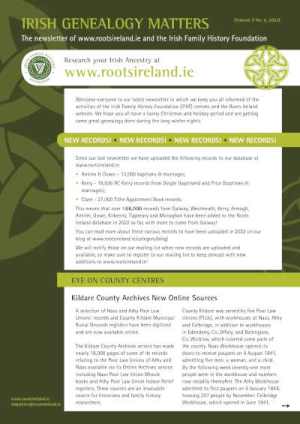
The winter edition of the Irish Family History Foundation's newsletter Irish Genealogy Matters has been published.

It carries news and developments from around its island-wide network of local genealogy and heritage centres, with details of some products (think gifts, books, courses etc) to tickle the fancy of family historians, and festive events.

It also provides a summary of recent additions to the RootsIreland.ie database, as well as a teaser for another bundle of records expected to be released before New Year is rung in.

Irish Genealogy Matters is free to download by clicking the image, right.

Two new Irish titles as BritishNewspaperArchive tots up 61m pages

The BritishNewspaperArchive.co.uk, which this morning held a total of 61,170,843 digitised pages of historical British and Irish newspapers, has added another couple of Irish titles. They are:

Dublin Sporting News:  The online holding when completely digitised will span 1889–1901. So far, editions published in the first five years of that period are available to search and view. While published in Dublin, the paper carried news and results from England, Scotland and Wales, and included 'Prophesies' from pundits at the big daily national papers. It covers many sports but horse-racing and coursing seem to dominate. The masthead is great... see below.

Dublin Advertising Gazette: The masthead of this paper described its contents as A Record of Trade, Property, Insurance, Railway and Shipping Intelligence but its adverts, which feature across the bulk of the four-page editions, are for a much wider range of life's essentials, including accommodation, tuition, pipes and tobacco, upcoming theatrical productions, homeware and clothing. The paper was published on Wednesdays as a freesheet and was in circulation from 1858–1877.

The entire holding of the BNA is shared with its sister database FindMyPast where all the titles are available to those with a PRO or PREMIUM subscription.

The masthead of the Dublin Sporting News in 1899.