Monday, 21 September 2020

Major Irish genealogy repositories back in Lockdown

With both the County and City of Dublin moving into Level 3 of the Irish Government's 'Plan for Living with Covid-19', the capital's major repositories for genealogists and historians, and other cultural attractions, are once again closed to the public. 

The restrictions, designed to drive down the coronavirus transmission rate in the county (currently at 114.2 compared with 59.1 for the country as a whole, and with the highest rate at 173.4 in Dublin North West) came into effect on Friday night. 

The National Archives of Ireland, the National Library of Ireland, the Dublin City Library & Archive, and all branch libaries have closed their doors (except for some local 'click & collect' services). However, some email services are being 'manned'. These include the free genealogy advisory services normally provided to visitors to the NAI (see webpage for details and email) and NLI (see details of online online services and email.).

For now, at least, the rest of the nation is on Level 2, which should mean local archives, libraries and local studies departments are open - with health and social distancing precautions in place, and often on an appointment-only basis.  However, officials are monitoring closely trends in the spread of Covid-19 in eight other counties: Donegal, Kildare, Leitrim, Limerick, Louth, Offaly, Waterford and Wicklow, so be aware that Level 3 restrictions may soon be implemented to areas beyond Dublin.

In Northern Ireland, a meeting of the Stormont Executive will decide this afternoon whether some areas covered by localised restrictions should be expanded and, if so, whether measure should be introduced NI-wide. 

Update to Northern Ireland, 4:50pm: Meeting resulted in increased social-only restrictions being re-introduced across the six counties, so PRONI will continue its current restricted appointment-only access system.


Third Clare title joins online BritishNewspaperArchive

The Clare Freeman and Ennis Gazette has joined the Irish collections of BritishNewspaperArchive and FindMyPast.

It is the third title from County Clare in these online databases.

The paper, which was published on Saturdays in the county town of Ennis, included a section dedicated to births, marriages and deaths, so it's an important publication for genealogists to check if they have family connections to the county.

It was founded in 1853 and survived for little more than 30 years, closing in 1884. All editions published during that period are now searchable in both databases. 

The other Clare titles available through the two online archives are the Clare Journal & Ennis Advertiser (1835-1872) and the Clare Advertiser & Kilrush Journal (1869-1887).

Thursday, 17 September 2020

New/updated USA genealogy records: 2-week summary

Below is a summary of US family history collections that have been either newly released or updated by the major genealogy databases in the first half of September. (The last summary list was published on 31 August, see blogpost).

My regular summaries are designed to help family historians whose Irish ancestors emigrated, temporarily or permanently, to the United States. By default, they should also be useful to anyone carrying out research in the US, regardless of the origin of their ancestors.

The figures in parenthesis in the New Collections section are the numbers of records/images in each new record set.

Unless otherwise stated, the figures in parenthesis in the Updated Collections section reflect the number of records added to the collection in the recent update, if a number has been clearly noted by the supplier. I do not include updates of fewer than 1,000 records.


NEW COLLECTIONS

Ancestry

FamilySearch

FindMyPast

MyHeritage

UPDATED COLLECTIONS


AmericanAncestors


Ancestry


FamilySearch

Some of the above content contains affiliate links. This means I may earn a small commission if you buy via these links. This does not affect the price you pay as a consumer, but it does contribute to keeping Irish Genealogy News online. See Advertising Disclosure tab above.

Wednesday, 16 September 2020

Irish Viking dna debunks our image of blonde warriors

The largest-ever DNA analysis of Viking remains has shed new light on the identity of Irish Vikings.

This group of invaders certainly changed the course of Irish history and left a lasting legacy on the island’s gene pool, and they are usually recognised as blonde-haired invaders, pirates and warriors, who travelled by sea from Scandinavia to raid and eventually settle on the island.

Viking whalebone plaque: National Museum Ireland - Archaeology
Now, a milestone international study involving cutting-edge DNA analysis on archaeological remains has revealed:
  • Irish Vikings derive much of their genetic ancestry from Norway
  • English Vikings show sharp ancestral differences with their Irish counterparts, with much stronger Danish influences
  • Many Vikings had brown hair, not blonde, including the famous Eyrephort warrior from Co. Galway
  • Viking identity in Britain and Ireland was not limited to those of Scandinavian ancestry
  • An individual buried in the Viking tradition from Ship Street Great is mostly of local origin
The first Irish Viking genomes were published today in the highly respected international journal Nature, as part of the largest ever DNA analysis of Viking remains, led by Professor Eske Willerslev, a Fellow at the University of Cambridge, and director of The Lundbeck Foundation GeoGenetics Centre, University of Copenhagen.

The six-year project also saw researchers from the National Museum of Ireland and Trinity College Dublin become part of the international effort to decode the genetic make-up of the Viking world. The results debunk the modern image of the typical Viking as a blonde-haired Scandinavian warrior.

You can find out more about this important project and its discoveries on the TCD website.

Ireland Genealogy Projects Archives: mid-month update

http://www.igp-web.com/IGPArchives/ire/leitrim/photos/tombstones/fenagh-coi/target16.html
Headstone photos and inscriptions from three graveyards in three counties have been donated by volunteers to Ireland Genealogy Projects Archives in the first two weeks of September.

They have now been uploaded to the group's free website and all family historians with ancestral connections to counties Dublin, Leitrim and Mayo are invited to access them as part of their research.

DUBLIN Genealogy Archives - Headstones
Mount Jerome Cemetery, Part 262

LEITRIM Genealogy Archives - Headstones
Fenagh, St Catherine's, Church of Ireland (additions)

MAYO Genealogy Archives - Headstones
Charlestown, Bushfield Cemetery, Pt 2 (T)


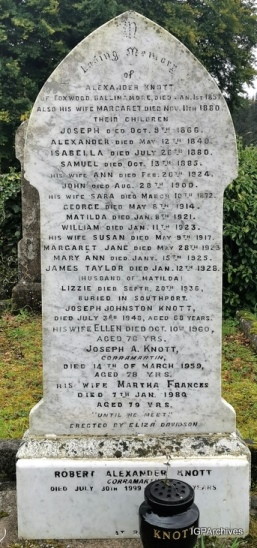
Right: The image from Fenagh St Catherine's churchyard shows the burial ground equivalent of a mighty tome, with its closely cut small text and a long story to tell of the Knott family of Ballinamore from 1840 to 1999. Photo courtesy Leila Dolan and IGPArchives. Click/tap picture for enlarged view.

Next scheduled Irish Census delayed to April 2022

The Irish Government has postponed Ireland's next census from 2021 to 2022. It was originally scheduled to take place on 18 April next year but will now be moved to 3 April 2022. The delay follows guidance received from the Central Statistics Office (CSO).

Explaining the decision, Pádraig Dalton, Director General of the CSO, said: “The Census of Population is a unique count of everyone present in Ireland on Census night and provides essential information for planning and decision making. It is vital that the Census enables everyone in Ireland to participate so that the information gathered reflects all of our needs and can be used to make decisions that benefit us all.

"The decision to postpone the Census scheduled for 18 April 2021 until 03 April 2022 was not taken lightly and was based on a number of factors. Foremost in the decision making, was the need to ensure the safety of the general public and CSO field staff, coupled with the need to deliver a Census that achieves the highest possible response rate, across all facets of Irish society.

"Furthermore, the Census of Population is a major logistical operation and COVID-19 restrictions have prevented or delayed many key planning activities from taking place over recent months.”

"On consideration of these challenges the Government has decided to postpone the 2021 Census until April 2022 to enable the CSO to undertake a comprehensive, inclusive and safe Census in 2022 which will provide valuable and accurate data for our country in the years ahead."

Ancestry indexes Newspapers.com marriage notices

A new addition to Ancestry – Newspapers.com Marriage Index, 1800s–1990 – will figure in my next two-week summary of new and updated US record collections but deserves its own 'launch' blogpost.

https://prf.hn/click/camref:1100l4pTC/destination:http%3A%2F%2Fsearch.ancestry.co.uk%2Fsearch%2Fdb.aspx%3Fdbid%3D62116
As its name clearly reveals, the new record set is an index to marriage announcements dating from the 1800s to 1999 as held in Ancestry's sister database Newspapers.com. The Index extracts not only the usual bride and groom data plus date and place of ceremony, it pulls out numerous facts from the announcements, including names of parents, occupations, residences, name of employers, names of children and siblings who attended the event, and other details published in the annoucements. If you're lucky, the announcement for your ancestor was fullsome.

And because the index presents these details, you don't necessarily need (even if you might want) to view the full published announcment on Newspapers.com.

On Monday evening, a close friend and genealogist phoned me about a Santry who had unexpectedly appeared in her DNA results. There's never previously been any reason to believe we're related, but if she matches to a Santry, it's likely we have some distant link. So when this new Index landed in Ancestry the following morning, I decided to check out her Horace Santry cousin. I'd never come across him; Horace is definitely not a name that's ever appeared in my family tree.

From this new Index alone, I was quickly able to work back from Horace's marriage in Kansas in 1965 via Ohio and Canada to the birth of one Daniel Santry in 1815 in the Santry stronghold of Clonakilty, County Cork. (The speed with which I was able to do this demonstrated with utter clarity how much harder Irish researchers have to work in the absence of 19th-century census collections.) With the facts presented via Ancestry's new index – see below – I was also able to trace forward in time to Horace's descendents, as well as to stretch the tree personnel to his siblings and other extended family.

I haven't yet been able to make a documentary connection to my own Santry family line, but I suspect it's out there somewhere and I'll search again later this week.

If you don't have a Newspapers.com subscription, this new Index collection of more than 11 million records on Ancestry will be an important friend to all Irish family historians with ancestors who emigrated to the USA.

The search result from Ancestry's new Index

Back To Our Past: 35+ Irish genealogy lectures for €10

Ireland's only island-wide genealogy conference, Back To Our Past, returns this autumn but for the first time will be virtual event. A programme of more than 35 talks has been scheduled and, thanks to its new home online this year, it will be accessible to researchers all around the world.

https://backtoourpast.ie
I'm sure all the speakers will give interesting and informative presentations. I've no reason to doubt that, judging by the names I recognise. However, you may find the organisers' website somewhat lacking in detail. Clarity and precision have never been a strong point of BTOP's marketing efforts. If you've checked out the website with the intention of getting yourself prepared for the event, you won't be alone in being confused.

Officially, BTOP 2020 starts on Friday and runs for three days. But the website also says the talks will be accessible online on Wednesday (tonight). Presumably this means all the talks will be available in one hit, ready for us to view at our own convenience over the three days ie not at scheduled times.

The website goes on to say that when the three official days come to an end, the talks will remain accessible for one month. (So why mention three days?) Just to muddy the waters even more, in an email received today, the access period has been extended to three months.

I guess all will become clear in due course. (See update below)

So back to the better features of BTOP: the lectures and the experts delivering them. There's a good mix of traditional Irish family history, most of them aimed at beginners, plus local and social history, some general Irish heritage topics and a handful of genetic genealogy presentations. Here's the line-up:

  • Introduction message by Tourism Ireland, with Niall Gibbons, CEO Tourism Ireland
  • Discovering Irish Pets and Their Families on Ancestry, with Dr. Jennifer Doyle and Valerie B. Prince
  • Tracing your Irish ancestors in Australian records, with Debra Carter, Ancestry
  • Basic Genealogy Principles; Combining DNA & Traditional Research Methods, with Eamon Healy, Ancestry.
  • Exploring Belfast’s Shipyard Heritage, with Dan Gordon
  • Using the National Archives to research your ancestors, with Tom Quinlan, NAI
  • How young people can become Family History Detectives, EPIC The Irish Emigration Museum
  • How Emigration Changed Ireland, with Dr Maurice J Casey, DFAT
  • Discovering the Forgotten Soldier in Your Family History,  with Thomas Murphy, IGRS
  • The history of GAA Football – Part One, with Eoghan Corry
  • The history of the GAA  – Part Two, with Eoghan Corry
  • The history of Hurling – Part Three, with Eoghan Corry
  • Finding Irish Ancestors in Glasgow City Archives (GCA), with Dr Irene O’Brien, GCA
  • Church records in Scottish archives, with Dr Irene O’Brien, GCA
  • Poor Law Records in Glasgow City Archives, with Dr Irene O’Brien, GCA
  • Tracing Irish emigrants to Australia, with Rhona Gleeson, Ancestry
  • Sources for researching a convict ancestor, with Tom Quinlan, NAI
  • Using IrishGenealogy.ie for Irish family research, with Brian Donnelly, NAI
  • Researching Irish Emigrants to the United States, with Pamela Holland
  • Preservation and storage of family history documents, with Christine Deakin, Irish Genealogy Solutions
  • Introducing Accredited Genealogists Ireland, its work and members, with Anne Marie Smith MAGI
  • Researching in the 1901 and 1911 Census of Ireland, with Nicola Morris MAGI
  • Searching for ancestors in Irish Civil Records, with Sandy O’Byrne MAGI
  • How to find what you’re looking for in Irish Roman Catholic records, with Joan Sharkey MAGI
  • Territorial Divisions in Ireland, with Helen Kelly MAGI
  • Being Prepared for Researching in Irish Records, with Paul Gorry MAGI
  • The Importance of Griffiths Valuation in Family Research, with Michael Walsh MAGI
  • Researching the Irish Diaspora, with Lorna Moloney, Merriman Research
  • The Story of Skelig Michael, with Lorna Moloney, Merriman Research
  • The origins of Irish family names, with Lorna Moloney, Merriman Research
  • A personal appraisal of William Butler Yeats, with Sir Bob Geldof
  • Being a lifetime James Joyce groupie, with Roger Cummiskey
  • How to trace Northern Ireland ancestors, with Brian Mitchell MAGI, Derry Genealogy Services
  • The evolution of Generic Genealogy in Ireland, with Gerard Corcoran,  ISOGG Ireland
  • Using Genetic Genealogy to understand Celtic Migrations, with Gerard Corcoran, ISOGG Ireland
  • Towards a Genetic Genealogy driven Irish Reference Genome, with Gerard Corcoran, ISOGG Ireland
  • Riverdance, a video

Click the image above to book your tickets. (The purchasing process is fine.)

UPDATE 16 September, 6pm: An email has just been issued to all registered delegates. This sets out the running order for the lectures over the three days. Apart from the introduction from Tourism Ireland, the lectures will not be repeated over the official event weekend. When the weekend is over, however, all ticket-holders will be able to view all the lectures in whatever order they want, whenever they want.

UPDATE: 18 September, 1pm: The password that registered delegates were meant to receive last night was not issued. An email received at 11am this morning apologised for delays caused by 'a few technical glitches' and promised they'd be resolved by noon. Right now, there are eight of the planned 15 Friday presentations available to view. No password seems to be needed. Unfortunately, three of the available presentations link to the wrong recording! Geez. In response to queries (please, no more) from other irritated researchers, all I can tell you is that, based on my own experience, the BTOP organisers are hellishly inefficient, so delays and cock-ups are pretty much par for the course, whether BTOP is online or offline, but they'll probably get it sorted sometime over the weekend. UPDATE: 18 September, 4pm: There are now 12 of today's scheduled 15 presentations available to view. The incorrect links mentioned in my last update have been corrected in the last hour.

Tuesday, 15 September 2020

Genealogy and Irish history events, 15-30 September

It's been six months since I posted an Events Listing, so it's great to be back with a busy schedule of events in the second half of September, and even better that most of the sessions can be enjoyed by researchers no matter where they live.  

Nearly all those noted below are online, and nearly are free. Some require booking, some don't. 

Culture Night and the Dublin Festival of History contribute a good number of this month's events and I've not listed all of them below. I've just picked out a few random ones that sparked my interest so be sure to follow the links and explore the full programme.

Tuesday 15 September
The Birth of the Border, with Cormac Moore. Hosted on Zoom by Foxrock Local History Club. 8pm. Click here to join meeting five minutes before scheduled time.

Michael Collins: The Man and the Revolution, with Anne Dolan and William Murphy in online conversation with Mark Duncan. Michael Collins knew the power of his persona, and capitalised on what people wanted to believe. Was he the man of his age, or was he just luckier, more brazen, more written about and more photographed than the rest? Free but need to booking. 7pm.

Wednesday 16 September
Living Through Turmoil: the Ordinary and Everyday Experience of the Irish War of Independence, a lecture with Richard McElligott. Host: National Library of Ireland. Platform: Facebook. 7pm. Details.

Thursday 17 September
Cavan Women in the Campaign of Independence, with Dr Sinéad McCoole. First of the Centenary Lecture Series with Cavan Library Service. 7:30pm. Can be viewed on the Library's website or facebook page.

Friday 18 September to Sunday 20 September
Back To Our Past Virtual. More than 35 talks, mostly on traditional genealogy (three on genetic genealogy). They include researching emigrant Irish ancestors to Australia and the USA, Scottish records, Irish surnames, crime and punishment records, six short talks aimed at beginners from members Accredited Genealogists Ireland, Ireland's sporting heritage, social and local history, DNA, and much more. €10 ticket will allow access to all the talks for three months. Details.

Friday 18 September – Culture Night
Revealing the Past: Grave Rubbing Experience, online with Angelina Foster. Recording of workshop held in Old St Michael’s Medieval Graveyard, demonstrating safe techniques in taking a print from a headstone or carving. Includes discussion of symbolism of the carvings and the many stories uncovered. 5pm–7pm. Details.

Virtual Tour of Leinster House
Visitors can read about the history of the building, learn about the work of the Irish legislature and explore some of the art on display throughout the chambers of Dáil and Seanad Éireann. 4pm - 11pm. Details.

Tour of the Jackie Clarke Museum, plus other entertainment on the night. The Jackie Clarke collection is one of the most important private collection of Irish history material in public hands, comprising over 100,000 items spanning 400 years. It includes artefacts associated with Theobald Wolfe Tone, plus letters from Michael Collins, Douglas Hyde, Michael Davitt and O’Donovan Rossa. It also contains rare books, proclamations, posters, political cartoons, pamphlets, handbills, works by Sir John Lavery, maps, hunger strike material and personal items from Leaders of the 1916 Rising. 6pm-8pm. Not online. Address: Pearse Street, Ballina, Co Mayo. Details. Phone: 096 73508.

Highlights from the Royal College of Physicians of Ireland. Online video, specially made for Culture Night, sees members and fellows of the college introduce the building and some of their favourite items from the collections. 4pm-11pm. Details.

Tour of Seymour's Mausoleum in Lawrencetown, an online tour of the newly refurbished Seymour’s Mausoleum, a family memorial and local landmark commissioned by the Seymour family of Ballymore Castle in Lawrencetown, Co Down. Live broadcast on Facebook. 6pm - 8pm. Details.

Monday 21 September
Suffering the Most - The Life and Times of Tomás Mac Curtáin and Terence MacSwiney, exhibition launch (delayed by the Covid-19 lockdown for 6 months). Tells the story of two of the most important men in modern Irish history. Officially opened 11 September by an Taoiseach Micheal Martin. Address: Cork Public Museum, Fitzgerald Park, Mardyke, Cork City. Covid-19 restrictions will be in place to ensure a safe and enjoyable visit for all. Details.

The National Library of Ireland’s Web Archive: preserving Ireland's online life for tomorrow, with Maria Ryan. In 2011 the National Library of Ireland began selectively archiving and preserving the Irish web. Since then over two thousand websites have been archived and many of these sites which are now saved in the NLI Web Archive no longer exist on the live web. Web archiving allows us to preserve the online life of Ireland and make it accessible to researchers both now and in the future. This talk will examine what web archiving is and how the NLI preserves themes and events such as arts, literature, elections, referendums and Covid-19. The talk is free but booking is essential as places are limited. Details.

Thursday 24 September
From Turmoil to Truce: Photographs of the War of Independence, a Zoom tour of the National Library of Ireland's exhibition. Learn about the War of Independence through the photographs of W.D. Hogan from the NLI’s photograph collection using the RTE online version of the exhibition. 11am. Free but need to book. Details.

The September 1920 attack on Arva RIC Barracks and its consequences, with Dr Brian Hughes. Part of the Centenary Lecture Series with Cavan Library Service. 7:30pm. Can be viewed on the Library's website or facebook page.

PRONI and the Creation of Ireland’s Virtual Record Treasury, a virtual research showcase of talks on key PRONI collections, explaining how they are being linked to collections from around the world, in order to replace the destroyed archive, and a demonstration of the new virtual reading room. The event includes a live broadcast of staff presenting some of the jewels of the archive. The day concludes with a History Ireland Hedge School at 7pm, as a panel of historians and archivists respond to Winston's Churchill's 1922 quote, that 'a State without archives is better than archives without a State’. Free but need to book.Details.

Poverty, Chastity and (Dis)Obedience: irish missionaries and the anti-apartheid Movement, the global premier of a 60-minute documentary dedicated to the generations of Irish missionary men and women wo devoted their lives to South Africa, standing in solidarity with its people and their struggle. Hosts,EPIC The Irish Emigration Museum & Lilliesleaf Farm. Broadcast at 6:30pm. Details.

Saturday 26 September
The Family History Show London, online. The show features an online lecture theatre, an 'Ask the Experts' area where you can put questions forward to specialists, as well as a number of virtual stalls where you can buy genealogical products. Scheduled presentations cover a variety of British family history topics from multiple speakers and will be available throughout the day. Each talk will be available for 24 hours, so don't worry if you're in another time zone. Tickets £6. Early bookers will receive a free virtual goody bag on the day worth over £10. Details.

Sunday 27 September
Quarry Road, Cabra – A walking tour with Eamon Delaney. A Dublin Festival of History event. Quarry road was built by the British Government for veterans of World War One. It is one of many such housing developments built around the city, for ex-military families, mostly from working class backgrounds. Details.

Tuesday 29 September
Queer Treasure, with Tonie Walsh. A Dublin Festival of History event. An overview of the Irish Queer Archive, its foundation and the historic transfer in 2008 to the National Library of Ireland of the IQA Collections and examines how Ireland’s national cultural institutions have embraced LGBTQ+ histories. 7:00pm. Details.

Monday, 14 September 2020

British genealogy collections: 2-week update summary

Below is a summary of new and updated family history record collections for England, Scotland and Wales released by the major genealogy databases so far this month (see last summary, 1 September).

This regular summary of releases relating to British collections is designed to help family historians whose Irish ancestors migrated, temporarily or permanently, to England, Scotland or Wales. By default, it will also be useful to anyone carrying out research in those three nations, regardless of the origin of their ancestors.

The figures in parenthesis in the New Collections section are the numbers of records/images in the new record set.

Unless otherwise stated, the figures in parenthesis in the Updated Collections section reflect the number of records added to the collection in the recent update. In some instances, the supplier has not made this figure available. I don't usually include updates of fewer than 1,000 records.


NEW COLLECTIONS

Ancestry


BritishNewspaperArchive  (and shared with FindMyPast)

FindMyPast

UPDATED COLLECTIONS

Ancestry
FamilySearch
TheGenealogist
  • Map Explorer  Tithe Maps for Cheshire, Dorset, Hertfordshire, Kent, Lancashire, Lincolnshire, Norfolk, Staffordshire, Yorkshire West Riding (3,655 new; total 6,972)

Some of the above content contains affiliate links. This means I may earn a small commission if you buy via these links. This does not affect the price you pay as a consumer, but it does contribute to keeping Irish Genealogy News online. See Advertising Disclosure tab above.