Friday, 6 June 2014

History Festival of Ireland this weekend

http://www.visualcarlow.ie/events/info/the-history-festival-of-ireland-saturday-pass1
Tomorrow morning will see the gates open on this year's History Festival of Ireland.

Now in its third year, the History Festival has decamped to the beautiful setting of Huntingdon Castle, Clonegal, Co Carlow.

 It takes place over the weekend and will deliver intellectual stimulation beyond your dreams! Speakers include MacMillan, Myles Dungan, Catriona Crowe, Stephen Rea, Eoin Colfer, Grace Dyas, Turtle Bunbury and Kevin Whelan, to name just a handful of the 50 who'll be stepping up to discuss a great range of subjects. I spotted 'The Burning of the National Archives' among them; genealogists be warned that you may find this tale distressing. (MAY?)

One €22.50 ticket gives you access to the entire programme of talks, debates, performances and interviews for the whole day, as well as access to the castle's wonderful gardens.

You can buy tickets at the gate but only in cash. If you want to pay by credit card, click the Book Now image above.


Launch, 20 June: Decade of Centenaries Timeline

A new free educational web resource will be launching online in two weeks.

The Decade of Centenaries Timeline will provide an illustrated timeline of events from Ulster’s history from 1885-1925. It was commissioned by Community Relations Council NI to reflect its Remembering the Future – A Decade of Anniversaries initiative.

An introduction and demonstration of the new site, together with talks about researching and using archive material, will be presented at the Public Records Office of Northern Ireland, Titanic Boulevard, Belfast, on Friday 20 June, 2pm to 4:30pm.

The event is free but booking is essential. To register, send an email to info@digitalkey.biz by Monday 16 June.

UPDATE 24 June:
The new website is now live: http://centenariestimeline.com/

Thursday, 5 June 2014

Two new features added to County Clare's GenMap

http://www.clarelibrary.ie/eolas/coclare/maps/gmap/index.html#M5C52.84947!-9.03398Z15R1L11L12L18
Clare County Library has upgraded its excellent Genmaps software with two new features.

The maps can now show the boundaries of townlands within their civil parishes across the county as well as pick out one or multiple categories of monuments. There's a long list of the latter, including holy wells, cairns, wedge tombs, ringforts, chapels, castles, graveyards and standing stones.

Certainly no excuse now for not being able to locate the less obvious monuments scattered around the landscape of Clare!

I don't find the signposting (sorry for the pun) around the site terribly easy, and I confess to having found the Help section difficult, but I may be in a particularly dozy mood. Perserverence playing with the features brought success, fortunately.

Worth spending time on, in my view.

Wednesday, 4 June 2014

Plenty of Irish sailors in FindMyPast's latest release

http://www.awin1.com/cread.php?awinmid=2114&awinaffid=123532&clickref=&p=http%3A%2F%2Fsearch.findmypast.co.uk%2Fsearch-world-Records%2Fbritish-royal-navy-personnel-1831
FindMyPast have added the 59th set of records in their 100 x 100 project, which set an ambitious target of 100 releases over 100 days. Today's new collection is the British Royal Navy Personnel 1831 record set which provide a snapshot of the Royal Navy during that year using ships' muster books, naval dockyard musters, hospital registers, Royal Marine shore lists and Navy lists.

The records detail 66,125 men, and were extracted from ships’ muster books covering 228 vessels, hospitals, bases or musters, and a good proportion are Irish men.

I've just done a quick recce and found a 30-year-old John Carty (born 1799 in Dundalk, Co Louth) who had entered the Navy two years earlier and was currently on the SS Melville stationed in Malta; and an Able Seaman Lawrence Doyle, born 1803 in Cobh, Co Cork, who had joined up in September 1827 and was currently at sea, off Jamaica, on the SS Victor.

Some interesting details to be had if you can link up with one of the individuals in this set!

Siege of Derry Museum moves to temporary home

The Apprentice Boys' Memorial Hall in Derry, one of the city's most important historical attractions and in urgent need of renovation, has received funding to allow it to relocate its Siege Museum to a temporary site nearby.

The neo-Gothic pile of the Memorial Hall was built in 1873 to commemorate the thirteen boys who rushed to close the gates of the walled city against Catholic forces in December 1688.

The action led to the Siege of Londonderry, which lasted 105 days and left some 4,000 dead of starvation and disease. 'No Surrender' became the slogan of the Apprentice Boys.

It was clear on my last visit to Derry two years ago that the fabulous building was in need of rather more than a bit of emulsion on the walls. It is closed until the renovation works are completed.

Announcing the relocation funding today, Minister for Social Development Nelson McCausland said: “This assistance will allow the Siege Museum project to temporarily relocate and continue operation of their popular museum facility while the Memorial Hall undergoes restoration.

“The organisation hosts many guided tours facilitating visitors all year round and this funding will allow it to operate without interruption. Importantly the funding will also provide for a Community Development Worker who will engage with the wider community to promote a greater understanding of the history, culture and traditions of the Apprentice Boys of Derry.”

A spokesperson at the Memorial Hall told me today that the Siege Museum will open just a stone throw away at 16 Bishop's Street next week, hopefully on Wednesday 11 June.

Tuesday, 3 June 2014

Irish genealogy and history events to 8 June

Wednesday 4 June: Chase of the Battleship Bismarck, with Lord Rathdonnell. Venue: Lisnavagh House, Rathvilly, County Carlow. The grounds will be open from 6:30pm for those would like an evening stroll followed by light refreshments before the talk. Proceeds to the Baltinglass Rectory repair fund. Tickets €20 (including refreshments) payable at the door. Booking essential. Email br@lisnavagh.com to reserve tickets.

Thursday 5 June: Desire and Dishonour: Heterosexuality in Nineteenth-Century Ireland, with Joanna Bourke. Host: British Association for Irish Studies. Venue: The Chancellor's Hall, Senate House (first floor), Malet St, London WC1E 7HU. 6pm – 7pm. Details and booking.

Friday 6 June: After the Gathering: Dissonant Voices in Irish Diaspora Studies. A conference hosted by Queen’s University’s Institute of Collaborative Research in the Humanities, DCAL and the Ministerial Advisory Group of the Ulster Scots Academy, will focus on diaspora histories, representations, culture and politics following the events of the Irish government’s Gathering year. 9:30am to 6pm. All-day attendance costs £5 (£2 unwaged/students), which includes teas/coffees and lunch; evening event is free. Venue (day): PRONI, 2 Titanic Boulevard, Belfast. Details. Booking essential: email afterthegathering@gmail.com.

Friday 6 June and Saturday 7 June: Charms and Magic in Medieval and Modern Ireland, a symposium. Host: Department of Early Irish at the National University of Ireland Maynooth. Venue: Physics Hall (reception Friday evening: Russell Library), South Campus, NUIM, Maynooth, Co Kildare. Times: Friday 5:30pm–7:30pm; Saturday 9:30am–5:30pm. Registration fee: €20 (€10 for students): Includes tea/coffee and lunch on the Saturday. Details (pdf).

Saturday 7 June: Traditional Dress in Rural Ireland, an illustrated talk with Clodagh Doyle from the National Museum of Ireland who will discuss traditional clothing in rural Ireland in the early 1900s, with a special focus on the Aran Islands. Venue: Galway City Museum. 2:00pm–3:00pm. Free but places limited, so booking is essential: phone +353 (091) 532460.

Saturday 7 June: Genealogy Workshop – practical tips, with Mayo Genealogy Group. Venue: National Museum of Ireland, Country Life, Turlough, Castlebar, Co Mayo. 11am–1pm. Free. Non-members welcome. Details.

Saturday 7 June: Family History Fair. Venue: LDS Family History Centre, 403 Holywood Rd, Belfast, BT4 2GU. Free to attend. 10am–4.30pm. Sign up here.

Saturday 7 and Sunday 8 June: The History Festival of Ireland. Huntington Castle, Clonegal, Co Carlow. Fantastic line-up of speakers. Beautiful setting. Tickets €22.50. Details at www.thehistoryfestivalofireland.com

End of May update from IGP-Archives

Ireland Genealogy Projects Archives are continuing to add photos of headstones at a pace (they raced past the 60,000 milestone during May) and now have a new volunteer working on the 1849 enlistees to the Royal Irish Constabulary. Here are the records added in the second half of the month:

https://blogger.googleusercontent.com/img/b/R29vZ2xl/AVvXsEhEKSvb5MkSbtia-u15pbNJ8bMD1spxD6kHJqsUHAVG5A1_cxgLtTTulZ-NYQXz54AD_O-vTnV6ah1nR2OT1WaXpfZSzr_aAcAz9HBMKcmVfhD6yxM07FNvXKIiTmKiKOVmU56ZEmGLSyIW/s1600/005_cunningham.jpg
Cunningham Family, Aghadowey, Derry
Click for larger image
IRELAND (General) Freemans Journal, newspaper
18 Sept 1841 Repeal Fund, Baltimore, Maryland, US
18 Sept 1841 Repeal in America, Long Island, NY, US
31 Oct 1841 Repeal Fund, Newburgh, Orange Co NY, US

CARLOW Genealogy Archives – Headstones
Dunleckney Cemetery - (MONAGHAN single headstone)

DERRY-LONDONDERRY Genealogy Archives – Headstones
Aghadowey, St Guaire's Parish Church, Part 1 & 2

DONEGAL Genealogy Archives – Census Substitutes
Hearth Tax - Raphoe Parish 1665

DUBLIN Genealogy Archives – Headstones
Deansgrange Cemetery, St. Brigids Section, pt 7

FERMANAGH Genealogy Archives – Headstones
Drumswords, St Macartan's (RC) Part 2, Aghadrumsee

FERMANAGH Genealogy Archives – Military & Constabulary
1849 Irish Constabulary (R.I.C.) Enlistees

GALWAY Genealogy Archives – Military & Constabulary
1849 Irish Constabulary (R.I.C.) Enlistees

KERRY Genealogy Archives – Military & Constabulary
1849 Irish Constabulary (R.I.C.) Enlistees

KILDARE Genealogy Archives – Military & Constabulary
1849 Irish Constabulary (R.I.C.) Enlistees

MEATH Genealogy Archives – Headstones
Dunboyne; St Peter's C of I (Plaques & Partial headstones)

SLIGO Genealogy Archives – Land Records
Valuation of Camross, ca. 1859-1861
Valuation of Carrigans Upper ca. 1861-63
Valuation of Village of Riverstown, ca. 1890's

SLIGO Genealogy Archives – Photographs
Wilkins, Matthew 1911

WICKLOW – Headstones
Rathnew Cem. end of Pt 7 & Pt 8


Monday, 2 June 2014

IGRS launches online 1901 Index to Townlands

Unlike the widely available 1851 Index,
the 1901 Index to Townlands includes
District Electoral Divisions
The Irish Genealogical Research Society has launched a searchable 1901 Index to Townlands on its website, IrishAncestors.ie.

It's the first time the 1901 Index – a key resource for identifying all land divisions in Ireland ‐ has been made available in an online database and genealogists will find it incredibly useful to their research.

The new database can be used to either locate a particular townland and the various land divisions it forms part of, or to identify the names of all townlands which fall into a given District Electoral Division (DED) or Civil Parish.

There are just over 64,000 townlands in Ireland. They are Ireland's most basic - and ancient - land divisions, measuring from just a few acres to several hundred. From the mid-19th century, just before the period of the Great Hunger, Irish land divisions became standardised through the introduction of the Poor Law System in 1838. Although the Poor Law was abandoned in the 1920s, the same system of land division is still in use to this day.

Given that the first Index to Townlands - published in conjunction with the 1851 Census of Ireland - did not note DEDs, the 1901 edition is all the more valuable because it records the DED number required to access data from the 1901 census returns, the earliest complete census for Ireland.

Speaking exclusively to Irish Genealogy News prior to the launch, IGRS chairman Steven Smyrl said: “This 1901 Index of Townlands joins a steadily growing number of resources being made available to all Irish family historians – whether or not they are members of the IGRS – through the Society's website. It will be of tremendous help to all Irish genealogists for years to come and is another example of how the IGRS is fulfilling its mission to facilitate the sharing of knowledge and provide access to some of its extensive archives.

Two IGRS members from Australia prepared the data for this unique resource
"Genealogists often need help identifying the townland of their ancestors. Often they have only a partial or guessed spelling. This database can be searched with incomplete placenames.

"In addition, researchers will be able to establish the names of the townlands surrounding a particular place; this was not possible with the original hardcopy of the Index."

The Index of Townlands database can be searched here.

A helpful 'Search Hints & Tips' section is also available from the search page to assist researchers in identifying the locality on a set of maps dating from 1935. In addition, Ordnance Survey Map numbers are noted.

The new database has been created from the hard work of two IGRS members, the historian Dr Perry McIntyre and genealogist Terry Eakin, both of whom live in Australia. They spent two years carefully inputting all of the data from the original 1901 hardcopy publication.


Book launch: Dukes of Leinster, 1872-1948; 5 June

http://www.fourcourtspress.ie/product.php?intProductID=1215
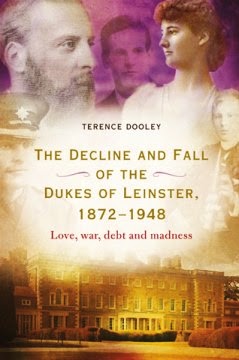
Newly published by Four Courts Press, The decline and fall of the dukes of Leinster, 1872–-1948: love, war, debt and madness, by Terence Dooley, will be launched on Thursday 5 June in The Carlton Suite, Carton House, Maynooth, Co Kildare. The event will be hosted by Conor Mallaghan.

The book tells the story of how, in a 70-year period, the dukes of Leinster fell from being Irelandʼs premier aristocratic family, close friends of the British monarchy, secure within the worldʼs most powerful empire, to relative obscurity in an independent Irish Free State (Irish Republic after 1949) that did not recognize titles.

And while in 1872, when this work opens, the 3rd duke of Leinster resided in some grandeur in the Palladian Carton House, the 7th duke would die impoverished in a one-room bedsit flat in St Georgeʼs Drive, Westminster, London, just over a century later in 1976.

The Leinster story moves from the small town of Maynooth, Co. Kildare, to London, to continental Europe, to an asylum in Edinburgh, to the US, before completing the circle and ending back in Maynooth in the 1940s.

The narrative of the family's decline and fall unfolds against such historical watersheds as the Land War of the 1880s; the simultaneous rise of the Home Rule movement; the breakup of Irish landed estates after 1903; the Great War of 1914-18; the revolutionary turmoil of 1916-23; and the 1920s global economic depression. The impact of such events has featured prominently in the historiography of the decline of the Irish landed class, both north and south. However, little attempt has been made to combine that history with private lives and experiences.

This book sets out to rectify this. In the process, it reveals the tragic personal story of Hermione, 5th duchess of Leinster, and her three sons, gathered from sources previously unused by historians of the Leinsters.

Terence Dooley is associate professor and director of the Centre for the Study of Historic Irish Houses and Estates, NUIM. He is the author of several books on country houses and the land question in 19th- and 20th-century Ireland; his most recent is an edited volume with Christopher Ridgway, The Irish country house: its past, present and future (2011).

If you'd like to attend the launch, let the publishers know by email or phone: +353 (0)1 453 4668

The 304-page, colour illustrated book is available now from Four Courts Press. ISBN: 978-1-84682-533-0, Catalogue Price: €24.95; Web Price: €22.45.

Sunday, 1 June 2014

RCBLibrary: latest news re Church of Ireland registers

Two great items of news from the Representative Church Body Library (RCBL) in Dublin...

Archive of the Month – June – Transcriptions of Taughboyne registers released
The RCBL has released online transcriptions of the surviving registers for three of the Taughboyne parishes in the Laggan Valley of north east Donegal. The painstaking transcription work has been carried out by the rector, the Revd Canon David Crooks.

The registers contain entries up to 1900, as follows:
  • Taughboyne, from 1820 onwards
  • All Saints Newtowncunningham (parish carved out of Taughboyne, 1871), from 1877
  • Killea (parish joined Taughboyne group in 1969), from 1877 for baptisms; 1845 for marriages; 1880 for burials
  • Craigadooish (chapel of ease), baptisms from 1871 to 1907
The printed transcripts, together with a digital copy of each have been presented by Canon Crooks to the RCB Library, and it is these transcripts that are available from today here.

Canon David Crooks said: “In my 30 years in Taughboyne Group of parishes, I have been contacted many times by people seeking information about their ancestors from our records. This involves painstaking research, trawling through old volumes to find the information required. Each time, the old books deteriorate a bit more.

“Although it is time consuming, the task of transcribing the records onto disc was very interesting, opening up a window into the lives of our ancestors who worshipped in this same place. Modern technology makes the whole task infinitely easier, and the finished product makes the task of obtaining information very much easier, too."  

Advance notice of Archive of the Month – July – Updated listing of locations of registers
Taughboyne, All Saints, Killea and Craigadooish are examples of parishes that retain their original registers in local custody, but which will soon be transferred to the RCBL. The RCBL is the official place of deposit for all non-current Church of Ireland parish registers in the Republic of Ireland – and indeed a growing number of post-disestablishment collections from Northern Ireland.

Recent developments will be apparent when the RCBL publishes next month's Archive: an updated and accurate Table of Church of Ireland Parish Registers throughout Ireland. This is the first time the listing/table has been made available online and will be a huge boon to researchers.

It's being redesigned, too, to provide a colour-coded alphabetical list of the surviving baptisms, marriages and burials for each parish, as well as information about what materials were lost (mostly as a result of the 1922 catastrophe at the Public Records Office of Ireland during the Irish Civil War); and finally where the vast quantity of surviving materials may now be consulted.

This list accounts for no less than 1091 Church of Ireland parish register collections now safely housed and available to researchers in the RCB Library.

It also gives details of around 500 collections, including those for Taughboyne, All Saints, Killea and Craigadooish, which remain in local custody ie in their parishes.