The third and final seminar in the Maps and Texts: using the Irish Historic Towns Atlas – Georgian and Victorian Towns series will be held in Academy House, 19 Dawson Street, Dublin 2 on Friday 23 May.
The series, which started in 2012, compares towns from a chronological and interdisciplinary perspective. This year's seminar will focus on urban development in the 18th and 19th centuries and themes under the spotlight will be towns with military barracks, the Big House and town improvement, canals, railways, public buildings and valuation maps. The plenary paper will focus on the capital and will preview the imminent publication of Irish Historic Towns Atlas, no. 26, Dublin, part III, 1756 to 1847 by Rob Goodbody.
Speakers include Toby Barnard, Arnold Horner, David Fleming, Jacinta Prunty, Helene Bradley, Frank Cullen, Rob Goodbody and David Dickson. You can download the full programme here.
It's free to attend the seminar but you need to book by email or phone +353-1-6762570 ext. 207.

Tuesday, 6 May 2014
Certificate in Oral History course starts in September
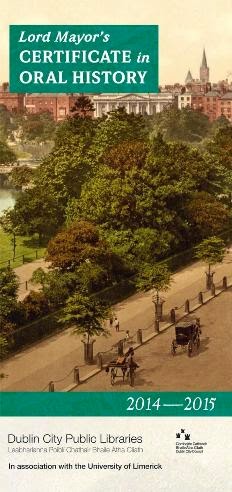
The course is designed to equip participants with skills in the preparation and conduct of oral history projects, including best practice in the collectino and archiving of oral history interviews. It will examine the wealth of recorded oral narrative sources in Ireland in both oral history and folklore.
It runs from September to April next year.
There's a fee of €500 and the deadline for applications is 29 August.
Two bursaries are available (closing date 14 August, email cityarchives@dublincity.ie).
To download the Lord Mayor’s Certificate in Oral History course brochure (2Mb pdf), click the picture, right.
Monday, 5 May 2014
Irish Lives Remembered May/June issue published

Now being produced to a bi-monthly, rather than monthly, schedule, the magazine has gone pink on its cover to welcome the Giro d'Italia to the island (the race gets underway on Friday 9 May in Belfast and two days later heads south through County Louth, where the publishers of ILR are based, en route to Dublin).
For the same reason, the cover photo features some fine looking chaps from Waterford Bicycle Club in 1909.
The research focus of this issue is County Carlow, the second smallest of Ireland's counties and a place close to my heart (I spent much of my childhood within spitting distance of the Barrow).
As well as details of Carlow Library's local studies department and archives, there's a feature about poet Carol Ann Duffy's roots in Hacketstown, pretty Rathvilly and the county town; a Q&A with John Nolan of Bagenalstown who is now based in the UK and involved with the Carlow Association London; and a piece by historian and author Turtle Bunbury who takes the reader through the eleven generations of his family who called the county home.
Genealogist Joe Buggy looks at finding Irish ancestors in New Hampshire, Shauna Hicks goes hunting for the same in the Australian Capital Territory and Brett Irwin seeks out American Civil War and slavery records in the Public Record Office of Northern Ireland.
There's also a feature about Ned Kelly and his family, an overview of genealogical resources at Newry and Mourne Museum, a piece about the Genealogical Society of Ireland and an analysis of two photos – one a young girl from the 1890s, the other a wedding party from 1914 taken at the Lafayette Studio in Dublin.
All this and more in the May/June issue, which can be viewed free of charge here.
Irish genealogy and history events this week: 5–11 May
The National Commemoration of the Famine is now underway in Strokestown, Co Roscommon and includes a week-long programme of events. You can download the full programme here, but I've included the lectures in the daily listing below:
Monday 5 May: The Quaker involvement in famine relief, with Rob Goodbody. Host: County Roscommon Historical & Archaeological Society. Venue: Strokestown Famine Museum. 7.00pm. Tel: 090 6626400.
Monday 5 May: The Famine Irish, lecture, with Dr Ciaran Reilly, and exhibition launch: The Famine Irish – Faces from County Roscommon. Host: Stokestown Park House. Venue: Strokestown Famine Museum. 8:30pm.
Tuesday 6 May: Professional genealogy, a workshop for those working towards becoming a professional Irish genealogist. Host: The Association of Professional Genealogists of Ireland (APGI). Venue: Helen Roe Theatre, Royal Society of Antiquaries of Ireland, 63 Merrion Square, Dublin 2. Booking essential. Details: info@apgi.ie
Tuesday 6 May to Thursday 8 May Genealogy talk, with Mary Skelly. Host and venue: Strokestown Genealogy Centre, Co Roscommon. Daily: lecture at 2pm; Centre open 10am to 3pm. Details: 071 9633380.
Tuesday 6 May: Belfast's industry and infrastructure, 1750 – 1911, with Dr Fred Hammond. Venue: PRONI, Titanic Boulevard, Belfast. 1pm. Free. Must book by email to proni@dcalni.gov.uk or telephone 02890 534800.
Tuesday 6 May: Do the Irish Speak English? with Dr Terry Dolan. Host: Kilmacanogue History Society. Venue: Glenview Hotel, Glen of the Downs, Co Wicklow. 8:30pm. Entry: €2 members/€3 non-members. All welcome.
Wednesday 7 May: Ceili Tales - Performance and Community Ceili Evening. Culmination of children's research project focussing on Irish migration to Northeast England. (Research co-ordinated by the Irish Genealogical Research Society). Venue: Daltons, The Customs House, South Shields NE33 1ES, UK. 7pm. Free. Email for tickets.
Wednesday 7 May: Plain people of the famine, with Professor Mark McGowan exploring strategies for uncovering Roscommon migrants of 1847 from the Canadian side. Venue: Strokestown Famine Museum, Co Roscommon. 8pm.
Wednesday 7 May: Not just Ned, the Irish in Australia, with Dr Richard Reid. Second in the History Downunder Talks series. Host: Keith Cameron Chair of Australian History, UCD. Venue: Boston College, 42 St Stephen’s Green, Dublin 2. 6pm. Free. Open to all. Details.
Wednesday 7 May: Michael Collins - Irelands Greatest, a screening and discussion. Host: Birmingham Irish Heritage Group. Venue: The Connaught Bar, High Street, Deritend, Birmingham, UK. Free. 7pm. Tel for info: +44 0121 604 6111.
Thursday 8 May: Enniskerry in 1914, with Jim Scanell. Host: Enniskerry Historical Society. Venue: Powerscourt Arms Hotel, Enniskerry, Co Wicklow. 8:30pm.
Thursday 8 to Friday 9 May: The country house and the Great War – the European experience, conference. Host: Centre for the Study of Irish Historic Houses and Estates. Venue: Aula Maxima, South Campus, NUI Maynooth. Programme and booking.
Thursday 8 May: Na Blianta Luatha – The Early Years of the Irish Language Movement in Northern Ireland, with Aodán Mac Póilin. This talk will be delivered in English with some Irish. Venue: PRONI, Titanic Boulevard, Belfast. 1pm. Free. Must book by email to proni@dcalni.gov.uk or telephone 02890 534800.
Thursday 8 May: Forgotten heroes – women, children and charity during the Great Hunger, with Professor Christine Kinealy. Venue: Strokestown Park House, Co Roscommon. 8pm.
Thursday 8 May: The wrecking of the RMS Tayleur, with Gill Hoffs. Venue: Irish World Heritage Centre, Irish Town Way, Cheetham Hill, Manchester M8 0AE, UK. 7:30pm. £5.
Friday 9 May: One minute's silence will be observed throughout County Roscommon to commemorate the Famine. 12noon.
Friday 9 May: The Early years of the Irish Language Movement in Northern Ireland, with Aodan Mac Poilin. Venue: PRONI, Titanic Boulevard, Belfast. 1-2pm. Free, but booking is essential at proni@dcalni.gov.uk or tel: 028 9053 4800. The talk will be delivered in English with some Irish.
Friday 9 May: The plight of females in the Famine, with Dr Ciarán Reilly. Venue: Strokestown Park House, Co Roscommon. 8pm. For details: John O Driscoll 071 9633013.
Friday 9 May: Traditional American Wake. A re-enactment. Hosted by SCDA. Venue: Hayden’s Cottage, Bridge Street, Strokestown, Co Roscommon. 9:30pm. For more details phone Henry Owens on 087 907 4869.
Saturday 10 May: Irish Genealogical Research Society Open Day & AGM. 10:30am to 3pm. Two lectures: Unlocking your deep and recent ancestry with DNA, with Maurice Gleeson, and Irish Heraldry: an overview for the genealogist, with Gerard Crotty. Venue: 34 Chepstow Villas, Bayswater, London. £25 members; £30 non-members. Includes light buffet and refreshments. All welcome. Booking essential. Details.
Saturday 10 May: The Famine, an afternoon of lectures. ’There is no person starving here’: Australian responses to the Great Famine, with Dr Richard Reid at 1:30pm; Remembering and commemorating the Great Famine in Australia, with Dr Perry McIntyre at 2pm; The making of the Irish National Famine Museum at Strokestown, with Professor Terence Dooley at 3pm; The Great Famine and the Great War – Writing the history of calamity, wtih Professor Vincent Comerford at 4pm. Venue: Strokestown Park House, Co Roscommon. More details: John O Driscoll 071 9633013.
Saturday 10 May: Genealogy Workshop – practical tips, with Mayo Genealogy Group. Venue: National Museum of Ireland, Country Life, Turlough, Castlebar, Co Mayo. 11am–1pm. Free. Non-members welcome. Details.
Sunday 11 May: National Commemmoration of the Great Famine. Ceremonies taking place across Ireland, but the National ceremony will be taking place in Strokestown at 2:30pm. This event is open to the public and everyone is invited to come along to the solemn and fitting commemoration of the Great Famine.
Sunday 11 May: The Great War trench systems of the Curragh and a site visit to Flagstaff Hill. Host: Kilcullen WW1 Commemoration Group. Venue: Heritage Centre, Kilcullen, co Kildare. Admission free. Email for details, or tel: 045 482193.
Monday 5 May: The Quaker involvement in famine relief, with Rob Goodbody. Host: County Roscommon Historical & Archaeological Society. Venue: Strokestown Famine Museum. 7.00pm. Tel: 090 6626400.
Monday 5 May: The Famine Irish, lecture, with Dr Ciaran Reilly, and exhibition launch: The Famine Irish – Faces from County Roscommon. Host: Stokestown Park House. Venue: Strokestown Famine Museum. 8:30pm.
Tuesday 6 May: Professional genealogy, a workshop for those working towards becoming a professional Irish genealogist. Host: The Association of Professional Genealogists of Ireland (APGI). Venue: Helen Roe Theatre, Royal Society of Antiquaries of Ireland, 63 Merrion Square, Dublin 2. Booking essential. Details: info@apgi.ie
Tuesday 6 May to Thursday 8 May Genealogy talk, with Mary Skelly. Host and venue: Strokestown Genealogy Centre, Co Roscommon. Daily: lecture at 2pm; Centre open 10am to 3pm. Details: 071 9633380.
Tuesday 6 May: Belfast's industry and infrastructure, 1750 – 1911, with Dr Fred Hammond. Venue: PRONI, Titanic Boulevard, Belfast. 1pm. Free. Must book by email to proni@dcalni.gov.uk or telephone 02890 534800.
Tuesday 6 May: Do the Irish Speak English? with Dr Terry Dolan. Host: Kilmacanogue History Society. Venue: Glenview Hotel, Glen of the Downs, Co Wicklow. 8:30pm. Entry: €2 members/€3 non-members. All welcome.
Wednesday 7 May: Ceili Tales - Performance and Community Ceili Evening. Culmination of children's research project focussing on Irish migration to Northeast England. (Research co-ordinated by the Irish Genealogical Research Society). Venue: Daltons, The Customs House, South Shields NE33 1ES, UK. 7pm. Free. Email for tickets.
Wednesday 7 May: Plain people of the famine, with Professor Mark McGowan exploring strategies for uncovering Roscommon migrants of 1847 from the Canadian side. Venue: Strokestown Famine Museum, Co Roscommon. 8pm.
Wednesday 7 May: Not just Ned, the Irish in Australia, with Dr Richard Reid. Second in the History Downunder Talks series. Host: Keith Cameron Chair of Australian History, UCD. Venue: Boston College, 42 St Stephen’s Green, Dublin 2. 6pm. Free. Open to all. Details.
Wednesday 7 May: Michael Collins - Irelands Greatest, a screening and discussion. Host: Birmingham Irish Heritage Group. Venue: The Connaught Bar, High Street, Deritend, Birmingham, UK. Free. 7pm. Tel for info: +44 0121 604 6111.
Thursday 8 May: Enniskerry in 1914, with Jim Scanell. Host: Enniskerry Historical Society. Venue: Powerscourt Arms Hotel, Enniskerry, Co Wicklow. 8:30pm.
Thursday 8 to Friday 9 May: The country house and the Great War – the European experience, conference. Host: Centre for the Study of Irish Historic Houses and Estates. Venue: Aula Maxima, South Campus, NUI Maynooth. Programme and booking.
Thursday 8 May: Na Blianta Luatha – The Early Years of the Irish Language Movement in Northern Ireland, with Aodán Mac Póilin. This talk will be delivered in English with some Irish. Venue: PRONI, Titanic Boulevard, Belfast. 1pm. Free. Must book by email to proni@dcalni.gov.uk or telephone 02890 534800.
Thursday 8 May: Forgotten heroes – women, children and charity during the Great Hunger, with Professor Christine Kinealy. Venue: Strokestown Park House, Co Roscommon. 8pm.
Thursday 8 May: The wrecking of the RMS Tayleur, with Gill Hoffs. Venue: Irish World Heritage Centre, Irish Town Way, Cheetham Hill, Manchester M8 0AE, UK. 7:30pm. £5.
Friday 9 May: One minute's silence will be observed throughout County Roscommon to commemorate the Famine. 12noon.
Friday 9 May: The Early years of the Irish Language Movement in Northern Ireland, with Aodan Mac Poilin. Venue: PRONI, Titanic Boulevard, Belfast. 1-2pm. Free, but booking is essential at proni@dcalni.gov.uk or tel: 028 9053 4800. The talk will be delivered in English with some Irish.
Friday 9 May: The plight of females in the Famine, with Dr Ciarán Reilly. Venue: Strokestown Park House, Co Roscommon. 8pm. For details: John O Driscoll 071 9633013.
Friday 9 May: Traditional American Wake. A re-enactment. Hosted by SCDA. Venue: Hayden’s Cottage, Bridge Street, Strokestown, Co Roscommon. 9:30pm. For more details phone Henry Owens on 087 907 4869.
Saturday 10 May: Irish Genealogical Research Society Open Day & AGM. 10:30am to 3pm. Two lectures: Unlocking your deep and recent ancestry with DNA, with Maurice Gleeson, and Irish Heraldry: an overview for the genealogist, with Gerard Crotty. Venue: 34 Chepstow Villas, Bayswater, London. £25 members; £30 non-members. Includes light buffet and refreshments. All welcome. Booking essential. Details.
Saturday 10 May: The Famine, an afternoon of lectures. ’There is no person starving here’: Australian responses to the Great Famine, with Dr Richard Reid at 1:30pm; Remembering and commemorating the Great Famine in Australia, with Dr Perry McIntyre at 2pm; The making of the Irish National Famine Museum at Strokestown, with Professor Terence Dooley at 3pm; The Great Famine and the Great War – Writing the history of calamity, wtih Professor Vincent Comerford at 4pm. Venue: Strokestown Park House, Co Roscommon. More details: John O Driscoll 071 9633013.
Saturday 10 May: Genealogy Workshop – practical tips, with Mayo Genealogy Group. Venue: National Museum of Ireland, Country Life, Turlough, Castlebar, Co Mayo. 11am–1pm. Free. Non-members welcome. Details.
Sunday 11 May: National Commemmoration of the Great Famine. Ceremonies taking place across Ireland, but the National ceremony will be taking place in Strokestown at 2:30pm. This event is open to the public and everyone is invited to come along to the solemn and fitting commemoration of the Great Famine.
Sunday 11 May: The Great War trench systems of the Curragh and a site visit to Flagstaff Hill. Host: Kilcullen WW1 Commemoration Group. Venue: Heritage Centre, Kilcullen, co Kildare. Admission free. Email for details, or tel: 045 482193.
Saturday, 3 May 2014
1908 to 1910 Dublin City electoral lists now online
Dublin City Libraries have completed the digitisation of another two years of the Dublin City Electoral Lists, so there are now three years of entries – for 1908, 1909 and 1910, a total of 160,000 records – available for free searching on dublinheritage.ie.
The lists hold the names of Dublin's residents and those who owned property in the city and who were registered to vote in the local and the parliamentary elections. There were some additional qualification criteria which narrowed down the numbers eligible to vote somewhat. Only around one-sixth of the city's population were registered.
The lists were introduced after the Local Government (Ireland) Act 1898 gave the vote (in local elections only) to all adult men and women over the age of 30; this was the first step towards universal adult franchise, which was achieved in 1921. You can find out more about the electoral lists here.
The Dublin City Electoral Lists Project aims to digitise all of the Dublin City Council Electoral Lists from 1898 to 1916. It forms part of the City Council's programme for the Decade of Commemorations.
The original lists are held by Dublin City Library & Archive at 138-144 Pearse Street, Dublin 2.
The lists hold the names of Dublin's residents and those who owned property in the city and who were registered to vote in the local and the parliamentary elections. There were some additional qualification criteria which narrowed down the numbers eligible to vote somewhat. Only around one-sixth of the city's population were registered.
The lists were introduced after the Local Government (Ireland) Act 1898 gave the vote (in local elections only) to all adult men and women over the age of 30; this was the first step towards universal adult franchise, which was achieved in 1921. You can find out more about the electoral lists here.
The Dublin City Electoral Lists Project aims to digitise all of the Dublin City Council Electoral Lists from 1898 to 1916. It forms part of the City Council's programme for the Decade of Commemorations.
The original lists are held by Dublin City Library & Archive at 138-144 Pearse Street, Dublin 2.
Origins offers 20% discount for May holiday
It's the May bank holiday weekend across the geographical British Isles, and Origins.net is taking the opportunity to offer a 20% discount on its annual subscriptions. The offer is available only until Tuesday, so be sure to act quickly.
The annual subscription includes access to British Origins, Irish Origins and the National Wills Index, the latter being the largest online resource for pre-1858 English probate material. While the British Origins line-up includes records dating back to the 1200s, the Irish Origins package is well-known for its excellent collection of directories (77 of them at the last count) and its Griffiths Valuation maps.
The regular price of an annual subscription is £55. To take advantage of the discount, follow these instructions from Origins.net:
1. Go to the subscription page of Origins.net
2. Select Origins Total Access Annual Subscription Package and click 'Subscribe'.
3. New to Origins.net? Enter MayBank2014 in the Promotion Code box at Registration
4. Or Login and enter MayBank2014 in the Promotion Code box at Checkout.
5. Start exploring over 130 million British and Irish family history records on Origins.net!
The offer is valid until Tuesday 6 May 2014 midnight (GMT) on first subscription payment.
* Kent Will Abstracts 1328-1691 have been added to the National Wills Index only this week.
The annual subscription includes access to British Origins, Irish Origins and the National Wills Index, the latter being the largest online resource for pre-1858 English probate material. While the British Origins line-up includes records dating back to the 1200s, the Irish Origins package is well-known for its excellent collection of directories (77 of them at the last count) and its Griffiths Valuation maps.
The regular price of an annual subscription is £55. To take advantage of the discount, follow these instructions from Origins.net:
1. Go to the subscription page of Origins.net
2. Select Origins Total Access Annual Subscription Package and click 'Subscribe'.
3. New to Origins.net? Enter MayBank2014 in the Promotion Code box at Registration
4. Or Login and enter MayBank2014 in the Promotion Code box at Checkout.
5. Start exploring over 130 million British and Irish family history records on Origins.net!
The offer is valid until Tuesday 6 May 2014 midnight (GMT) on first subscription payment.
* Kent Will Abstracts 1328-1691 have been added to the National Wills Index only this week.
Friday, 2 May 2014
May bank holiday opening/closing arrangements
Monday 5 May is a public (bank) holiday in both the Republic of Ireland and Northern Ireland, so no state-controlled libraries, archives or other repositories will be open, but please note the following:
- In the Republic, most city and town libraries are closed not just on Monday but also on Saturday 3 May.
- The Linen Hall Library in Belfast will open normal Saturday hours ie 9:30am to 4:00pm.
- While the Reading Room of the National Library of Ireland in Dublin will operate to normal weekend hours (Saturday 9:30am to 12:45pm; Sunday closed), it will not open on Monday.
- Exhibitions at the National Library of Ireland will be open on Saturday and Sunday as usual (Kildare Street: Saturday 9.30am–4.45pm; Sunday: 1:00pm–4:45pm. National Photographic Archive in Temple Bar: Saturday 10:00am–5.00pm; Sunday: 12:00pm–5.00pm). Bank holiday Monday opening will be from 12pm to 5pm only at both locations.
Free talk, 7 May: 'Not just Ned' – the Irish in Australia
 |
| The exhibition was held at the National Museum of Australia in 2011 |
Called Not Just Ned, the talk will be given by Dr Richard Reid who put together an exhibition of the same name at the National Museum of Australia about the Irish in Australia (see exhibition website).
Dr Reid will be speaking about the the lengths he had to go to in scouring Ireland and Australia in order to locate objects for the exhibition and will explain the fascinating stories behind a number of them.
Many hoped the exhibition would come to Ireland after it had completed its Australian run, but there was insufficient funding to do so and the objects were returned to their owners, never to be assembled again. This talk will provide a unique opportunity to see what Ireland missed out on.
This presentation is the second of the History Downunder Talks series which is hosted by the Keith Cameron Chair of Australian History at University College Dublin.
Venue: Boston College, 42 St Stephen’s Green, Dublin 2.
Date and time: Wednesday 7 May, 6pm.
Access: Free. Open to all.
Ireland Genealogy Projects Archives: latest uploads
Here's a list of what's been added to IGP-Web in the last two weeks of April. A big chunk of the upload has seen text transcriptions added to the Fermanagh files which previously had only a file name. There's still a few hundred of these in the pipeline.
GENERAL IRELAND Genealogy Archives – Census
Assorted Census Fragments 1841/1851
DERRY/LONDONDERRY Genealogy Archives – Census Substitutes
Londonderry Hearths, Chimnies & Fireplaces, 1663
Parish Of Comber. Hearths, Chimneys And Fireplaces. 1663
Parish Of Clandermoyt. Hearths, Chimneys And Fireplaces. 1663
Faughanvale Hearths, Chimnies & Fireplaces, 1663
FERMANAGH Genealogy Archives – Church
Ballyshannon Births (Kilbarron) C. Of I. 1785-1876
Irvinestown Baptisms Methodist Circuit 1829-1913
Irvinestown Marriages Methodist Circuit 1839-1927
Kilskeery C.of I. Baptisms 1767-1872
FERMANAGH Genealogy Archives – Headstones
Derrylin, Kinawley Parish Church (CoI) - Transcription added
WICKLOW Genealogy Archives – Church
Killiskey Parish Church, Ashford. List of Registered Vestry Men, 1870
GENERAL IRELAND Genealogy Archives – Census
Assorted Census Fragments 1841/1851
DERRY/LONDONDERRY Genealogy Archives – Census Substitutes
Londonderry Hearths, Chimnies & Fireplaces, 1663
Parish Of Comber. Hearths, Chimneys And Fireplaces. 1663
Parish Of Clandermoyt. Hearths, Chimneys And Fireplaces. 1663
Faughanvale Hearths, Chimnies & Fireplaces, 1663
FERMANAGH Genealogy Archives – Church
Ballyshannon Births (Kilbarron) C. Of I. 1785-1876
Irvinestown Baptisms Methodist Circuit 1829-1913
Irvinestown Marriages Methodist Circuit 1839-1927
Kilskeery C.of I. Baptisms 1767-1872
FERMANAGH Genealogy Archives – Headstones
Derrylin, Kinawley Parish Church (CoI) - Transcription added
WICKLOW Genealogy Archives – Church
Killiskey Parish Church, Ashford. List of Registered Vestry Men, 1870
Thursday, 1 May 2014
New blog launched for 18th-century enthusiasts
A new blog has launched today that will be of interest to the historians among you and to those what want to know more about the times their ancestors lived through.
It's The Eighteenth-Century Ireland Blog and it'll be published by the 18th-century Ireland Society: ECIS.
To mark the launch, the editors – Lisa Marie Griffith and Suzanne Forbes – have teamed up with Four Courts Press to offer the chance to win one of these two excellent titles:
It's The Eighteenth-Century Ireland Blog and it'll be published by the 18th-century Ireland Society: ECIS.
To mark the launch, the editors – Lisa Marie Griffith and Suzanne Forbes – have teamed up with Four Courts Press to offer the chance to win one of these two excellent titles:
- Irish provincial cultures in the long eighteenth century: Essays for Toby Barnard,
Raymond Gillespie & R. F. Foster (eds)
- Clubs and societies in eighteenth-century Ireland,
James Kelly & Martyn J. Powell (eds)
Subscribe to:
Posts (Atom)