Tuesday, 7 August 2018

New study to examine the food our Irish ancestors ate

A new five year project, led by Tipperary-born Dr Susan Flavin of Anglia Ruskin University, has received €1.5million funding to examine Ireland’s food culture in the 16th and 17th century.

Written records of consumption in this period tend to focus on the island's wealty households and offer few details of the average diet. The project team will therefore include archaeobotany, zooarchaeology, isotope and organic residue analysis experts, who will test pottery and bone to build a detailed picture of what was eaten, where, why and by whom, and its likely effects at an individual level. A database will also be developed to map the archaeological and dietary evidence across different regions of Ireland and different social contexts.

This level of detail into what was on the menu before the Famine has not been attempted before.

The 16th and 17th centuries witnessed significant changes in the Irish diet, with the introduction of new foreign foods to the dining tables of the elite.

Dr Flavin, Senior Lecturer in History at Anglia Ruskin University and author of Consumption and Culture in Sixteenth-Century Ireland, said: “Ireland presents a unique case study for understanding the dynamic role of food and drink in a society undergoing political and cultural change.

“There is a perception that Ireland remained isolated from the major dietary changes that occurred across early modern Europe, but my research suggests a much more complex and integrated picture.

“Trade was booming in 16th-century Ireland, there was colonisation and immigration from England, Scotland, Wales, France and the Netherlands, and there is evidence that certain global tastes filtered into the country.

“Foreign luxuries such as sugar, turkeys, pineapples and artichokes found their way into the homes of the elite. We also know that at the lower levels of society the European fashion for hopped beer, and with it continental drinking rituals, was embraced by both men and women. At the same time, new ways of ‘civilised’ eating and drinking were accepted, even among some in the lower classes of society.”

The €1.5million funding comes from a European Research Council Starting Grant, designed to support 'outstanding researchers' lead ambitious projects. Dr Flavin will be supported by academics from University College Dublin, the Institute of Technology Sligo, Durham University and the University of Bristol.

You can read a short 2017 Belfast Telegraph report into Dr Flavin's research into the important role of beer in 16th-century Ireland here.

Monday, 6 August 2018

Ancestry UK offers free access to 30m military records

To mark the centenary of World War One, Ancestry.co.uk is offering free access to more than 30million military records over the next three days.

http://www.dpbolvw.net/click-5737308-10819001?url=https%3A%2F%2Fwww.ancestry.co.uk%2Fcs%2Ffree-accessAmong the record sets featuring in the free access collection are British, Canadian, South African and Anzac records including British Army WWI Pension Records 1914-1920; UK Military Campaign Medal and Award Rolls, 1793-1949; Royal Hospital Chelsea Pensioner Admissions and Discharges, 1715-1925; Royal Navy Registers of Seamen's Services, 1848-1939; and UK Shipping and Seamen WWI and WWII Rolls of Honour, 1914-1945.

Obviously, there are a lot of Irish service personnel to be found in these military sets, but there are also the following three specifically Irish collections to be checked out:

Ireland, Casualties of World War I, 1914-1922
Ireland, Royal Irish Constabulary Pensions, 1873-1925
Ireland, Royal Hospital Kilmainham Pensioner Discharge Documents, 1724-1924

See the full list of military collections featured in the free access promotion here.

Free access to the featured collection will run until 23:59pm on Thursday 9 August.

Click the image above to start searching. To view the records you'll need to have a free registered account. If you don't already have one, you will need to register with your name and email address; Ancestry will then send you a username and password to access the collection.

IGRS launches 1799 census of Carrick-on-Suir, County Tipperary

The Irish Genealogical Research Society is launching a new online database: a census – or statistical survey – of the County Tipperary town of Carrick-on-Suir. It was compiled in 1799 and notes vital biographical details about the town’s entire population; people from all walks of life, both Catholic and Protestant, numbering just under 11,000.

Nick Reddan FIGRS created the database
The census was compiled by Lieutenant-Colonel William Morton Pitt of the Dorset Militia, a member of parliament at Westminster who represented Dorset constituencies from 1780 to 1826. Pitt was assisted in compiling the census by local men Francis White and Patrick Lynch.

Its purpose isn’t clear, but it seems likely to be connected with Pitt’s unsuccessful attempt to gain preferment as a commissioner of the Irish union from his relative and namesake, William Pitt, the Prime Minister.

The original manuscript is now held by the British Library, London. Arranged by street, it comprises data on 1,738 homes and 10,907 individuals.

Australia-based Nick Reddan, a Fellow of the Society and its webmaster, transcribed the manuscript and created the database, which records the names of inhabitants, their sex, age, occupation, religion, address and marital status. To view a sample entry, click the image below.

https://drive.google.com/file/d/19hG31hqcPPLGzJp17rZgvzXNxXJf7r9P/view?usp=sharing
A sample from the 1799 census. Click image for enlarged view

Launching the new resource, IGRS chairman Steven Smyrl said: "Gems like the 1799 census substitute for the town of Carrick-on-Suir are rarities that need to be carefully preserved and given the widest possible public exposure. Pitt’s manuscript is unusual for being so extensive and this has proved to be the reason it has taken until now to put it in the public domain.

“Nick Reddan’s careful work in transcribing this material has ensured it will now, finally, be easily accessible online to answer queries regarding the lives of the people of Carrick-on-Suir living over 200 years ago.”

The Society acknowledges with thanks the kind permission of the British Library to publish the data contained in the Pitt manuscript.

Search the database here:

Full Database – Members only.
Surname Count – Free to all.

Irish genealogy, history & heritage events, 5-19 August

Monday 6 August: Public Holiday in Republic of Ireland only. All repositories and libraries closed (except National Library of Ireland's exhibitions). Free genealogy advisory services at National Library and National Archives of Ireland will not operate.

Monday 6 August: The Great Watershed – Belfast before and after the First World War, with Roger Dixon. First of the Eastside Arts Festival 2018 lunchtime lectures. Host and Venue: PRONI, Belfast. 1pm. Free. CANCELLED.

Wednesday 8 August: Carson's betrayal of Women? Unionist attitudes to female suffrage 1912-14, with Jason Burke. Eastside Arts Festival 2018 lectures. Host and Venue: PRONI, Titanic Blvd, Belfast. 1pm. Free. Need to book. Details.

Thursday 9 August: Shellshock in WW1, with Dr Stefanie Linden. Host: Western Front Association, Antrim and Down branch. Venue: PRONI, Titanic Boulevard, Belfast BT3 9HQ. 6:30pm. All welcome. Free. No need to book.

Friday 10 August: The Dreams Must be Dreamed: The life and times of Charlotte Despard, with Philip Orr. Third of the Eastside Arts Festival 2018 lunchtime lectures. Host and Venue: Public Record Office of Northern Ireland, Titanic Boulevard, Belfast. 1pm. Free, but need to book. Details.

Friday 10 and Saturday 11 August: Celtic Connections Conference. Hosts: The Irish Ancestral Research Association (TIARA) & The Irish Genealogical Society International (IGSI). Venue: Boston Marriott Newton 2345 Commonwealth Avenue, Auburndale, MA, USA. Several Irish-themed lectures will be presented over the two days by well-known Irish genealogists from Ireland, UK and North America. Details.

Saturday 11 August: Researching your family history - a drop-in session with Mayo Genealogy Group. Host and venue: Museum of Country Life, Turlough Park, Castlebar, Co Mayo. 11:30am–1pm. Free.

Monday 13 August: NLI Reading Room and Manuscript Room closed. Venue: National Library of Ireland, Kildare Street, Dublin 2. On-going Monday closures are to facilitate extensive redevelopment of the premises. All other services/exhibitons/cafe, including Genealogy Advisory Service, will open at 11am (late opening is to facilitate a staff development meeting) and operate as normal from that time. Details.

Monday 13 August: The Military Service Pensions Collection: Dependants of the War of Independence and Civil War casualties, with Robert McEvoy. Host and venue: Richmond Barracks, off Bulfin Rd, Inchicore, Dublin 8. ‏11am. Tickets €5, includes tea/coffee & scone. Book or purchase at the door.

Tuesday 14 August to Saturday 18 August: Scots-Ulster Reunion & Conference, 5 days of tours, lectures, music, culture, and celebration. Host: Maine Ulster Scots Project. Venue: Bowdoin College, 255 Maine St, Brunswick, ME 04011, USADetails.

Thursday 16 August to Sunday 19 August: West Cork History Festival - lectures, performances, screenings (field trips all sold out). Venue: Rosebank, Russagh, Castletownshend Road, Skibbereen, Co. Cork (Rosebank is the the former dower house of the Liss Ard estate, less than a mile outside the town). All presentations/performances are in marquees. Programme and tickets.

Saturday 18 August: Máire Ní Murchú, the bean feasta/wisewoman of Beara, with Niamh Ní Lochlainn. Host Bere Island Project Group. Venue: Bere Island Heritage & Information Centre, Ballinakilla, Bere Island, Co Cork.  2.30pm. Details.

Saturday 18 August: Sharing family history stories, with Penny Bristol-Jones, Eilish Feeley and Marie Gillooly. Host and venue: Roscommon County Library, Abbey Street, Roscommon, Co. Roscommon. 10am to 12:30pm. Free. Details: T 0906 637272. Not suitable for under 12s.

Saturday 18 August: Genealogy workshop, with resident genealogist Lynn Brady. Host and Venue: Glasnevin Cemetery Museum, Finglas Rd, Botanic, Dublin 11. 2pm to 3:30pm. Free but booking required at booking@glasnevintrust.ie. Details.

Sunday 19 August: Family Genealogy Day. Learn how to research or consult a genealogist. Host and venue: Belderrig Community Centre, Belderrig, Ballina, Co. Mayo. 3pm to 5pm. Free. Everyone welcome, although not suitable for under 12s.

Thursday, 2 August 2018

Summer savings from Family Tree DNA

https://www.familytreedna.com/
There's a 20% discount on offer from Family Tree DNA, and it'll run throughout August.

It applies to a number of different products, but I'm only going to mention three here:

  • Family Finder (autosomal DNA) is down from US$79 to US$59, a saving of US$20
  • Paternal Ancestry (Y-DNA) is reduced from US$169 to US$129, a saving of US$40
  • Maternal Ancestry (Mt-DNA) is reduced from US$199 to US£149, a saving of US$50

For full details of these and all the Summer Savings offers, click the image above.

If you are already a customer of Family Tree DNA, you should log into your account to find even more enticing discounts available on upgrade tests.

GRO's online civil bmd registers: latest on progress

https://civilrecords.irishgenealogy.ie/churchrecords/civil-search.jspDon't get too excited, now.

Since the last upload of images of GRO's birth, marriage and death registers to IrishGenealogy.ie back in November, the expectation has been that the next tranche would be coming along this summer. That's certainly what I understood, anyway.

It seems the next release is running behind that schedule. The managers of IrishGenealogy.ie are currently anticipating the next batch to be ready for upload in November or thereabouts.

While this may be a bit later than expected, there is some good news within the delay. It is expected that the next batch will include all the outstanding historical records ie Marriage records from 1845 to 1869 and Death records from 1864 to 1877, and the 'top-up' years of Births in 1917, Marriages in 1942 and Deaths in 1967.

In the meantime, if you're desperate for more information than IrishGenealogy's Marriage and Death indexes provide, you might want to check out FamilySearch.org's recently updated collection – Ireland Civil Registration, 1845-1913.

This collection holds Birth records for the period 1864-1913, Marriages for 1845-1870, and Deaths for 1864-1870. There are no images of registers, but the transcriptions include a little more information than IrishGenealogy's simple index provides. See below for an example return from a search of the Marriage Index.


Wednesday, 1 August 2018

Dublin's Registry of Deeds to fully reopen on 2 August

Following essential maintenance works that have severely restricted researcher access over the last five weeks, the Registry of Deeds on Henrietta Street will be fully open from Thursday 2 August.

The Transcribing Room, which holds memorials of deeds from 1708-1832, reopened on 16 July, but the Transcribing Room Vault, which holds deeds from 1896-1910, has been closed throughout the works period.

All public areas will be accessible from 10am tomorrow..

Ireland Genealogy Projects Archives: latest additions

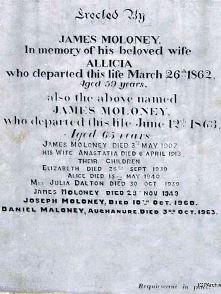
Below are the files uploaded to Ireland Genealogy Projects Archives (IGPA) in the last two weeks of July. They include a good number of photos + inscriptions of headstones (750 from Mount Jerome Cemetery alone), some transcriptions of baptism registers from the parish of Clones, and several files of transcriptions of memorials in Meath.

http://www.igp-web.com/IGPArchives/ire/laois/photos/tombstones/ballylinan/target58.html
100 years of death in the Moloney family,
who rest in Ballylinan/Ballylynan churchyard,
Co Laois. Photo courtesy of IGPA,
William Muldowney and Michael Brennan.
Click image for enlarged view.
The latter relate to photos of headstones that had already been added to IGPA as image-only files; the transcription work has now been carried out by IGPA volunteers.

DUBLIN Genealogy Archives - Headstones
Mount Jerome Cemetery, Parts 201-205

FERMANAGH Genealogy Archives - Headstones
Colaghty (CoI) Graveyard (Additional)

LAOIS Genealogy Archives - Headstones
Ballylinan Graveyard

MAYO Genealogy Archives - Headstones
Aghamore Old Cemetery

MEATH Genealogy Archives - Headstones
Bective, St. Mary's (CoI) Graveyard (Transcribed)
Knockcommon Old Cem., Beauparc (Transcribed)
Castletown Cemetery - New, Right Side (Transcribed)
Castletown Cemetery -  New Left Side (Transcribed)
Navan, St. Mary's (G-H & J-L) (Transcribed)

MONAGHAN & FERMANAGH Genealogy Archives - Church Records
Clones Parish Registers, Baptisms, 1800-1804
Clones Parish Registers, Baptisms, 1805-1808

Death of former AGI President Henry 'Harry' McDowell

Accredited Genealogists Ireland (AGI) has reported the death of one of its founding members and former presidents, Henry "Harry" McDowell.

A professional genealogist since the 1970s, Harry was one of Ireland's longest practising genealogists. He was elected a Fellow of the Irish Genealogical Research Society in 1989, served as President of the County Kildare Archaeological Society from 2000-2004 and was elected a Fellow of AGI in 2011.

In 2015, Dundalgan Press published Irregular Marriages in Dublin Before 1837 – his transcript of the surviving (clandestine) marriage registers of Dublin's Lutheran Reverend Schulze.

You can find out more about Harry and his contribution to Irish genealogy in AGI's tribute here.

RCBLibrary's 'Parish No.1’ (Shrule, Co. Longford) shows range of material available for parish histories

The Representative Church Body Library's
first collection of parish material came from Shrule.
Click image to download list of material.
August's Archive of the Month feature from the RCB Library provides a potted history of the repository and highlights the very first collection of parish material that came into the RCB's custody in 1926.

This early collection is from the Parish of Shule in County Longford and, together with additional materials transferred from the parish in the 1980s and 2010s, has been accessioned as parish collection or P.001.

In the feature, Dr Miriam Moffitt brings a professional historian’s perspective on the content of this particular collection and the array of supporting resources also available in the RCB Library that shine a light on the story of this particular Church of Ireland parish, and its community.

As well as focusing on the surviving content of the Shrule parish record collection itself, including baptismal, marriage and burial registers, the minutes of the vestry and select vestry meetings, preachers’ books, and sundry other materials, she supplements this with detail on the additional information available from such sources as diocesan visitations, magazines and the clerical succession lists, documenting the lives of individual clergy who served in a parish, as well as the rich and now searchable Church of Ireland Gazette which has been digitized and is available to 1936 inclusive here.