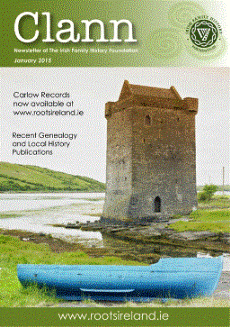
The latest edition of Clann, the quarterly newsletter of the Irish Family History Foundation, has been published.
As usual, it brings a round-up of additions to RootsIreland.ie over the last three months (all reported in Irish Genealogy News, of course!) and details of happenings and plans for the IFHF's network of Heritage/Genealogy Centres across the island.
There are also book reviews and a couple of articles.
It's free to view on-screen in flip-page mode or to download as a pdf. Just click the image.
Irish Genealogy News - Pages
Tuesday, 10 February 2015
Limerick's Genealogy Day returns on 14 March
Following last year's successful inaugural event when Limerick was Ireland's City of Culture, Genealogy Day will be returning to ChristChurch on Saturday 14 March.
The organisers are Christ Church United Presbyterian and Methodist Church in partnership with the Irish Ancestry Research Centre (IARC) and, as last year, they will be bringing together the historical church registers from several denominations in Limerick including Methodist, Presbyterian, the Religious Society of Friends in Ireland (Quaker) and the Church of Latter Day Saints (Mormon).
"It's an unusual event," says IARC's John King. "It invites the local community to take a rare opportunity to view original baptism and marriage records, to discuss local history and to sit down with experts to discover something about their own ancestors."
Genealogy Day will take place in Christ Church at 51A O'Connell Street at the start of the city's week-long St Patrick's Festival. It's completely free to attend and there's no need to book. Hours are 10am to 3pm. The day will conclude with a lecture on the Special Collections of the University of Limerick Library.
As well as the historical church registers, professional genealogical research services such as Eneclann, Find my Past, IARC and Limerick Genealogy will be attending. So too will institutional repositories such as Limerick Museum & Archives and the University of Limerick. Local groups such as the Irish Georgian Society and the Thomond Archaeological & Historical Society have also been invited.
The organisers are Christ Church United Presbyterian and Methodist Church in partnership with the Irish Ancestry Research Centre (IARC) and, as last year, they will be bringing together the historical church registers from several denominations in Limerick including Methodist, Presbyterian, the Religious Society of Friends in Ireland (Quaker) and the Church of Latter Day Saints (Mormon).
"It's an unusual event," says IARC's John King. "It invites the local community to take a rare opportunity to view original baptism and marriage records, to discuss local history and to sit down with experts to discover something about their own ancestors."
Genealogy Day will take place in Christ Church at 51A O'Connell Street at the start of the city's week-long St Patrick's Festival. It's completely free to attend and there's no need to book. Hours are 10am to 3pm. The day will conclude with a lecture on the Special Collections of the University of Limerick Library.
As well as the historical church registers, professional genealogical research services such as Eneclann, Find my Past, IARC and Limerick Genealogy will be attending. So too will institutional repositories such as Limerick Museum & Archives and the University of Limerick. Local groups such as the Irish Georgian Society and the Thomond Archaeological & Historical Society have also been invited.
Letters of 1916 project receives funding for outreach
![]() |
| Some 1700 letters have already been contributed |
The SFI's €1.6 million total funding will be shared by 39 initiatives designed to encourage people of all ages to develop an active and informed interest and involvement in science, technology, engineering and maths in Ireland. The financial support will allow the Letters of 1916 project to extend its outreach, with four Community Engagement Events planned for Enniscorthy, Wexford; Cork; Galway and Belfast this year.
The Letters of 1916 project is the first public humanities crowd-sourced project in Ireland and is creating a digital collection of letters written around the time of the Easter Rising (1 Nov 1915 – 31 Oct 1916).
Some of the letters submitted were held at institutions (in Ireland and abroad), while others have been submitted by private individuals whose ancestors lived through the period. These letters comment on the Easter Rising, literature and art, World War One, politics, business and ordinary daily life. The collection will add a new perspective to the events of the period, a confidential and intimate glimpse into early 20th-Century life in Ireland, as well as how Irish politics was viewed internationally.
As of the end of January, some 1598 letters had been transcribed and a further 100-odd were uploaded and awaiting transcription by the project's volunteers. If you have a letter to contribute or would like to discover some of the previously untold stories hidden in the letters of 1916 by becoming a volunteer transcriber, see the Contribute page.
The online archive is scheduled to launch this November but, in the meantime, the project's website presents a collection of 'Featured Letters' which have been contextualised by the team with biographical and historical background and a certain amount of 'reading between the lines'.
Those attending the newly-funded Letters of 1916 community engagement events will learn about the technology and the practices used to create and manage a digital archive, as well as how to ‘read’ advanced discovery methods (including network analysis, topic modeling, and geospatial mapping).
They will be offered the opportunity to take a hands-on part in the processing of historical documents for inclusion in a digital archive and experience the full range of activities from digital imaging to processing to uploading letters using the Omeka content management system. They will also be tutored on how to create machine-readable transcriptions of letters using XML/TEI tags. By taking part, attendees will gain a new insight into, and appreciation for, the technologies behind Web 2.0.
BMD announcements for Cork, 1828-30: now online
Cork City Libraries's Local Studies Department has uploaded another useful addition to its online resources section on CorkPastAndPresent.ie (an essential site for anyone with Cork City and county ancestors).
It's the McDonnell's Index of Births, Marriages and Deaths, which includes bmd announcements published in The Constitution and Cork Advertiser newspaper from 1828 to 1830.
These transcriptions are the work of a local researcher, Paschal McDonnell. A member of the Local Studies team told Irish Genealogy News that this date was chosen as a continuation of the work carried out by renowned Irish genealogist Rosemary ffolliatt whose transcriptions of earlier editions appeared in her magazine The Irish Ancestor (published 1969–1986).
Mr McDonnell started his transcription work with the 1828 announcements and, as far as I can see from looking at his Indexes, continued with the following two years. This isn't clear from the filenames which suggest that events for 1828 alone are included. Click the image above to choose from the Births, Marriages and Deaths pdf (freely downloadable).
The Cork Constitution is not currently included in either of the two big online Irish newspaper databases (IrishNewsArchive.com or BritishNewspaperArchive.co.uk/FindMyPast) but they are available to view at the Local Studies Rooms at Cork Central Library on Grand Parade, Cork; the holding includes bound volumes of the paper run, with some gaps) from 1825 to 1922, while microfilmed copies can be consulted for 1823, 1826-1833, 1835-1837, 1839-1848.
It's the McDonnell's Index of Births, Marriages and Deaths, which includes bmd announcements published in The Constitution and Cork Advertiser newspaper from 1828 to 1830.
These transcriptions are the work of a local researcher, Paschal McDonnell. A member of the Local Studies team told Irish Genealogy News that this date was chosen as a continuation of the work carried out by renowned Irish genealogist Rosemary ffolliatt whose transcriptions of earlier editions appeared in her magazine The Irish Ancestor (published 1969–1986).
Mr McDonnell started his transcription work with the 1828 announcements and, as far as I can see from looking at his Indexes, continued with the following two years. This isn't clear from the filenames which suggest that events for 1828 alone are included. Click the image above to choose from the Births, Marriages and Deaths pdf (freely downloadable).
The Cork Constitution is not currently included in either of the two big online Irish newspaper databases (IrishNewsArchive.com or BritishNewspaperArchive.co.uk/FindMyPast) but they are available to view at the Local Studies Rooms at Cork Central Library on Grand Parade, Cork; the holding includes bound volumes of the paper run, with some gaps) from 1825 to 1922, while microfilmed copies can be consulted for 1823, 1826-1833, 1835-1837, 1839-1848.
Strong Irish-themes for Canberra 2015 programme
The 14th Australasian Congress on Genealogy and Heraldry will be taking place at the National Convention Centre Canberra from Thursday 26 (evening) to Monday 30 March. The theme of this year's Congress is 'Generations meeting across time'.
Featuring a trade hall, vendor demonstrations and four streams of presentations throughout the day, there is plenty on offer for every Irish family historian, no matter their level of experience. I don't know why but I was surprised to see quite so many Irish-themed lectures in the extensive programme, which classifies every session by level from beginner to advanced and features high quality Australian and international speakers.
Since there are so many Irish lectures, I think I'll just let you find them for yourself in the busy Congress schedule.
As you'd expect from such a major event, there are social events, a research interests register, a Librarians' Seminar, a range of excursions for non-genie pals and spouses, and opportunities for after-hours research at local respositories.
Registration is required for single day attendance or for the full four-day package.
Featuring a trade hall, vendor demonstrations and four streams of presentations throughout the day, there is plenty on offer for every Irish family historian, no matter their level of experience. I don't know why but I was surprised to see quite so many Irish-themed lectures in the extensive programme, which classifies every session by level from beginner to advanced and features high quality Australian and international speakers.
Since there are so many Irish lectures, I think I'll just let you find them for yourself in the busy Congress schedule.
As you'd expect from such a major event, there are social events, a research interests register, a Librarians' Seminar, a range of excursions for non-genie pals and spouses, and opportunities for after-hours research at local respositories.
Registration is required for single day attendance or for the full four-day package.
Monday, 9 February 2015
Irish family history and heritage events, 9–21 February
Monday 9 February: The story of Limerick Palatines, with Austin Bovenizer. Host: Limerick Historical Society. Venue: Room 301, Mary Immaculate College, Limerick. 8pm. Admission is free and everybody is welcome.
Monday 9 February: My experience of family history research, with George Busby. Host: North of Ireland Family History Society, Newtownabbey Branch. Venue: Drama Theatre, Glengormley High School, 134 Ballyclare Road, Newtownabbey, BT36 5HP. 7pm. All welcome.
Tuesday 10 February: The Comerfords in Ireland: disentangling myths and legends, with Rev Comerford. Host: Genealogical Society of Ireland. Venue: Dún Laoghaire FE Institute, Cumberland Street, Dún Laoghaire, Co Dublin. 8pm. Admission: €3.
Tuesday 10 February: DNA and family history, with George Gordon. Venue: Host: North of Ireland Family History Society, Lisburn Branch. Venue: Bridge Community Centre, Railway Stree, Lisburn. All welcome. 7:30pm. All welcome.
Tuesday 10 February: Book launch: Fighting for Republican Spain, by Barry McLoughlin. Host: Irish Centre for the Histories of Labour and Class. Venue: Charlie Byrne's Bookshop, Middle Street, Galway. 6pm.The book includes bio details on the 230 Irish volunteers who went to defend the Spanish Republic. All welcome.
Tuesday 10 February: The Hanging of the Kearneys in Tallaght, 1816, with Eamonn Maloney. Host: Tallaght Historical Society. Venue: County Library, Tallaght, Co Dublin. 7pm.
Wednesday 11 February: Mourne men and U-boats, with Matt Maginnis. Host and Venue: Newry & Mourne Museum, Bagenal's Castle, Castle Street/1A Bank Parade, Newry, BT34 2BY. 7:30pm. Light refreshments served. Free but need to book by phone to 028 3031 3173 or email.
Wednesday 11 February: Linguistic Connections between Ireland and Scotland, a lunchtime talk with Professor Mícheál Ó Mainnín. Host and Venue: PRONI, Titanic Boulevard, Belfast. Lecture Theatre at 1pm. Free but must book by email to proni@dcalni.gov.uk or tel: 028 90 534800.
Thursday 12 February: The Famine in County Monaghan, with Brian Mac Domhnall. Host: Friends of Monaghan County Museum Lecture Series. Venue: Monaghan County Museum. 1-2 Hill Street, Monaghan Town. 8pm. Free. All welcome.
Thursday 12 February: National Archives of Ireland's publication plans for 2015, with Catriona Crowe. Hosts: Eneclann and Ancestor Network. Venue: Boardroom, National Archives of Ireland, Bishop Street, Dublin 8. 2:30pm. Free, but need to book by email. Limited to 12 attendees.
Thursday 12 February: The forgotten copper mines of West Carbery, with Paddy O'Sullivan. Host: Cork Literary and Scientific Society. Venue: Crawford Art Gallery, Emmet Place, Cork City. 8pm. Admission: €8.
Thursday 12 February: Irish Emigration to Canada in the 1820s, with John O'Connell. Host: Cork Genealogical Society. Venue: FRC, Sarsfield Road, Wilton, Cork City. 8pm. All welcome.
Friday 13 February: Irish soldiers on film, with Captain Labhras Joye. Host: Military History Society of Ireland. Venue: Griffith College, South Circular Rd, Dublin 8. All welcome. 8pm.
Friday 13 February: Where did they all go? Irish emigration in the 19th century, an evening seminar. Host: Edenderry Historical Society. Venue: Town Hall, Edenderry, Co Offaly. Details.
Saturday 14 February: Learn to love your computer, again: how to get better results from the digital tools at your command, with Mary Cahill. Hosts: Eneclann and Ancestor Network. Venue: Trustees Room of the National Library, Kildare St, Dublin 2. 2pm. Free, but need to book by email. Limited to 16 attendees.
Saturday 14 February: Drop-in Genealogy workshop, with Mayo Genealogy Group. Venue: NMI, Country Life, Turlough Park, Castlebar, Co Mayo. Free. No booking required and new researchers welcome. 11:3am–1pm.
Saturday 14 February: Forms and organisation, with Audrey Leonard. An 'Irish Saturday' class. Host: Irish Genealogical Society International (IGSI). Venue: William J. Hoffman Library and Research Center, previously known as the Minnesota Genealogical Society (MGS) library, located at 1185 Concord Street North, S. St. Paul, Minnesota, USA. 10:30am to Noon. $10 for IGSI members and $15 for non-members. Register.
Monday 16 February: The Cork, Bandon and Southcoast Railway, with Chris Larkin. Host: Enniskeane Area Heritage Group and Ballineen & Enniskeane Dev Assoc. Venue: Cort Mhuire, Ballineen, Co Cork. 8pm. €5 (students free). All welcome.
Monday 16 February: History of Derry through the River Foyle, with Roy Hamilton. Host: North of Ireland Family History Society, Foyle Branch. Venue: City's Central Library, 35 Foyle Street, Derry, Co LondonDerry BT48 6AL. 7pm. All welcome. (Rescheduled from 2 February.)
Monday 16 February: Sir Richard and William Vitruvius Morrison and their remodeling of the Irish Country House, with Edmund Joyce. Part of the Carton Lecture Series. Host: Centre for the Study of Historic Irish Houses and Estates & NUI Maynooth. Venue: Carton House, Maynooth, Co Kildare. Admission fee €10. Light refreshments served from 7:15pm. Enquiries (0)1 651 7708.
Monday 16 February: The workhouse in Larne, with Rev John Nelson. Host: North of Ireland Family History Society, Larne Branch. Venue: Larne Bowling & Lawn Tennis Club, 112-120 Glenarm Road, Larne, BT40 1DZ. 7:30pm. All welcome.
Monday 16 February: James H Tuke, Quaker Philanthropist, with Gerry Moran. Host: Galway Archaeological and Historical Society. Venue: Harbour Hotel, Dock Road, Galway. 8pm.
Tuesday 17 February to Saturday 28 April: The 1913 Lockout Tapestry will be on display. Consisting of 32 panels illustrating the historical event that saw 100,000 people in Dublin facing starvation as a consequence of a conflict between capital and labour forces. A collaborative visual arts project of commemoration. Dublin City Library & Archive, Pearse Street, Dublin 2. Free.
Wednesday 18 February: Explore Archives Online. Practical workshops and behind the scenes tours. Host and Venue: Public Record Office of Northern Ireland, Titanic Boulevard, Belfast. 2—4:30pm. Free. Fully booked. Waiting list: email at proni@dcalni.gov.uk.
Wednesday 18 February: A sort of homecoming: Irish soldiers and the aftermath of the Great War, with Dr Myles Dungan. Host and Venue: Newry & Mourne Museum, Bagenal's Castle , Castle Street, 1A Bank Parade, Newry BT34 2BY. 7:30pm. Light refreshments served. Free but need to book by phone to 028 3031 3173 or email.
Wednesday 18 February: Waterford people and stories from old newspapers, with William Fraher. Host: Waterford County Museum. Venue: Green Room, Town Hall, Dungarvan, Co Waterford. 8 pm. Admission: €5.00
Wednesday 18 February: Memories of the Emergency in Dublin, with Mary Muldowney. Host: Ballsbridge, Donnybrook and Sandymount Historical Society. Venue: Pembroke Library, Anglesea Road, Ballsbridge, Dublin 4. 1pm. Book via Library on (01)668 9575 or pembrokelibrary@dublincity.ie.
Wednesday 18 February: Trawling under sail in Dubiln Bay, with Cormac Lowth. Host: Dún Laoghaire Borough Historical Society. Venue: Kingston Hotel, Adelaide Street, Dún Laoghaire. 8pm. Members €2.50; Guests: €3:50. Retired: €2.
Wednesday 18 February: The Quakers in Carlow, with John Smyth. Host: Carlow Historical and Archaeological Society. Venue: Seven Oaks Hotel, Carlow. 8pm. All welcome.
Thursday 19 February: Beginning your family history, with Clare Roots Society. Venue: Maguire Suite, Old Ground Hotel, O'Connell Street, Ennis, Co. Clare. 8pm. Everyone welcome.
Thursday 19 February: Digital records, with Joan Magee. Host: North of Ireland Family History Society, North down and Ards Branch. Venue: 1st Presbyterian Church Hall, Main Street, Bangor, Co Down. 7:30pm. All welcome.
Thursday 19 February: Becoming revolutionary: The year before 1916, with Brian Hughes. Hosts: Glasnevin Trust and Trinity College Dublin. Venue: Glasnevin Cemetery Museum, Finglas Road, Dublin 11. 7pm. Tickets €10 (or €40 the series). Bookings by telephone (0)1 882 6550 or email: booking@glasnevintrust.ie.
Saturday 21 February: Irish Genealogy help session, with Kathleen McGee, at 10am; Irish Famine Records at NARA, with Dorothy Dougherty at 11am. Host: Irish Family History Forum. Venue: Bethpage Public Library, 47 Powell Avenue, Bethpage, NY, 11714, USA. Details.
Saturday 21 February: Family history and folklore, with Seamus MacAnnaidh. Host: North of Ireland Family History Society, Fermanagh Branch. Venue: The Library, Halls Lane, Enniskillen, Co. Fermanagh, BT74 7DR. 2:15pm. All welcome.
Monday 9 February: My experience of family history research, with George Busby. Host: North of Ireland Family History Society, Newtownabbey Branch. Venue: Drama Theatre, Glengormley High School, 134 Ballyclare Road, Newtownabbey, BT36 5HP. 7pm. All welcome.
Tuesday 10 February: The Comerfords in Ireland: disentangling myths and legends, with Rev Comerford. Host: Genealogical Society of Ireland. Venue: Dún Laoghaire FE Institute, Cumberland Street, Dún Laoghaire, Co Dublin. 8pm. Admission: €3.
Tuesday 10 February: DNA and family history, with George Gordon. Venue: Host: North of Ireland Family History Society, Lisburn Branch. Venue: Bridge Community Centre, Railway Stree, Lisburn. All welcome. 7:30pm. All welcome.
Tuesday 10 February: Book launch: Fighting for Republican Spain, by Barry McLoughlin. Host: Irish Centre for the Histories of Labour and Class. Venue: Charlie Byrne's Bookshop, Middle Street, Galway. 6pm.The book includes bio details on the 230 Irish volunteers who went to defend the Spanish Republic. All welcome.
Tuesday 10 February: The Hanging of the Kearneys in Tallaght, 1816, with Eamonn Maloney. Host: Tallaght Historical Society. Venue: County Library, Tallaght, Co Dublin. 7pm.
Wednesday 11 February: Mourne men and U-boats, with Matt Maginnis. Host and Venue: Newry & Mourne Museum, Bagenal's Castle, Castle Street/1A Bank Parade, Newry, BT34 2BY. 7:30pm. Light refreshments served. Free but need to book by phone to 028 3031 3173 or email.
Wednesday 11 February: Linguistic Connections between Ireland and Scotland, a lunchtime talk with Professor Mícheál Ó Mainnín. Host and Venue: PRONI, Titanic Boulevard, Belfast. Lecture Theatre at 1pm. Free but must book by email to proni@dcalni.gov.uk or tel: 028 90 534800.
Thursday 12 February: The Famine in County Monaghan, with Brian Mac Domhnall. Host: Friends of Monaghan County Museum Lecture Series. Venue: Monaghan County Museum. 1-2 Hill Street, Monaghan Town. 8pm. Free. All welcome.
Thursday 12 February: National Archives of Ireland's publication plans for 2015, with Catriona Crowe. Hosts: Eneclann and Ancestor Network. Venue: Boardroom, National Archives of Ireland, Bishop Street, Dublin 8. 2:30pm. Free, but need to book by email. Limited to 12 attendees.
Thursday 12 February: The forgotten copper mines of West Carbery, with Paddy O'Sullivan. Host: Cork Literary and Scientific Society. Venue: Crawford Art Gallery, Emmet Place, Cork City. 8pm. Admission: €8.
Thursday 12 February: Irish Emigration to Canada in the 1820s, with John O'Connell. Host: Cork Genealogical Society. Venue: FRC, Sarsfield Road, Wilton, Cork City. 8pm. All welcome.
Friday 13 February: Irish soldiers on film, with Captain Labhras Joye. Host: Military History Society of Ireland. Venue: Griffith College, South Circular Rd, Dublin 8. All welcome. 8pm.
Friday 13 February: Where did they all go? Irish emigration in the 19th century, an evening seminar. Host: Edenderry Historical Society. Venue: Town Hall, Edenderry, Co Offaly. Details.
Saturday 14 February: Learn to love your computer, again: how to get better results from the digital tools at your command, with Mary Cahill. Hosts: Eneclann and Ancestor Network. Venue: Trustees Room of the National Library, Kildare St, Dublin 2. 2pm. Free, but need to book by email. Limited to 16 attendees.
Saturday 14 February: Drop-in Genealogy workshop, with Mayo Genealogy Group. Venue: NMI, Country Life, Turlough Park, Castlebar, Co Mayo. Free. No booking required and new researchers welcome. 11:3am–1pm.
Saturday 14 February: Forms and organisation, with Audrey Leonard. An 'Irish Saturday' class. Host: Irish Genealogical Society International (IGSI). Venue: William J. Hoffman Library and Research Center, previously known as the Minnesota Genealogical Society (MGS) library, located at 1185 Concord Street North, S. St. Paul, Minnesota, USA. 10:30am to Noon. $10 for IGSI members and $15 for non-members. Register.
Monday 16 February: The Cork, Bandon and Southcoast Railway, with Chris Larkin. Host: Enniskeane Area Heritage Group and Ballineen & Enniskeane Dev Assoc. Venue: Cort Mhuire, Ballineen, Co Cork. 8pm. €5 (students free). All welcome.
Monday 16 February: History of Derry through the River Foyle, with Roy Hamilton. Host: North of Ireland Family History Society, Foyle Branch. Venue: City's Central Library, 35 Foyle Street, Derry, Co LondonDerry BT48 6AL. 7pm. All welcome. (Rescheduled from 2 February.)
Monday 16 February: Sir Richard and William Vitruvius Morrison and their remodeling of the Irish Country House, with Edmund Joyce. Part of the Carton Lecture Series. Host: Centre for the Study of Historic Irish Houses and Estates & NUI Maynooth. Venue: Carton House, Maynooth, Co Kildare. Admission fee €10. Light refreshments served from 7:15pm. Enquiries (0)1 651 7708.
Monday 16 February: The workhouse in Larne, with Rev John Nelson. Host: North of Ireland Family History Society, Larne Branch. Venue: Larne Bowling & Lawn Tennis Club, 112-120 Glenarm Road, Larne, BT40 1DZ. 7:30pm. All welcome.
Monday 16 February: James H Tuke, Quaker Philanthropist, with Gerry Moran. Host: Galway Archaeological and Historical Society. Venue: Harbour Hotel, Dock Road, Galway. 8pm.
Tuesday 17 February to Saturday 28 April: The 1913 Lockout Tapestry will be on display. Consisting of 32 panels illustrating the historical event that saw 100,000 people in Dublin facing starvation as a consequence of a conflict between capital and labour forces. A collaborative visual arts project of commemoration. Dublin City Library & Archive, Pearse Street, Dublin 2. Free.
Wednesday 18 February: Explore Archives Online. Practical workshops and behind the scenes tours. Host and Venue: Public Record Office of Northern Ireland, Titanic Boulevard, Belfast. 2—4:30pm. Free. Fully booked. Waiting list: email at proni@dcalni.gov.uk.
Wednesday 18 February: A sort of homecoming: Irish soldiers and the aftermath of the Great War, with Dr Myles Dungan. Host and Venue: Newry & Mourne Museum, Bagenal's Castle , Castle Street, 1A Bank Parade, Newry BT34 2BY. 7:30pm. Light refreshments served. Free but need to book by phone to 028 3031 3173 or email.
Wednesday 18 February: Waterford people and stories from old newspapers, with William Fraher. Host: Waterford County Museum. Venue: Green Room, Town Hall, Dungarvan, Co Waterford. 8 pm. Admission: €5.00
Wednesday 18 February: Memories of the Emergency in Dublin, with Mary Muldowney. Host: Ballsbridge, Donnybrook and Sandymount Historical Society. Venue: Pembroke Library, Anglesea Road, Ballsbridge, Dublin 4. 1pm. Book via Library on (01)668 9575 or pembrokelibrary@dublincity.ie.
Wednesday 18 February: Trawling under sail in Dubiln Bay, with Cormac Lowth. Host: Dún Laoghaire Borough Historical Society. Venue: Kingston Hotel, Adelaide Street, Dún Laoghaire. 8pm. Members €2.50; Guests: €3:50. Retired: €2.
Wednesday 18 February: The Quakers in Carlow, with John Smyth. Host: Carlow Historical and Archaeological Society. Venue: Seven Oaks Hotel, Carlow. 8pm. All welcome.
Thursday 19 February: Beginning your family history, with Clare Roots Society. Venue: Maguire Suite, Old Ground Hotel, O'Connell Street, Ennis, Co. Clare. 8pm. Everyone welcome.
Thursday 19 February: Digital records, with Joan Magee. Host: North of Ireland Family History Society, North down and Ards Branch. Venue: 1st Presbyterian Church Hall, Main Street, Bangor, Co Down. 7:30pm. All welcome.
Thursday 19 February: Becoming revolutionary: The year before 1916, with Brian Hughes. Hosts: Glasnevin Trust and Trinity College Dublin. Venue: Glasnevin Cemetery Museum, Finglas Road, Dublin 11. 7pm. Tickets €10 (or €40 the series). Bookings by telephone (0)1 882 6550 or email: booking@glasnevintrust.ie.
Saturday 21 February: Irish Genealogy help session, with Kathleen McGee, at 10am; Irish Famine Records at NARA, with Dorothy Dougherty at 11am. Host: Irish Family History Forum. Venue: Bethpage Public Library, 47 Powell Avenue, Bethpage, NY, 11714, USA. Details.
Saturday 21 February: Family history and folklore, with Seamus MacAnnaidh. Host: North of Ireland Family History Society, Fermanagh Branch. Venue: The Library, Halls Lane, Enniskillen, Co. Fermanagh, BT74 7DR. 2:15pm. All welcome.
Friday, 6 February 2015
Project underway on Tullynally Castle's wage ledgers
![]() |
| Tullynally Castle, near Castlepollard, Co Westmeath. Photo by Peter Gavigan |
The project involves the scanning and indexing of 21 volumes of wages ledgers for staff who worked at the Castle near Castlepollard in the north of the county. Also known as Packenham Hall Castle, Tullynally is the largest house in private hands in Ireland and has been the home of the Packenham family (now the Earls
of Longford) since the second half of the 17th century.
The wages ledgers don't go back that far! Senior genealogist Bernie Norris told Irish Genealogy News that the ledgers date to the early 1800s. "They record both men and women by their first name and surname, which is quite unusual for these types of records, and they are laid out by the days of the week to show exactly which days were worked and how much was due in wages. Later ledgers also record the very specific duties performed by each individual."
The scanning of the ledgers is underway and should be completed in the next few months, at which point the collection will be indexed by name.
"We're not expecting that the resulting database will be uploaded to the Internet for full public access," says Bernie. "However, the Pakenham family is keen that this information be shared without charge with researchers who believe their ancestor worked in the house or in the grounds."
No research queries can be handled until the project is finished, so, if you know your family had some connection with the Castle, keep an eye on the Dún Na Sí Heritage Centre website for that news before submitting your request.
Free access to Ancestry IE, UK & NZ this weekend
Ancestry has a couple of free access promotions running this weekend. The terms are pretty much the same for each, but check out the different expiry times.Ireland and UK
First up is free access to Ancestry.co.uk and its UK and Ireland collection of some one billion records. You can see the full range of Irish collections here.
The free access weekend started this morning and ends at midnight on Sunday 8 February (23:59 GMT). You need to have an account (not a current subscription) in order to take advantage of the offer, so you'll need to register if you haven't already. It's free to register and you don't have to provide credit card details.
Waitangi Day
Ancestry.com.au has a separate offer running this weekend to mark Waitangi Day. All NZ records are free until midnight on Monday 9 February (11:50 NZDT).
See the range of New Zealand collections here.
As with the UK promo, you need to register for free with Ancestry.com.au with your name and email address. A username and password is then emailed to you for access to the records.
Happy researching!
Thursday, 5 February 2015
Irish and Ulster-Scots in Northern Ireland
Some interesting figures have been published today into the knowledge and use of Irish and Ulster-Scots in Northern Ireland. The main findings, below, are the result of a survey carried out on behalf of the Northern Ireland Statistics and Research Agency (NISRA).
Irish
Ulster-Scots
Irish
- In 2013/14, 15% of the population have some knowledge of Irish, i.e. they can understand, speak, read or write Irish. This is an increase on the 13% of the population who had some knowledge of Irish in 2011/12.
- A higher proportion of Catholics (30%) have knowledge of Irish than both those with other or no religion (12%) and Protestants (3%).
- Adults living in the least deprived areas are less likely to have knowledge of Irish than those living in the most deprived areas (13% and 19% respectively).
- Four out of every 100 people (4%) use Irish at home, conversing with family or housemates, at least occasionally. A similar proportion (4%) use Irish socially, at least occasionally, conversing with friends or acquaintances.
- Almost a half (49%) of adults agree that Irish is an important part of Northern Irish culture.
Ulster-Scots
- In 2013/14, 17% of the population had some knowledge of Ulster-Scots, i.e. can understand, speak, read or write Ulster-Scots. This is an increase on the 15% of the population who had some knowledge of Ulster-Scots in 2011/12.
- Gender, age, religious background, marital status, having a disability, having dependants and where adults live are all related to whether they have any knowledge of Ulster-Scots.
- Six out of every hundred people (6%) use Ulster-Scots at home, conversing with family or housemates, at least occasionally. A similar proportion (7%) use Ulster-Scots socially, at least occasionally, conversing with friends or acquaintances.
- More than two out of every five (42%) adults agree that Ulster-Scots is an important part of Northern Irish culture.
Company founded to protect Ireland's folklore heritage
![]() |
| NFF Chairman Cathal Goan with board members Dr Kelly Fitzgerald and Professor Ríonach uí Ógáin |
The latter is held in trust by University College Dublin and is one of the largest folklore collections in the world. It runs to 3million pages in manuscript form and represents the voices of 100,000 contributors, including 10,000 hours of audio recordings, 70,000 photographs and 1,000 hours of moving images, and tells the story of Irish life, folk history and culture.
Essentially, the NFF will provide the National Folklore Collection with the champion it has long needed. A primary objective will be to increase public awareness of Irish folklore and develop greater interest in it, and its fundraising role will enable the Collection to be enhanced and extended with new Irish folklore material. It will also allow new and current material to be published and disseminated nationally and internationally. This should mean that, in time, we'll be seeing more digitisation and more material appearing on Dúchas.ie.
Dúchas.ie was quietly launched just over a year ago with a first tranche of the Schools' Manuscript Collection freely viewable. This allowed visitors to the site the opportunity to read on-screen some 64,000 pages of handwritten folklore recorded by schoolchildren in counties Dublin, Mayo, Donegal and Waterford in the late 1930s. Since then, this online collection has been increased with children's stories from counties Galway and Leitrim; all can be searched by name and parish.
Críostóir Mac Cárthaigh, senior archivist at the National Folklore Collection, told Irish Genealogy News that the digitisation team is now working on the pages written by pupils in Co Kerry. In addition, with an agreed list of around 4,000 keywords (search vocabulary) now in place, the Topics search facility should go live this summer.
The National Folklore Foundation is a spin-out from UCD's School of Irish Celtic Studies, Irish Folklore and Linguistics.
Subscribe to:
Posts (Atom)