Thursday, 24 November 2022

Three new and updated Irish genealogy collections join Ancestry and TheGenealogist

Both Ancestry and TheGenealogist have recently expanded their Irish collections. Two of the new additions are available elsewhere – let's not forget that fresh transcriptions or redigitised material can often bring new discoveries – while the other is an update to a growing obituary index.

Ireland's Memorial Records, 1914–1918
New to TheGenealogist is a collection of some 50,000 records of Irish soldiers and soldiers with a connection to Ireland who died in World War I.

This collection, which is online at several other databases, was originally compiled by the Committee of the Irish National War Memorial and published in an eight-volume set in 1923, complete with decorative borders designed by Harry Clarke, the renowned stained glass artist and book illustrator.

Each entry gives the name, regiment, rank, date and place of death of the soldier, including in some cases, their date of birth and next of kin.

Ireland, National Army Census, 1922
New to Ancestry, this collection is sourced from Ireland's MilitaryArchives. The records was gathered at midnight on the 13th-14th of November 1922, less than one year since the Partition of the island and at the mid-point of the Irish Civil War, when military leaders needed an accurate count of the strength of their forces to make decisions about feeding, clothing, and arming the troops.

The index holds the details of some 32,000 soldiers and can also be searched by their next of kin's name and address. The records include age, religion, marital status and residence of the soldier and the date and place of attestation.

UK and Ireland, Newspapers.com Obituary Index, 1800s-current
This index provides data mostly gleaned from death notices and obituaries published in titles held by Ancestry's sister database Newspapers.com. Since arriving on Ancestry about 18 months ago, it is updated every few months and now holds more than 19 million entries. Unfortunately, the proportion of that total with an Irish flavour is tiny.

If you do find a record of interest, however, the genealogical information provided by the index is generous, typically including age, place of birth and death, names of family and funeral attendees.

Wednesday, 23 November 2022

25% off annual subscriptions to RootsIreland.ie database

RootsIreland.ie, the single most useful database for Irish genealogists, is offering a 25% discount on its annual subscription. The all-island database gives researchers access to the most complete and accurate set of Roman Catholic church records online, as well as millions of records of Church of Ireland, Presbyterian, Baptist, Methodist, Quaker and smaller denominations. Many of these church records are not available online anywhere else.

The database, which is managed by the not-for-profit Irish Family History Foundation, holds a total of more than 23 million records, all transcribed from the IFHF's network of 34 genealogy centres. These centres have an unparalleled amount of local knowledge and add to the database regularly. This year, they have added almost 136,000 to the RootsIreland database, and more than 27,000 more are due to be uploaded for County Clare shortly.

The discount offer will run until 11:59pm IST/GMT on Thursday 10 December.

To take advantage of the worthwhile discount, click the logo above.

If you already have a subscription, click the logo, My Account, My Subscription and Start a New Subscription. The 25% discount will then begin when your current sub expires.

Tuesday, 22 November 2022

Two more Irish titles join the online British Newspaper Archive

As the BritishNewspaperArchive.co.uk (BNA) approaches a new milestone of 60million pages of historical newspapers, two more Irish titles have been added to the database. They are:

The Roscommon Herald
Established in 1859, the Roscommon Herald is still in circulation and is the County's largest selling local newspaper. It is a weekly print title, produced from Roscommon Town and Boyle and published on Tuesdays. The BNA's holding, when complete, will span 1859 to 1953.

The Midland Reporter and Westmeath Nationalist
This paper was published in Mullingar from 1891 to 1939 and was an important regional paper in its day. The BNA holding, however, seems to be limited to the editions circulating in 1928. only.

In addition to the two new titles above, researchers may also wish to take a look at another historical paper much read by Irish Catholics, especially those who had settled in Liverpool, London and Irish hotspots in the north of England.

The weekly Catholic Times and Catholic Opinion was founded in 1860 in Manchester and went on to became the most widely read Catholic paper in England around the turn of the 19th century. Despite a decline in circulation in the first half of the 20th century, it continued to be published and it was only two years ago that it merged with The Universe.


Monday, 21 November 2022

Enjoy 25% savings on all FindMyPast subscription packages

FindMyPast is offering 25% off most of its subscription packages.

The discount will expire on Sunday 27 November at 11:59pm Irish/British Standard Time (IST/BST).

Choose from the FindMyPast 'territories' below and then select your preferred subscription. The sale savings will have been applied so you can see the discounted price you'll pay.

This offer has expired.


FindMyPast Ireland – 25% off any 1- or 12-month subscription.


FindMyPast USA/Canada – 25% off any 1- or 12-month subscription.


FindMyPast UK – 25% off any 3- or 12-Month subscription.


FindMyPast Australia/NZ – 25% off any 1- or 12-month subscription.


Some of the above content contains affiliate links. This means I may earn a small commission if you buy via these links. This does not affect the price you pay as a consumer, but it does contribute to keeping Irish Genealogy News online. See Advertising Disclosure tab above


UHF's online winter Irish Genealogy Essentials course starts soon

Ulster Historical Foundation's last online Genealogy Essentials Course of 2022 will get underway on Wednesday this week and will run until 17 January 2023. There's still time to register... just!

This course consists of:

  • 21 pre-recorded lectures on essential topics relating to Irish genealogical research (over 28 hours of content)
  • Four live "Q and A" sessions/Tutorials with the course lecturers (scheduled at different times to suit different time zones)
  • Downloadable lecture handouts and reading list.

The topics covered by the course are: 19th- and early 20th-century Censuses; Archives and Libraries in Ireland; Irish land divisions; Civil birth, marriage and death records; Church registers; Wills; Estate papers; Griffith's Valuation and revision books; Tithe Applotment Books and Freeholder records; The Registry of Deeds; Workhouse and local government records; Burial records; Pre-1800 census substitutes; The Ulster Plantation; Occupation and Business records; Newspapers and Trade/Street Directories; School and education records; and Law and Order records.

You can view short samples from two of the lectures, and find more information, at ancestryireland.com.

Half price monthly & annual subscriptions to IrishNewsArchive.com

The Dublin-based IrishNewspaperArchive.com is offering 50% savings on its Silver and Gold subscription packages.

A Silver subscription, which will probably suit most family historians, gives you access to some 140 local, regional and national titles that cover the entire island of Ireland. They span 1783 to current editions.

The Gold subscription includes the same Silver package plus the Radical Collection of papers, giving access to a total of 215 titles. 

This is a Black Friday Sale, so don't hang around. A specific date has not been provided for expiry of the discount but I doubt it will run past 28 November.

Irish genealogy, history and heritage events, 21 Nov. to 4 Dec.

Monday 21 November: The Cobains of Kilwaughter, with Norah Crammond. A hybrid meeting hosted by the North of Ireland Family History Society, Larne Branch. In-person venue: Larne Museum and Arts Centre, 2 Victoria Road, Larne, BT40 1RN. Online: email branch secretary for zoom link. 7:15pm - 8:45pm GMT. All welcome. Details.

Tuesday 22 November Estate Records, with Brett Irwin of PRONI. A hybrid meeting of the North of Ireland Family History Society, Belfast Branch. In-person venue: Stranmillis University College, Belfast BT9 5DY. Online via zoom - see details. All welcome. 7pm.

Tuesday 22 November Internal Migration in Ireland, 1600-2000, with Dr Patrick Fitzgerald (Mellon Centre for Migration Studies). Online talk. Host: Libraries NI, Heritage from Home Series 3. 12:30pm. All welcome. Free but need to register, here.

Tuesday 22 November When the Music Stopped: Rethinking the ‘traumatic silence’ of the Irish Civil War. An online event hosted by the National Library of Ireland. 7pm–8pm. Free. All welcome. Need to register.

Wednesday 23 November Burning the Big House – Understanding Civil War Conflagrations, with Professor Terence Dooley. An in-person event hosted by Westmeath Archaeological & Historical Society in association with Westmeath County Council's Decade of Centenaries programme. Venue: Greville Arms Hotel, Mullingar, Co Westmeath. 8pm.

Wednesday 23 November Using Free Websites to Find your Family, with Aiden Feerick MAGI. An online event hosted by Dublin City Culture Club. 11am. All welcome. Free, but need to book.

Wednesday 23 November Exploring the Irish Experience of WW1, an online exhibition tour. Host: National Library of Ireland. 1pm to 1:45pm. Free. All welcome. Need to book.

Thursday 24 November: Twenty ways to find a townland, and other hints and tips, an online event with Georgina Scally MAGI. The final talk in the National Archives of Ireland's lecture series. 6pm. Free. All welcome. Need to book.

Thursday 24 November: "The Bulletin" and "Persons Unknown", an online premiere of two audio plays inspired by once-classified official records, taking us back to a time when military and civilian efforts to control propaganda shaped the relations between Britain and Ireland forever. The plays will be followed by a panel discussion with record specialists from the UK National Archives, writers and members of the production team. 7pm–9pm. Free. All welcome. Need to book.

Thursday 24 November Haunted Histories, with Dr David Hume talking about stories, superstitions and folklore in Ulster. Hosted by the North of Ireland Family History Society, Ballymena branch. 7:15pm–8:45pm GMT. A hybrid meeting. In-person at Michelin Arts Workshop, Braid Arts Centre 1-29 Bridge Street, Ballymena, Co Antrim. Online: email Ballymena@nifhs.org for zoom link. Details.

Thursday 24 November: History and the role it plays in our identity and contemporary politics, an address from Taoiseach Micheál Martin, T.D.. An online event in the Ireland 1922 series hosted by the Royal Irish Academy. Booking essential. Free. All welcome. 7pm to 8pm.

Friday 25 November: Killure-Kilgerrill: Its People and Places. An in-person launch of a new, 726-page local history published by Killure Heritage Group. 7.30pm. Venue: Gullane’s Hotel, Main Street, Ballinasloe, Co Galway. Details. Book on sale locally at Salmons and online via Kennys.ie.

Friday 25 November: Tipperary Cumann na mBan, with Dr Noreen Higgins. An in-person event hosted by Emly Historical Society at St.Ailbes Hall, Emly, Tipperary. 8pm. Refreshments will be served. All welcome.

Tuesday 29 November: GRONI Records, with Kathie Walker. A hybrid meeting hosted by the North of Ireland Family History Society, Causeway Coast and Glens Branch. Venue: Sandel Centre, Knocklynn Road, Coleraine, Co LondonDerry. 8pm. All welcome. Email secretary for online zoom link. Details.

Tuesday 29 November: The Lighthouses of the Shannon Estuary, with Gerald Butler, author of The Lightkeeper. An in-person event hosted by the Kilrush and District Historical Society at Teach Ceoil (Old Church of Ireland), Grace St, Kilrush, Co. Clare. 8pm to 9pm. All welcome.

Tuesday 29 November Gendering Loss in the Irish Civil War, with Professor Lindsey Earner-Byrne who explores the impact on the relatives of those injured or killed as a result of the conflict. Hosted by the National Library of Ireland and University College Cork. A hybrid event. Venue: The Shtepps Lecture Theatre, The Hub, UCC, College Road, Cork City. See details for online link.

Wednesday 30 November: Exploring Victorian Belfast, an in-person event with Dr Alice Johnson, Dr Paul Harron and Stephen Scarth. Venue: Public Record Office of Northern Ireland 2 Titanic Boulevard Titanic Quarter, Belfast BT3 9HQ. 2pm–3:45pm. All welcome. Free but need to register. Details.

Thursday 1 December: Always in the Human Consciousness - Exploring the Memory of Ireland's Revolutionary Period, with Tomás Mac Conmara. An in-person event hosted by the Oral History Network of Ireland. Venue: Royal Society of Antiquaries of Ireland, 63 Merrion Square, Dublin 2. 7pm to 9pm. Free but need to book your place. Details.

Thursday 1 December: Mixed marriages in medieval Ireland, with Dr Katherine Simms delivering the Irish Texts Society's Breandán Ó Buachalla Lecture 2022. An online event in partnership with the National Library of Ireland. Free. 6:30pm–7:45pm. All welcome. Need to book.

Thursday 1 December: The cult of St Edmund in Ireland, with Dr Francis Young. An online event. Host: the Public Record Office of Northern Ireland in conjunction with The Ulster Society of Irish Historical Studies. 7pm to 8pm. All welcome. Free. Book here.

Friday 2 December and Saturday 3 December Foundation of the Irish State, a two-day conference hosted by University College Dublin. An in-person event at University College Dublin, Belfield, Dublin. 9am–5pm both days. Full details.

Friday 2 December Members’ Experiences, a series of 10-minute talks about members' family history research, followed by Christmas festivities. An in-person event hosted by North of Ireland Family History Society's Belfast Branch. Venue: St. Donard’s Hall, Beersbridge Road / Bloomfield Road, Belfast BT5 5LT. 7:30pm–9pm.

Friday 2 December Dating Old Family Photographs, an online class with Alison Tait. Hosted by the North of Ireland Family History Society. £10. All welcome. 7pm–8:30pm GMT. Booking.

Friday 2 December British Army operations in Ireland in 1922-1924, an in-person event with Anthony Kinsella. Host: Military History Society of Ireland. Venue: Griffith College, South Circular Rod, Dublin 8. 8pm. Non-members welcome.

Friday, 18 November 2022

Researchers with County Kildare ancestors are in for a treat!

Kildare County Archives has released online a trio of collections that will give a lift to any genealogist carrying out research in the county. This is the first tranche of county-held material to be digitised by the County Archives service, and you could hardly have asked for a better selection of collections, as you'll see below. They are all free to view and the digitisation has been done to a high standard.

Kildare County Archivist Karel Keily told Irish Genealogy News that she hopes to add more sources over the next year. Some patience is urged; Karel is a team of one!

Here are the newly digitised collections:

Athy Poor Law Union Indoor Relief registers from 1878 to 1918
Each of the 16 registers contains an alphabetical index. Unfortunately, the majority of them have pages missing and some are in poor condition.

Sample from Athy Workhouse register 1878-9. Click for larger view.
Nonetheless, these registers record admission and discharge details of named individuals, along with their register number; age; marital status; occupation; religion; name of spouse and number of children, if relevant; the nature of any disability; townland of residence; date admitted; condition ie health on admission; and date of death or discharge.

A striking feature of the registers is the high proportion of people being admitted from counties other than Kildare.

One earlier volume, dating from September 1875 to August 1879, is held by Kildare County Archives but has not been digitised due to conservation issues.

Naas Poor Law Union Minute books from 1839 to 1858
This collection holds the Minutes of proceedings at the weekly meeting of the Naas Board of Guardians from April 1839 to June 1859. It contains weekly statistical information on the state of the workhouse eg numbers of inmates , numbers admitted during the week, numbers discharged or died, numbers of lunatics and idiots, etc, plus the numbers provided for by outdoor relief.

Each meeting records certain accounting reports such as the costs of provisions, clothing accounts and a report from the Master of the Workhouse. Other business likely to be reported included staff absences, sick leave, adverts for tenders, and medical expenses for the dispensary districts. Each minute book contains an alphabetical index.

Interment Registers
Digitised registers are now available for 15 burial grounds across the county. These include Ballybracken, Kildangan; Crosspatrick, Kilmeague; Fontstown, Athy; Laraghbryan, Maynooth; St. Conleth's, Newbridge; St. Corban's, Naas; Nicholastown, Athy; and Yewtree, Monasterevin. The span of dates varies from graveyard to graveyard with the earliest dating from 1887.

The Archives hold records for a further five municipal burial grounds.

A number of the registers contain parchment paper pages and are semi-translucent. This results in the text on the underside of some pages being visible and some entries may be difficult to read or indecipherable. Also some registers contain only one or two pages.

Thursday, 17 November 2022

Two weeks of new/updated English, Scottish & Welsh collections

Below is a summary of newly released and updated family history record collections for England, Scotland and Wales from the major genealogy databases. (Previous summary, 4 November.)

My regular summary of releases and updates relating to British collections is designed to help family historians whose Irish ancestors migrated, temporarily or permanently, to England, Scotland or Wales.

By default, it will also be useful to anyone carrying out research in those three nations, regardless of the origin of their ancestors.

The figures in parenthesis in the New Collections section are the numbers of records/images in the new record set.

Unless otherwise stated, the figures in parenthesis in the Updated Collections section reflect the number of records added to the collection in the recent update. In some instances, the supplier has not made this figure available. Where two figures are given, the first is the number of additions, the second is the new total.

Please note that I don't usually include updates of fewer than 1,000 records.


NEW COLLECTIONS


Ancestry
BritishNewspaperArchive, and shared with some FindMyPast subscriptions (59 million+ pages)

DeceasedOnline

FamilySearch

FindMyPast

MyHeritage

TheGenealogist

UPDATED COLLECTIONS


Ancestry

DeceasedOnline
  • Wolverhampton: Bilston Cemetery (64,600); Bushbury Cem / Crem (19,973 / 75,023)

FindMyPast

Some of the above content contains affiliate links. This means I may earn a small commission if you buy via these links. This does not affect the price you pay as a consumer, but it does contribute to keeping Irish Genealogy News online. See Advertising Disclosure tab above.

.

Wednesday, 16 November 2022

Release date for the 1926 Census of Ireland announced

The Irish Government has today announced that the 1926 Census of Ireland will be released online and free in April 2026. The project will be carried out by the National Archives of Ireland.

This is music to many Irish genealogists ears because, with the clock ticking down and no official word about the necessary digitisation getting underway, many researchers had become a bit twitchy about whether its publication would be on time. We had false promises from politicians back in 2016 about an early release, and we've signed petitions a-plenty since, but at least we can now look forward to the timely arrival of the material. It won't be early. It will be on time.

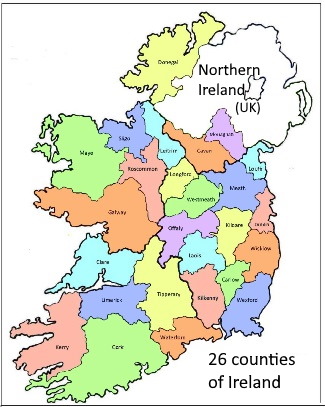
Some €5M in state funding is being provided for the digitisation and publication project, which will involve the release of more than 700,000 individual return sheets containing data from the 26 Republic of Ireland counties (see map right - the coloured counties make up RoI).

The 1926 Census was the first census undertaken following the foundation of the state, and gathered information on the population's age, occupation, religion, housing and use of the Irish language.

It was taken on 18 April 1926, when the population stood at 2,971,992, down 5.3% on the previous census in 1911. Only County Dublin recorded an increase in its number of inhabitants; all other counties recorded a loss.

In 1926, a total of 92.6% of the population was Catholic and 18.3% could speak Irish. Of those employed, 51% were in agricultural occupations, 4% were fisherman, 14% were in manufacturing and 7% were domestic servants. Very different times. Details are available at the Central Statistics Office website.

Speaking at the official announcement today, Catherine Martin, Minister for Tourism, Culture, Arts, Gaeltacht, Sport and Media, said: "The €5M funding will provide for the complex, time consuming and multistage process to digitise all of the information collected by the first census of the Irish State. I am confident that work will be completed in time for release 100 years after the census was taken.

"Given the success of the digitised 1901 and 1911 census returns, I’m sure that the 1926 Census will be equally as popular and have a significant global reach once released. The census is a fundamental part of our national heritage and collective knowledge.”