Monday, 6 April 2015

Civil registration indexes return to IrishGenealogy.ie

The Irish civil registration indexes are back online at IrishGenealogy.ie! Well, I say they're back... On the home page, they're there one minute, gone the next. Presumably this will settle down during the day. (The link I've just given appears stable, so far.)

Following their undignified and speedy removal last year, they have, as expected, been returned to us on the state-run site with the 100-year (births 1864–1914), 75-year (marriages 1845/1864–1939) and 50-year (deaths 1864–1864) ruling in place, as operates in Northern Ireland without the world falling in.

As far as I can see, mother's maiden surnames are included in the birth records from 1900. I was able to find a couple of earlier birth examples, with maiden names, for my Driscoll family (see below), but none for either Santry or Kelly, so it seems a little haphazard.

Anyway, good to see them back.


(Thanks to Stuart McGee, who was up early this Easter Bank Holiday Monday!)

Wednesday 8 April (10:54am): Looks like the site is fully restored now and you can reach the Civil Records via the Home Page again.

Monday 20 April: Watch out for missing records! John Grenham has been investigating the revised collection in his Irish Times column.

Friday, 3 April 2015

Ancestry opens up Ireland/UK collections for Easter

Ancestry UK is offering free access to its Ireland and UK collection this Easter weekend.

It's a straightforward 'free access' process. You have to register with name and email address but no financial information is requested – you just go direct to searching for your ancestors. The promotion will expire at 23:59 BST on Easter Monday, 6 April.

You can see a full list of the record sets here.

http://www.dpbolvw.net/click-5737308-10819001-1408706803000?url=http%3A%2F%2Fwww.ancestry.co.uk%2F

Road to the Rising: Dublin, Easter Monday

See www.rte.ie/1916 for detailed online
version of the day's programme
The countdown to the Centenary of the 1916 Rising starts on Easter Monday with the Road to the Rising event in Dublin.

It's centred on O'Connell Street, which will be pedestrianised for 12 hours and transformed into a 1915 thoroughfare, but includes several other nearby venues. The programme is widely available in paper format and also available online at www.rte.ie/1916.

Such an event obviously has loads of interest to family historians whose ancestors lived through the early 1900s, and the day's schedule is seriously packed with talks exploring social and political issues of the time. There is also a dedicated genealogy stream, with genealogists from Timeline and Eneclann based at the GPO all day to answer the public's research questions.

Nicola Morris, a member of the Association of Professional Genealogists in Ireland and director of Timeline, told Irish Genealogy News that she will be at the GPO from 10am. "I'll be giving advice to people searching for their ancestors, with specific focus on Dublin in 1915 and 1916.

"The service is offered on a first come first served basis and if it is anything like the World War One event held in Trinity College last summer, which was very, very busy, it would be best to turn up early."

During the afternoon, she'll also be giving at mid-afternoon talk – Researching your 1916 relatives – at Connolly Hall, Liberty Hall. "I'm really looking forward to meeting people who are looking for a family connection to the Rising, although proving those connections can be a challenge!" she said.

NOTE: The National Library of Ireland's Register your Treasures sessions at the GPO are fully booked. So, too, are all performances of Yellow, the ANU theatre production.

For those who can't make it to Dublin, RTE Radio 1 will be broadcasting a live edition of the History Show from 1:30pm to 3pm. Myles Dungan and guests will be discussing life, personalities and events in 1915.


Ireland Genealogy Projects Archives: latest additions

Here's the list of latest additions to Ireland Genealogy Projects Archives. The 1848 Royal Irish Constabulary records for all counties have now been uploaded.

ARMAGH Genealogy Archives - Military & Constabulary
If only all inscriptions were this legible!
Hugh and Elizabeth Reilly, Drumlane, Cavan.
Photo courtesy David Hall & Valerie Ackroyd.
Irish Constabulary from Armagh - 1848

CAVAN Genealogy Archives - Headstones
Drumlane Priory (partial)

DUBLIN Genealogy Archives
Deansgrange Headstones
Deansgrange Cem St. Mary's Section, Pt 8
Deansgrange Cem. - North Section Part 5
Deansgrange Cem. - St. Patrick's Section, Pt 21
Mount Jerome Headstones
Mount Jerome Cem. Pts 96-100 - (750)

KILKENNY Genealogy Archives - Directories
19th Century Callan Directories

LEITRIM
Genealogy Archives - Headstones
Kiltoghert Graveyard (R.C.)
Kiltyclogher CoI Graveyard

ROSCOMMON Genealogy Archives - Headstones
Shankill Cemetery (partial)

TIPPERARY Genealogy Archives - Military & Constabulary
Royal Irish Constabulary  - 1848

WATERFORD Genealogy Archives - Headstones
Ferrybank Graveyard (R.C) (partial)
Tramore (R.C.) Graveyard - (partial)

WICKLOW
Genealogy Archives - Vital Records
Assorted deaths from 1869


Thursday, 2 April 2015

Report makes 37 recommendations for the future of Irish genealogy

Readers with long memories may recall some mention on this blog of our politicians trying to gather some idea of where Irish genealogy was at and see if it could help develop 'a plan to capture the full value of our genealogical heritage'.

The Oireachtas Joint Committee on the Environment, Culture and the Gaeltacht heard a range of views back in November/December 2014 and a draft report was presented today by Catherine Murphy TD at Leinster House. In her introduction, she says: 'Ultimately, the report should be considered a snapshot of the current debate regarding the availability and accessibility of genealogical and cultural records and it is hoped that the recommendations made herein would help shape future policy decisions in this area.'

The 38-page Report of the Joint Committee on maximising our cultural and genealogical heritage, makes 37 recommendations. I'm not going to list them all here but from a quick read through, I've pulled out a few to give you a flavour:

Recommendation 7: Appoint a Chief State Genealogical Officer as a matter of urgency.

Recommendation 8: It is desirable that local research facilities are maintained and indeed improved to ensure future growth of genealogy research in Ireland.

Recommendation 14: Urgently undertake a condition survey of Church Records.

http://www.oireachtas.ie/parliament/media/Committee-Report-on-Geneology.pdf
Click front cover to download report
Recommendation 22: Introduce legislation, similar to Northern Ireland, to facilitate an online service that is comparable to that recently launched by GRONI. This searchable database should be one that not only provides access to the indexes but also to the scanned images of the civil records.

Recommendation 23: Urgently relocate the GRO [Research Room] to a central location, with modern facilities to facilitate research from visitors both online and in person.

Recommendation 24: Change the 100 year embargo to 70 years to allow access to the 1926 Census records.

Recommendation 26
: Provide funding, or allow for commercial partnership, for the completion of a specific project on the digitisation of the 1926 Census records and ultimately deliver online access on the same level as 1901 and 1911.

To download this essential Easter weekend reading, click the image above. (PDF 3Mb.)


Easter opening arrangements of major repositories

Easter is almost upon us, so here's a note of opening and closing arrangements for the major specialised libraries/research centres in Dublin, Belfast and London over the period.

IRELAND

National Library of Ireland
The Reading Rooms will be closed from Good Friday 3 April to Easter Monday 6 April inclusive and there will be no Genealogy Service running at Kildare Street.
The Kildare Street exhibitions will be closed from Good Friday 3 April to Easter Sunday 5 April inclusive, and open on Easter Monday from Noon until 5pm.
National Photographic Archive in Temple Bar will be closed on Good Friday 3 April but open on Saturday 4 April from 10am to 5pm; open on Easter Sunday from Noon until 5pm; and open on Easter Monday from Noon to 5pm.

National Archives of Ireland
The Reading Room of the National Archives in Bishop Street will close at 5pm on Thursday 2 April and will re-open on Tuesday 7 April at 9:15am. The free Genealogy Service will not run on Good Friday or Easter Monday.

Registry of Deeds
The Registry of Deeds will be closed Good Friday and Easter Monday. Reopening Tuesday 7 April at 10am. 

General Register Office Research Room
The Werburgh Street office will close at 4:30pm on Thursday 2 April. Closed Good Friday 3 April and Easter Monday 6 April. Reopening Tuesday 7 April at 9:15am.

Dublin City Library and Archives
The DCL&A on Pearse Street, along with all Dublin City's public libraries, will be closed on Good Friday 3 April until Easter Monday 6 April inclusive. All libraries will return to normal hours on Tuesday 7 April.

RCBL
The Reading Room of the Representative Church Body Library will be closed on Good Friday 3 April and Easter Monday 6 April. Reopens at 9:30 on Tuesday 7 April.


NORTHERN IRELAND

PRONI
The Public Record Office of Northern Ireland will be open from 9:00am to 4:45pm on Good Friday 3 April. It will be closed on both Monday 6 April and Tuesday 7 April and will reopen on Wednesday 8 April at 9:00am.

GRONI
The Public Search Room of the General Register Office of Northern Ireland will be open normal hours (9:30am–4:00pm) on Good Friday 3 April. It will then be closed until Wednesday 8 April, reopening at 9:30am.

Linen Hall Library 
Open normal hours (9:30am to 5:30pm) on Good Friday 3 April. Closed Easter Saturday, Monday and Tuesday. Reopening  9:30am on Wednesday 8 April.

NIFHS Research Centre
The North of Ireland Family History Society Research Centre closed for its Easter break on 1 April. It reopens on Tuesday 14 April.


ENGLAND

IGRS Library
Closed on Saturday 4 April. Reopening Saturday 11 April.

The National Archives, Kew 
Closed from Good Friday 3 April to Easter Monday 6 April inclusive.


Wednesday, 1 April 2015

Saving the Famine Irish: Quinnipiac University, USA

A new exhibition – Saving the Famine Irish: The Grey Nuns and the Great Hunger – opens today at Ireland’s Great Hunger Institute in Quinnipiac University, Connecticut. It tells the story of the religious orders in Montreal whose members gave selflessly to Irish immigrants during their time of greatest need.

Ireland's Famine immigrants to Montreal were not only among the poorest of the poor, but many of them also arrived sick with typhus fever. Despite this, a number of people in the English and French Canadian communities provided the ailing and the dying with shelter and support.

In the forefront of this compassionate movement were the Sisters of Charity, also known as the Grey Nuns.

Venue: The Lender Special Collection Room in Quinnipiac University’s Arnold Bernhard Library, Hamden, Connecticut, USA.
Hours: Monday to Saturday, 9am–5pm; Sunday, 12pm–5pm.

Manchester United says 'No': PRONI Doc of the Month

Okay, it's got nothing to do with genealogy, but the Public Record Office of Northern Ireland's Document of the Month for April is a good reminder of the wide range of topics and the sometimes esoteric nature of material being protected and preserved in our wonderful archives.

This month's document is a letter from Sir Matt Busby, manager of the Manchester United football club from 1945 to 1969, and a British soccer legend.

PRONI’s Gavin McMahon explains: “Manchester United had been invited by Glentoran FC to play a match at the Oval to promote the Ulster 71 festival. However, the result proved to be an own goal for Manchester United, as Busby was unable to confirm Manchester United’s participation. This led to Division One rivals, Leeds United, playing instead in a match which resulted in a famous 3-1 victory to Glentoran.

“In Sir Matt’s letter, he advises that no commitment was agreed to playing the match and that it would be subject to club commitments and agreement with manager, Wilf McGuiness.

“Little did Wilf McGuiness know that he would be sacked 10 days later on Boxing Day. It is all very reminiscent of the manner in which David Moyes was dismissed only a few months after succeeding Alex Ferguson."

Manchester United was to have been offered £3,500 to field a full team including its pin-up winger George Best, a native of Belfast. Leeds United would eventually be paid £4,000 for the match that took place on 5 May 1971.

Irish News Archive adds seven Kerry titles

Excellent news for those researching family from County Kerry: IrishNewspaperArchive.com has added seven new titles to its database, as follows:
  • Chute’s Western Herald : 02/01/1828 – 04/05/1835
  • Kerry Examiner : 01/01/1841 – 11/03/1856
  • Kerry Sentinel : 26/04/1878 – 23/12/1916
  • Kerry Weekly Reporter : 03/02/1883 – 14/08/1920
  • Raymond’s Kerry Herald : 12/01/1856 – 16/02/1856
  • Tralee Chronicle & Killarney Echo : 18/03/1843 – 20/05/1881
  • Tralee Mercury : 14/02/1829 – 20/07/1839
The online archive now holds 54 titles from across the island.

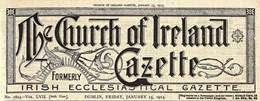
Church of Ireland Gazette: 1915 editions now online

Search the 1913-1915 Church of Ireland Gazette
The Representative Church Body Library (RCB Library) has released online all editions of the Church of Ireland Gazette published in 1915.

In addition, highlights from those editions have been brought together to create a digital presentation now released as the April 2015 Archive of the Month.

The 1915 editions join those already available for the years 1913 and 1914, enabling further analysis of various aspects of the momentous changes that occurred in Ireland in this early decade of the 20th century. They also provide an invaluable resource for the opinions and attitudes of members of the Church of Ireland through changing times.

Written and read by lay and clerical members of the Church both north and south, the Gazette reflected how unfolding political events in Ireland and abroad were communicated to and received by members of this significant minority community in Ireland 100 years ago.

Last year the RCB Library (the principal repository for Church of Ireland records) launched a sponsorship appeal to continue the work of digitization of this important resource. These efforts came to the attention of the Irish government, and financial support from the National Commemorations Programme (managed by the Department of Arts, Heritage and the Gaeltacht) has made possible the digitization of the 1915 editions. It is hoped that further support from other individuals will enable the work to continue over the next few years, and sponsorship details are available on the presentation page.

Further background about the history of the Gazette (including a full list of its editors) was published when the 1913 digital editions were released as the Archive of the Month, August 2013.