Friday, 2 October 2020

More editions of the Church of Ireland Gazette go online

Following last month's announcement from the RCB Library that post-1949 editions of the Church of Ireland's Gazette would be digitised and released in monthly instalments, the second such tranche has been uploaded for free viewing.

It covers all editions published in 1960 to 1969 inclusive and, as with last month's instalment, it is accompanied by a presentation in the ‘Borderless Church’ series from the Representative Church Body Library.

The '1960s' presentation is from Brian M Walker, Professor Emeritus of Irish Studies at Queen’s University Belfast. In the 60s, the newly relaunched Gazette was reaching out to both Northern Ireland and the Republic, and Professor Walker explores further aspects of this, and how strong editorial input ensured that events of national importance in both jurisdictions as well as international events were well covered and carefully analysed.

He concludes: "The 1960s were a time of great change in Ireland, north and south, and this is revealed in the pages of the Gazette. We see how, in spite of such differences, the Church of Ireland maintained an all-Ireland approach. These years showed evidence of considerable vitality for the parishes and the clergy. Progress was made to tackle existing political and denominational divisions, but serious problems remained.

"While the challenge in the 1960s involved the building of many new churches and other buildings, the challenge would move in the 1970s to facing the effects of violence and civil strife. The Gazette would continue to record and to comment about the life and faith of the Church in response to these events."

To search and view the 1960s releases, and all the other editions of the Gazette up to 1969, go to https://esearch.informa.ie/rcb.

For the Borderless Church series of presentations, see Dr Marie Coleman’s analysis of the 1950s editions of the Gazette here.

Ireland Genealogy Projects Archives: latest updates

This headstone in Fahy Graveyard on Lough Allen is inscribed:
'Here lies the body of THADH McHUGH who died ... 1788'.
Photo courtesy of Leila Dolan and IGP Archives.

In the second half of September, four bundles of headstone photos + inscriptions have been uploaded to the Ireland Genealogy Projects Archives. They have all been donated by volunteers and are free to access.

Of particular note is the latest instalment to the Mount Jerome Cemetery collection. It is the 50th such instalment since 2008 from contributor Yvonne Russell, and brings the total number of images in the collection to 40,000. That's a terrific achievement.

The latest additions are:

DUBLIN Genealogy Archives - Headstones Mount Jerome Cemetery - Pt 263 & 264

FERMANAGH Gen. Archives - Headstones Callow Hill/Callowhill Graveyard (additional)

LEITRIM Genealogy Archives - Headstones Fahy Graveyard on Lough Allen

MEATH Genealogy Archives - Headstones Clonard Cemetery - partial (T)

Thursday, 1 October 2020

British genealogy: what's new since mid-September?

Below is a summary of new and updated family history record collections for England, Scotland and Wales released by the major genealogy databases in the second half of September (see last summary blogpost of 14 September).

This regular summary of releases relating to British collections is designed to help family historians whose Irish ancestors migrated, temporarily or permanently, to England, Scotland or Wales.

By default, it will also be useful to anyone carrying out research in those three nations, regardless of the origin of their ancestors.

The figures in parenthesis in the New Collections section are the numbers of records/images in the new record set.

Unless otherwise stated, the figures in parenthesis in the Updated Collections section reflect the number of records added to the collection in the recent update. In some instances, the supplier has not made this figure available. Please note that I don't usually include updates of fewer than 1,000 records.


NEW COLLECTIONS

Ancestry

BritishNewspaperArchive (shared with FindMyPast)


UPDATED COLLECTIONS 

DeceasedOnline

FamilySearch

FindMyPast

FreeBMD

The Genealogist

  • 71 Air Force Lists added (2m+ names)
  • 385 extra War Memorials (31,000+ names)

Some of the above content contains affiliate links. This means I may earn a small commission if you buy via these links. This does not affect the price you pay as a consumer, but it does contribute to keeping Irish Genealogy News online. See Advertising Disclosure tab above.

Tuesday, 29 September 2020

Quarterly summary of new & updated Canadian records

Below is a summary of Canadian family history collections that have been either newly released or updated by the major genealogy databases during the last three months. The last summary list was published on 1 July, see blogpost).

These regular listings of additional sources are designed primarily to help family historians whose Irish ancestors emigrated to Canada, but you don't have to have heritage from Ireland!

They may prove useful to any researcher looking for a brief update of what's been recently made available for tracing ancestors in Canada.

Unless otherwise stated, the figures in parenthesis reflect the number of records uploaded to a new collection, or the total number in a newly topped-up collection (if provided by the database owner).

NEW COLLECTIONS

FamilySearch

Fold3

MyHeritage


UPDATED COLLECTIONS

Ancestry

FamilySearch


Some of the above content contains affiliate links. This means I may earn a small commission if you buy via these links. This does not affect the price you pay as a consumer, but it does contribute to keeping Irish Genealogy News online. See Advertising Disclosure tab above.

Friday, 25 September 2020

Glasnevin Cemetery's 1.5m-record database still offline

I was alerted this morning via Boards.ie's excellent Genealogy forum that a problem first announced two weeks ago with Glasnevin Cemetery's online burial records database has not yet been rectified.

As a result, family historians, whether or not they have an account, cannot currently search the 1.5million-record-collection, which dates back to 1828. The database is, of course, also unavailable to personal visitors to the Museum because, along with other cultural attractions and archival repositories in the county and city, it is closed due to Dublin's local lockdown.

In response to an email from a forum member (thanks, Hermy), resident genealogist Lynn Brady has advised that the problem started with a major technical outage and it is expected that the system will not be fully functional again for another week.

Thinking aloud, I learned a few weeks ago that Glasnevintrust.ie was shortly to be upgraded. I wonder if this had anything to do with the outage...?

It may be one of those weird coincidences or I may be mistaken/high/bonkers, but the appearance of the website seems to have changed since I first looked at it today.

Thursday, 24 September 2020

KDHS takes over new heritage and genealogy centre

Some wonderful news from Kilrush, County Clare. A project to restore and convert the local landmark of Turret Lodge into a community-run Heritage and Genealogy Centre has been completed. 

The keys to the protected structure were handed over on Tuesday to the Kilrush and District Historical Society (KDHS), whose members will operate the new genealogy and exhibition space. 

The detached stone gate house, which dates to 1845 and is adjoined to a castellated archway and narrow turret marking the entrance into the Vandeleur Estate demesne, has been fully restored thanks to €190,000 funding from the Historic Towns Initiative 2019, a partnership between the Heritage Council and the Department of Culture, Heritage and the Gaeltacht, and a further €50,000 grant from Clare County Council (CCC). 

At the official opening and handover on Tuesday, Pat Dowling, Chief Executive of Clare County Council, said: “This project provides the local community with a truly unique space while also delivering on the conservation of an important building. The renovated Turret Lodge will increase the cultural, heritage and tourism offering of Kilrush Town. I would like to acknowledge the work and involvement of all of the groups that have brought this project to fruition.” 

It will be a while before the doors are fully open, however. The KDHS facebook page explains that the Lodge's windows will remain boarded up until security equipment is installed, but when Covid-19 restrictions allow it, the Society will organise a launch celebration and the public will be given tours of the historical property. 

In the meantime, you can watch a you-tube recording of a talk about the restoration project here.

Pictured at the official key handover at the Turret Lodge, Kilrush on Tuesday 22 September, were (l-r): Carmel Greene, CCC; Leonard Cleary, CCC; Mayor of Clare, Cllr Mary Howard; Pat Dowling, CCC; and Lisa O’Sullivan, Chairperson of Kilrush and District Historical Society. Photo courtesy Clare County Council.

Wednesday, 23 September 2020

Pack HeritageMaps.ie for genealogical research trips

This morning, the Heritage Council has issued an encouragement to Ireland’s ‘staycationers’ to use digital its Heritage Maps resource when holidaying at home. While that particular message doesn't earn itself a place on a genealogy blog, reading the official statement prompted me to revisit this splendid and free online map of the island, and gives me an excuse to once again mention its value to family historians.

Workhouses (cerise squares), sheela na gigs (brown circles), and burial
grounds (crosses) are identified in this map of southern Tipperary
The map, which you will find at HeritageMaps.ie, allows visitors to create customisable maps and personalised itineraries for visiting Ireland’s heritage. A genie taking a break in the south of County Tipperary, for example, might want to go graveyard hunting, or to see what remains of the area's workhouses, or to pose for holiday snaps beside the nearest sheela na gig. In no time at all, all the sought locations can be identified via the heritage map, see right (crosses indicate graveyards; cerise squares, workhouses; brown circles, early medieval stone carvings).

Among the categories of maps that superimpose on a regular Google map of the island are archaeology and architecture, landscapes and coastlines, habitats and species, rivers and lakes, geology and recreation.

Most recently, thirty new maps were uploaded, covering Ireland’s Greenways and Blueways, Wexford’s biking and hiking trails, Coillte Recreation sites and a vast range of things to do in Northern Ireland. Maps are uploaded from trusted sources, including State agencies, local authorities researchers and academics, and each entry is supported with links to external websites.

Make sure HeritageMaps is on your Genealogy Resources list, as well as your Holiday Research list.

Latest update from Irish Registry of Deeds Index Project

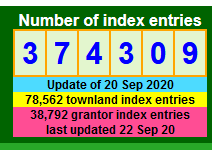
The latest database update to the online Registry of Deeds Index Project shows the online index now holds 374,309 index records from 40,085 memorials of deeds, comfortably passing another milestone in the last couple of weeks.

https://irishdeedsindex.net/search/search.phpIn addition, Project volunteers have continued transcribing Townland and Grantor Indexes, with 78,562 and 38,667 entries respectively.

There is now a full transcription of the Grantors' Index for A–D surnames spanning 1708-1729.

All Index entries are fully searchable and free. Click/tap the image, right.

If you've a yearning to do some transcribing and and would like to contribute towards this important project, please do consider signing up. Copies of the manuscripts and Index books are freely available at FamilySearch.org, and transcriptions are gathered digitally, so the entire contribution process is carried out remotely and without any costs to volunteers... except for their time, of course. You'll find several how-to guides on the site.

Tuesday, 22 September 2020

SOG to host online Irish history workshop, 17 October

The Society of Genealogists will host a live 3-hour online seminar on Saturday 17 October, starting a 10:30am. The seminar – The 1600s & 1800s - Times of Great Change in Ireland – will include two talks, both presented by Fellows of the Irish Genealogical Research Society.

Together, the talks will introduce delegates to record sources for this period and will provide a strong overview and understanding of the issues that affected, directly or indirectly, the lives and dreams of our ancestors in Ireland during the 17th century. The seminar will be of particular benefit to those whose knowledge of Irish history is rusty or shaky, and to family historians educated outside of Ireland.

To see all SOG events and classes
click image.

The 1600s, with Roz McCutcheon FIGRS
The 17th century was a seismic period in Irish history. It included the defeat and flight of the old Irish nobility; the Ulster Plantation; the 1641 Rebellion; the Cromwellian campaign and land confiscations; the Williamite wars; and the introduction of the Penal Laws in the 1690s. In this talk, Roz will explore the period from the viewpoint of one woman and her family, who appear in many of the documents linked to these events, and include her sons and grandsons fighting on both sides in the major conflicts.

19th-century land issues, with Jill Williams FIGRS
Like the 1600s, the 1800s was a turbulent period, especially for issues relating to land holdings. Fortunately, surviving land records abound. Jill's talk will reveal where extensive knowledge of our forbears, whether rich or poor, can be found. She will examine Tithe Applotments, The Great Hunger, evictions, assisted emigration, Griffiths Valuation, the Encumbered Estates Act, land wars, Whiteboys, and an increasing push for justice regarding land rights.

A comprehensive list of sources will be provided to delegates. There will be time for Questions & Answers after each talk and a short break between them. The fee is £20.

I would recommend anyone interesting in gaining a better appreciation of Ireland's political and social history during these two centuries books their place on this course as soon as possible. Jill and Roz's classes are always over-subscribed and this seminar appears to no exception; I have watched the counter of available places tumble over the just the last few days! Click the link at the top of the page.

Monday, 21 September 2020

Major Irish genealogy repositories back in Lockdown

With both the County and City of Dublin moving into Level 3 of the Irish Government's 'Plan for Living with Covid-19', the capital's major repositories for genealogists and historians, and other cultural attractions, are once again closed to the public. 

The restrictions, designed to drive down the coronavirus transmission rate in the county (currently at 114.2 compared with 59.1 for the country as a whole, and with the highest rate at 173.4 in Dublin North West) came into effect on Friday night. 

The National Archives of Ireland, the National Library of Ireland, the Dublin City Library & Archive, and all branch libaries have closed their doors (except for some local 'click & collect' services). However, some email services are being 'manned'. These include the free genealogy advisory services normally provided to visitors to the NAI (see webpage for details and email) and NLI (see details of online online services and email.).

For now, at least, the rest of the nation is on Level 2, which should mean local archives, libraries and local studies departments are open - with health and social distancing precautions in place, and often on an appointment-only basis.  However, officials are monitoring closely trends in the spread of Covid-19 in eight other counties: Donegal, Kildare, Leitrim, Limerick, Louth, Offaly, Waterford and Wicklow, so be aware that Level 3 restrictions may soon be implemented to areas beyond Dublin.

In Northern Ireland, a meeting of the Stormont Executive will decide this afternoon whether some areas covered by localised restrictions should be expanded and, if so, whether measure should be introduced NI-wide. 

Update to Northern Ireland, 4:50pm: Meeting resulted in increased social-only restrictions being re-introduced across the six counties, so PRONI will continue its current restricted appointment-only access system.