John Grenham has announced the news every Irish genealogist has been longing – dreaming – of hearing for years: the National Library of Ireland is to publish its collection of pre-1880 Roman Catholic Registers online.
I've heard rumours about this during the past year, but everytime I've asked the question I've been told 'no, it's not happening'.
I almost don't mind having been lied to!
John broke news of this fantastic development in his Irish Roots column. Go read and be happy.
UPDATE: See my later post for additional details from the National Library of Ireland's official press release.

Monday, 1 December 2014
Lantern slide show of Boer War and Great Wars images
The Representative Church Body Library’s commemoration of the 100th anniversary of the outbreak of the First World War continues with the online presentation of lantern slides relating to “The Great European War” and related items from the earlier Boer War. These originated (before their transfer to the RCB Library) in St Patrick’s Cathedral Deanery, Dublin, where they may have been used to inform contemporary audiences about these conflicts.
The “Great European War” and related Boer War slides collectively form part of a bigger collection of lantern slides that were transferred from the Deanery into the library during the past 18 months.
They reveal the important role that the church and church personnel played in disseminating visual materials in times past when photography was a relatively privileged and rare occupation. Since its acquisition by the library it has been arranged, catalogued and listed into five main groups, of which the War images are one component.
The online slide show speculates how such a collection might have ended up at St Patrick’s and demonstrates how they were used as contemporary educative tools to inform people what was going on in an otherwise limited visual era. In church halls, churches and cathedrals, audiences would gather to be brought up to date with on the realities of warfare, and specifically the progress of the Allied advance on mainland Europe between 1914 and 1918 and related events.
View the lantern slide show here..
(November's Archive of the Month – the Church of Ireland’s short commemorative film about the Great War and ten letter writers from the trenches, The Boys From East Belfast, continues at this permanent link.)
The “Great European War” and related Boer War slides collectively form part of a bigger collection of lantern slides that were transferred from the Deanery into the library during the past 18 months.
They reveal the important role that the church and church personnel played in disseminating visual materials in times past when photography was a relatively privileged and rare occupation. Since its acquisition by the library it has been arranged, catalogued and listed into five main groups, of which the War images are one component.
The online slide show speculates how such a collection might have ended up at St Patrick’s and demonstrates how they were used as contemporary educative tools to inform people what was going on in an otherwise limited visual era. In church halls, churches and cathedrals, audiences would gather to be brought up to date with on the realities of warfare, and specifically the progress of the Allied advance on mainland Europe between 1914 and 1918 and related events.
View the lantern slide show here.
(November's Archive of the Month – the Church of Ireland’s short commemorative film about the Great War and ten letter writers from the trenches, The Boys From East Belfast, continues at this permanent link.)
Friday, 28 November 2014
RootsIreland adds seven new databases for Derry City
RootsIreland.ie has uploaded seven new record sets from Derry Genealogy Centre. Mostly compiled from Derry City record sets, these databases date from 1628 to 1921 and most fall into the category of census substitutes.
They are:
UPDATE: On 4 March 2015, more than four months after the upload to RootsIreland, the Belfast Telegraph wrote a feature about the 'new' databases. It might have been somewhat behind the times in terms of news, but the feature includes some interesting additional information about these records. Read it here.
They are:
- The earliest census of the city, namely the rent roll of 1628
- The names of 905 men from Derry and surrounding estates who defended Derry’s walls during the 1641 Rebellion
- The names of 1,660 supporters of the 1689–91 Williamite campaign, many of whom fought at the Siege of Derry in 1689
- The names of 226 citizens of the city who signed a petition condemning a Jacobite plot to assassinate King William III in 1696
- The names of 110 leaseholders within the walled city in 1738
- The names of 191 Derry men and women who were held in the County Jail on Bishop Street from 1839 to 1856 awaiting transportation to Australia
- Reconstruction of census for Derry city during ‘the Troubles’ of 1920, extracted from Derry Almanac of 1921, which names 8,367 heads of households against their street address and house number.
UPDATE: On 4 March 2015, more than four months after the upload to RootsIreland, the Belfast Telegraph wrote a feature about the 'new' databases. It might have been somewhat behind the times in terms of news, but the feature includes some interesting additional information about these records. Read it here.
Thursday, 27 November 2014
Nine new Irish titles join British Newspaper Archive

This brings to sixteen the number of newspaper to have joined the BNA during November.
The newest titles (with the number of editions in brackets) are:
- The Advocate, or Irish Industrial Journal: 1856–Jan 1860 (406)
- Athlone Sentinel: Nov & Dec1834 (6)
- Dublin Medical Press: 1846, 1848, 1850–59; 1865 (676)
- Enniskillen Chronicle and Erne Packet: May 1813, 1824–38; 1840–41 (with gaps) (751)
- Farmer's Gazette & Journal of Practical Horticulture: Nov 1845; 1846; 1857–58; 1866; 1869–70 (317)
- Southern Reporter and Cork Commercial Courier: Jan–Nov 1845; 1846; 1848–Nov 49 (122)
- Tralee Chronicle: March 1843–47; Jan–Oct 1848; 1849 (588)
- Ulster General Advertiser/Herald of Business and General Information: 1858 (52)
- Wexford Independent: 1843–56 (1,171)
All the new titles and uploads have also joined the Irish newspaper collection in FindMyPast's Ireland and World packages.
Tuesday, 25 November 2014
Winter issue of Irish Roots published
The latest issue of Irish Roots Magazine has been published and is now available in good newsagents and bookshops, as well as downloadable in digital format here.
Beyond the pretty picture on the cover of this issue, beginners and, indeed, many intermediate level researchers, will benefit from the first of a new Back To Basics feature series designed to place Irish records in their historical context and point family historians in the direction of the main repositories and their online records, as well as the best guide books.
Another article takes an in-depth look at government gazettes, especially the Dublin Gazette, and their value to genealogists, while those with ancestors from Limerick will want to follow up the advice and recommended resources in a spotlight feature focussing on that county.
A very unusual case study follows George Mitchell from County Monaghan who was killed in action as a soldier in the Indian Army; it'll be of great value as a methodology to follow in tracing the story of a WW1 ancestor, as well as highlighting a lesser-known battlefield of WW1: the advance into Iraq in 1917. Fascinating.
Other features look at the surnames of Leinster (I was surprised to learn that there are no big Norman-origin names among the top-20 in this province), and the famous Christmas Truce on the Western Front 100 years ago.
Irish-Australian politicians are also explored; there's my own regular review of new resources, developments and happenings in Irish genealogy; and, for Irish-American researchers, there's a helpful article about using Special Collections to discover more information about immigrant ancestors. There's also a rather sad tale of a family that made the journey to Manhatten and subsequently returned to County Cork.
As if that weren't enough, Nicola Morris, MAPGI, of Timeline Research, answers readers queries and provides readers with some great tips for their own research, and there's news from around the Irish genealogical groups. I spotted in the Society Notes section that the North of Ireland Family History Society will be expanding its excellent Research Centre in Newtownabbey, Co Antrim, after a neighbouring unit in the complex became vacant. This means the society, the island's busiest and biggest, will be able to host genealogy classes for local groups. I look forward to following up this development.
Irish Roots magazine costs €4.50/£3.35 in the shops, €7 by mail (anywhere), or $3.99 for a digital copy. A one-year subcription costs $12 (digital) or, for hard copy, €25/US$37/CAN$40/AUS$42/UK£25 (approximately) including postage.
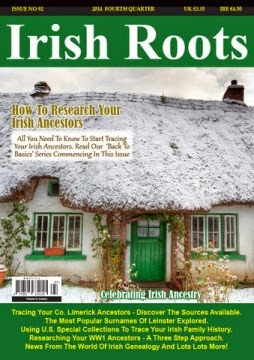 |
| Irish Roots magazine is available by post or downloadable in digital format |
Another article takes an in-depth look at government gazettes, especially the Dublin Gazette, and their value to genealogists, while those with ancestors from Limerick will want to follow up the advice and recommended resources in a spotlight feature focussing on that county.
A very unusual case study follows George Mitchell from County Monaghan who was killed in action as a soldier in the Indian Army; it'll be of great value as a methodology to follow in tracing the story of a WW1 ancestor, as well as highlighting a lesser-known battlefield of WW1: the advance into Iraq in 1917. Fascinating.
Other features look at the surnames of Leinster (I was surprised to learn that there are no big Norman-origin names among the top-20 in this province), and the famous Christmas Truce on the Western Front 100 years ago.
Irish-Australian politicians are also explored; there's my own regular review of new resources, developments and happenings in Irish genealogy; and, for Irish-American researchers, there's a helpful article about using Special Collections to discover more information about immigrant ancestors. There's also a rather sad tale of a family that made the journey to Manhatten and subsequently returned to County Cork.
As if that weren't enough, Nicola Morris, MAPGI, of Timeline Research, answers readers queries and provides readers with some great tips for their own research, and there's news from around the Irish genealogical groups. I spotted in the Society Notes section that the North of Ireland Family History Society will be expanding its excellent Research Centre in Newtownabbey, Co Antrim, after a neighbouring unit in the complex became vacant. This means the society, the island's busiest and biggest, will be able to host genealogy classes for local groups. I look forward to following up this development.
Irish Roots magazine costs €4.50/£3.35 in the shops, €7 by mail (anywhere), or $3.99 for a digital copy. A one-year subcription costs $12 (digital) or, for hard copy, €25/US$37/CAN$40/AUS$42/UK£25 (approximately) including postage.
Monday, 24 November 2014
Irish News Archive: reductions to hold to end of year
There's been a lot going on at the Irish Newspaper Archive in the last few weeks, what with the addition of the Leinster Express to the portfolio and then the launch of 108 years of the Irish (Cork) Examiner.
It seems, however, that recent talk of permanent price-cuts may have been a bit premature (see blogpost). Although prices have now been reduced – from €60 to €30 for the monthly sub, and €360 to €178 for the annual – these should be considered a 50% Christmas Special Offer only, rather than a fixed price for the longer term.
Once the festivities are over, if not before, the Irish Newspaper Archive will advise the New Year's pricing regime.
It seems, however, that recent talk of permanent price-cuts may have been a bit premature (see blogpost). Although prices have now been reduced – from €60 to €30 for the monthly sub, and €360 to €178 for the annual – these should be considered a 50% Christmas Special Offer only, rather than a fixed price for the longer term.
Once the festivities are over, if not before, the Irish Newspaper Archive will advise the New Year's pricing regime.
Diaries at the ready: PRONI dates until mid-January

This Thursday (28 November) will be the last late-night at the Titanic Bouvlevard offices until the third week of the New Year, as PRONI will close at 4.45pm on the following Thursday evenings: 4, 11 & 18 December and 8 January 2015.
Over the festive period, PRONI will be closed on Wednesday 24, Thursday 25 and Friday 26 December and on Thursday 1 January 2015.
Late-night Thursdays will recommence on 15 January 2015.
The week after next, 8–12 December, will be Preservation Week at the repository. This will result in some service restrictions. There will be no Document Production, but the Public Search Room, including Self-Service Microfilm area, will be operating as normal. (During that week, the PRONI team will be posting articles about preservation, reprographics, preventative conservation, digital preservation and emergency planning as well as publishing photos recording what they get up to behind the scenes.)
Irish genealogy and history events, 24 Nov – 6 Dec
Tuesday 25 November: Dublin at war, 1914-18, a History Ireland ‘Hedge School’ debate. Venue: National Library of Ireland, Kildare St, Dublin 2. Chaired by Tommy Graham, editor of History Ireland. Panelists Padraig Yeates, Brian Hanley, Ann Mathews, and David Fitzpatrick. 7pm. Admission free. No need to book.
Tuesday 25 November: Family history resources at Coleraine Library, with Sarah Carson. Host: North of Ireland Family History Society, Coleraine Branch. Venue: Guide Hall, Terrace Row, Coleraine, Co Derry-Londonderry. 8.00pm. Lecture followed by light refreshments. All welcome. €3 for non-members.
Tuesday 25 November: Recruitment in the First World War in Kilrush, Co Clare, with Paul O'Brien. Host: Kilrush and District Historical Society. Venue: Teach Ceoil, Grace Street, Kilrush, Co. Clare. 8pm. €5 for non-members. All welcome.
Wednesday 26 November: Irish Volunteers and National Volunteers in Meath, October 1914-April 1916, a Decade of Centenaries lecture, with Ruth Illingworth. Hosts: Meath Archaeological & Historical Society. Venue: St Mary's Church of Ireland Hall, Navan. 7.30pm.
Thursday 27 November: What really happened at the Battle of Clontarf, with Professor Seán Duffy. Host: The Friends of the Library – Trinity College Dublin. Venue: Thomas Davis Theatre, Arts Building, Trinity College Dublin. 7:30pm. Admission €5/Members & Concessions €2.50. All welcome.
Thursday 27 November: Official opening of the Ulster-Scots Hub & Discover Ulster-Scots Centre at the Corn Exchange Building, 1-7 Victoria Street, Belfast. Formalities by the Minister of Culture, Arts and Leisure. 6pm to 7:30pm. All welcome but you need to reserve your space by email to ciara.shevlin@dcalni.gov.uk.
Thursday 27 November: A street through time, featuring Market Street, with Johnnie Kennedy. Host: Strabane History Society. Venue: Room 5, Strabane Library, 1 Railway Street, Strabane, Co Tyrone BT82 8EF. 7:30pm
Thursday 27 November: From Mons to Gallipoli – Irish soldiers at war in the first 9 months of WW1, with Lar Joye. Host: Royal Society of Antiquaries of Ireland. Venue: 63 Merrion Square South, Dublin 2. 7:30pm. Free.
Thursday 27 November: Graveyard research in North Antrim, with Dorothy Arthur. Host: North of Ireland Family History Society, Ballymena branch. Venue: Michelin Arts Workshop, Braid Arts Centre 1-29 Bridge Street, Ballymena BT43 5EJ, Co Antrim. 7:15pm.
Friday 28 and Saturday 29 November: A safe place for ships: Cork, Ireland, Europe and the Sea, a conference on the maritime history of Cork. Organised by the School of History, University College Cork. Venue: Main Campus, Electrical Building, L-1, UCC. Topics include the Vikings, piracy, the Spanish Armada, international trade, Emigration, the Napoleonic War at sea, island nations, port cities, WW1 submarine warfare, the Lusitania, and more. Admission is free and no registration is required. Details.
Saturday 29 November: Dublin in the rare auld rhymes, a night of song, story and recitations. Host: Stoneybatter and Smithfield People's History Project. Venue: The Cobblestone pub, 77 King St North, Dublin 7. Donation to Capuchin Day Centre at the door. 8pm.
Tuesday 2 December: The heritage sites of County Kildare, with Ger McCarthy. Host: Naas Local History Group. Venue: Community Library, Harbour View, Naas, Co Kildare. 7:45pm.
Tuesday 2 December: Women in Waterford History, with Andy Kelly. Venue: Town Hall Theatre, Friary Street, Dungarvan, Co Waterford. 8pm. €5. All welcome.
Wednesday 3 to Friday 5 December: Reading Room closed to public for annual media review. National Archives of Ireland, Bishop Street, Dublin. Details.
Wednesday 3 December: Ulster and the First World War, with Jonathan Bardon. Venue: PRONI, Titanic Boulevard, Belfast. 1pm. Free but need to reserve your place by email to proni@dcalni.gov.uk or telephone 02890 534800.
Friday 5 December: Ireland, Australia and the First World War, with Dr Jeff Kildea. Host: Military History Society of Ireland. Venue: Griffith College, South Circular Road, Dublin 8. Non-members welcome. 8pm.
Saturday 6 December: Survival and revival – Ireland's historic gardens and demesne landscapes, with Finola Reid. Venue: Tipperary County Museum, Mick Delahunty Square, Clonmel, Co Tipperary. 10am to Noon, with refreshments provided. €5 per session. Bookings: julia.walsh@tipperarycoco.ie or 076 106 5564.
Tuesday 25 November: Family history resources at Coleraine Library, with Sarah Carson. Host: North of Ireland Family History Society, Coleraine Branch. Venue: Guide Hall, Terrace Row, Coleraine, Co Derry-Londonderry. 8.00pm. Lecture followed by light refreshments. All welcome. €3 for non-members.
Tuesday 25 November: Recruitment in the First World War in Kilrush, Co Clare, with Paul O'Brien. Host: Kilrush and District Historical Society. Venue: Teach Ceoil, Grace Street, Kilrush, Co. Clare. 8pm. €5 for non-members. All welcome.
Wednesday 26 November: Irish Volunteers and National Volunteers in Meath, October 1914-April 1916, a Decade of Centenaries lecture, with Ruth Illingworth. Hosts: Meath Archaeological & Historical Society. Venue: St Mary's Church of Ireland Hall, Navan. 7.30pm.
Thursday 27 November: What really happened at the Battle of Clontarf, with Professor Seán Duffy. Host: The Friends of the Library – Trinity College Dublin. Venue: Thomas Davis Theatre, Arts Building, Trinity College Dublin. 7:30pm. Admission €5/Members & Concessions €2.50. All welcome.
Thursday 27 November: Official opening of the Ulster-Scots Hub & Discover Ulster-Scots Centre at the Corn Exchange Building, 1-7 Victoria Street, Belfast. Formalities by the Minister of Culture, Arts and Leisure. 6pm to 7:30pm. All welcome but you need to reserve your space by email to ciara.shevlin@dcalni.gov.uk.
Thursday 27 November: A street through time, featuring Market Street, with Johnnie Kennedy. Host: Strabane History Society. Venue: Room 5, Strabane Library, 1 Railway Street, Strabane, Co Tyrone BT82 8EF. 7:30pm
Thursday 27 November: From Mons to Gallipoli – Irish soldiers at war in the first 9 months of WW1, with Lar Joye. Host: Royal Society of Antiquaries of Ireland. Venue: 63 Merrion Square South, Dublin 2. 7:30pm. Free.
Thursday 27 November: Graveyard research in North Antrim, with Dorothy Arthur. Host: North of Ireland Family History Society, Ballymena branch. Venue: Michelin Arts Workshop, Braid Arts Centre 1-29 Bridge Street, Ballymena BT43 5EJ, Co Antrim. 7:15pm.
Friday 28 and Saturday 29 November: A safe place for ships: Cork, Ireland, Europe and the Sea, a conference on the maritime history of Cork. Organised by the School of History, University College Cork. Venue: Main Campus, Electrical Building, L-1, UCC. Topics include the Vikings, piracy, the Spanish Armada, international trade, Emigration, the Napoleonic War at sea, island nations, port cities, WW1 submarine warfare, the Lusitania, and more. Admission is free and no registration is required. Details.
Saturday 29 November: Dublin in the rare auld rhymes, a night of song, story and recitations. Host: Stoneybatter and Smithfield People's History Project. Venue: The Cobblestone pub, 77 King St North, Dublin 7. Donation to Capuchin Day Centre at the door. 8pm.
Tuesday 2 December: The heritage sites of County Kildare, with Ger McCarthy. Host: Naas Local History Group. Venue: Community Library, Harbour View, Naas, Co Kildare. 7:45pm.
Tuesday 2 December: Women in Waterford History, with Andy Kelly. Venue: Town Hall Theatre, Friary Street, Dungarvan, Co Waterford. 8pm. €5. All welcome.
Wednesday 3 to Friday 5 December: Reading Room closed to public for annual media review. National Archives of Ireland, Bishop Street, Dublin. Details.
Wednesday 3 December: Ulster and the First World War, with Jonathan Bardon. Venue: PRONI, Titanic Boulevard, Belfast. 1pm. Free but need to reserve your place by email to proni@dcalni.gov.uk or telephone 02890 534800.
Friday 5 December: Ireland, Australia and the First World War, with Dr Jeff Kildea. Host: Military History Society of Ireland. Venue: Griffith College, South Circular Road, Dublin 8. Non-members welcome. 8pm.
Saturday 6 December: Survival and revival – Ireland's historic gardens and demesne landscapes, with Finola Reid. Venue: Tipperary County Museum, Mick Delahunty Square, Clonmel, Co Tipperary. 10am to Noon, with refreshments provided. €5 per session. Bookings: julia.walsh@tipperarycoco.ie or 076 106 5564.
Friday, 21 November 2014
Yet more transcriptions from Clare County Library
Clare County Library has had a busy month of website uploads. Having added five new sets of transcriptions just over a week ago (see blogpost), three more have been added in the last few days.
They are headstone inscriptions from the graveyards of Kilmaleery, Kilconry and Clonloghan, and the dates recorded range from 1765 to 1996. The main family names from Kilmaleery are McMahon, Frawley, Fahy and McInerney; in Kilconry they are Donohue/O’Donoghue, Burke, McMahon and McNamara; while the prominent surnames in Clonloghan are Hannan/Hannon, Hastings, Hickey, Moroney and Corbett.
The transcriptions have been taken from surveys carried out by Pat Carrig for OBAIR Newmarket-on-Fergus in the late 1990s. His original survey notebooks were lent to the library by Canon Reuben Butler.
They are headstone inscriptions from the graveyards of Kilmaleery, Kilconry and Clonloghan, and the dates recorded range from 1765 to 1996. The main family names from Kilmaleery are McMahon, Frawley, Fahy and McInerney; in Kilconry they are Donohue/O’Donoghue, Burke, McMahon and McNamara; while the prominent surnames in Clonloghan are Hannan/Hannon, Hastings, Hickey, Moroney and Corbett.
The transcriptions have been taken from surveys carried out by Pat Carrig for OBAIR Newmarket-on-Fergus in the late 1990s. His original survey notebooks were lent to the library by Canon Reuben Butler.
FindMyPast delivers Griffith's Valuation maps & plans
Since 2003, this GV collection has been available only on Irish Origins, now a sister company of FindMyPast.ie in the DC Thompson Family History stable.
It was developed by the National Library of Ireland, Eneclann and OMS Services and brought together 300 of the 301 GV publications dispersed across the National Library, the National Archives, the Valuation Office, the Genealogical Office, the Gilbert Library, the private collection of George Handran and other archives.
The information was then digitised and made fully searchable (by person and placename) to create what is widely accepted as the most comprehensive version of Griffith's Valuation online.
The Ordnance Survey (OS) maps and town plans used by the team working on Griffith's Primary Valuation during 1847-1864 still exist, marked up and annotated by those working on the Primary Valuation and subsequently by Valuation Office personnel. For many places there are multiple plans, usually created at different times, and these are easily accessible when viewing the images. The majority are undated, but the one you retrieve when searching the FindMyPast collection will usually be the earliest ie the one first used in Griffith's Valuation.
Unfortunately, the FindMyPast collection does not have maps, only transcripts, for the six counties of Northern Ireland (Antrim, Armagh, LondonDerry, Down, Fermanagh and Tyrone).
Subscribe to:
Posts (Atom)